Of great misfortune and unforeseen reward

Texas Rangers

Big man lost? No problem, so far . . .

Maybe, as much as he loathed the original move of the second Washington Senators to Texas for 1972, the late Frank Howard put a good word in when he arrived in the Elysian Fields Monday. On the same day he departed, the Rangers got just what they needed to win World Series Game Three. On the day after, they got a lot more of what they needed to end Game Four one win shy of a franchise-first Series title.

Rest assured, however, that the gentle giant nicknamed Capital Punishment did not arrange for the Rangers to lose Max Scherzer and Adolis García for the rest of the Series.

The Rangers needed anything Scherzer had left in Game Three and got it, until his back tightened after three shutout innings to open. They needed their bullpen, paced by usual starter Jon Gray, to keep the Diamondbacks from getting frisky at the plate, and they got that, too, other than one late excuse-us! run.

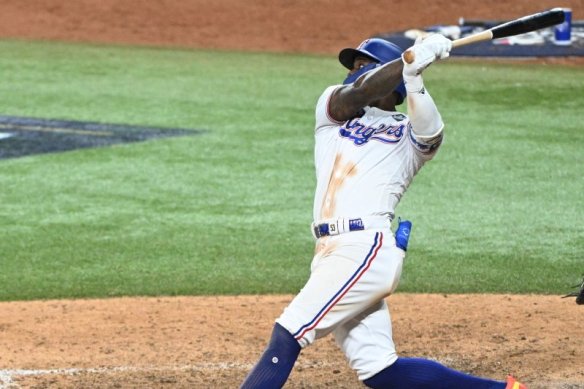
They needed just enough runs to make a difference and to stop a couple of potential runs with their arms and leather, and they got both. They even needed the usually mistake-conscious Diamondbacks to make a critical mistake and got that, too. But they didn’t need García straining his left oblique after an eighth-inning swing at the plate.

Losing García for any length after everything he did to get and keep them here could have been even more grave than losing Scherzer, who wouldn’t have expected to see further Series action until a possible Game Seven. But the Rangers didn’t just rise to the Game Four occasion on Halloween, they smothered it.

“What good is it,” asked Howard once, “to be able to throw a ball through a brick wall if you can’t hit the wall?” The Rangers didn’t expect Scherzer to throw anything through a brick wall, just elusive enough to Diamondbacks bats or enough to compel them to hit them where they were. He’s not Max the Knife anymore, but he didn’t have to be. So long as he kept the Snakes from biting, he set a tone for the Ranger pitching staff. He set it well enough to leave room for the Rangers to win Monday night, 3-1.

Of course, he and they got more than a little help from their friends. Shortstop Corey Seager provided an early blast plus a late defensive double play that probably saved Game Three. Adolis Garcia took advantage of a critical Diamondbacks baserunning mistake, Christian Walker running through his third base coach’s stop sign, to help save it defensively, himself.

Then came the news that García wouldn’t be in the Game Four starting lineup at least. Then, later, came the news he’d be off the Rangers roster along with Scherzer the rest of the set, barring divine (Howardian?) intervention. Their replacements: a relief pitcher named Brock Burke and a utility player named Ezequiel Durán.

Durán can hit a bit and with some long-ball power, and he can handle shortstop especially if Seager needs a break or matchup relief. Burke is a testy proposition at best; he can miss bats but when he doesn’t it can be disaster. (4.37 ERA; 4.90 fielding-independent pitching rate; 5.78 K/BB ratio but 9.7 hits per nine and 2.0 home runs per nine.)

Thus did the Rangers plug difficult-to-impossible holes, not to mention inserting Travis Jankowski into right field in García’s place, and reach for a bullpen Game Four. As did the Diamondbacks. Andrew Heaney opening for the Rangers, Joe (Be Fruitful and) Mantiply for the Snakes.

What was it that Don Vito Corleone once said about great misfortune sometimes leading to unforeseen rewards?

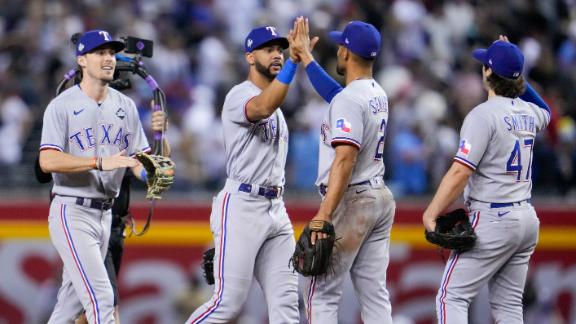
First, García himself gave his teammates a pre-game talk that began with telling them how much he loves them and finished with a call to go out and win two more Series games he had no doubt they could do. Then, stirred by that address from a guy who isn’t known for clubhouse speeches just yet, the Rangers went out and got half the job done Tuesday night.

They made early work of the Snakes with a five-run second, the runs scoring on a wild pitch by Mantiply’s relief Miguel Castro, then a two-run triple by struggling Marcus Semien to chase Castro in favour of Kyle Nelson, and then a two-run homer from Corey Seager on Nelson’s dollar.Then they got nastier in the third: a two-run double (Jankowski, maybe doing a García impression) and a three-run homer. (Semien—did he figure out ways to break out of a postseason slump, or what?)

Meanwhile, it remained a bullpen game on only one side of the field. Surprising maybe everyone watching, Heaney pitched well into the fifth inning, his only blemish until then a second-and-third, nobody-out jam in the fourth out of which he escaped with only one run coming home on a sacrifice fly.

The Diamondbacks only thought they could out-smart the Rangers by staying with a bullpen game and using their lowest-leverage bulls to try sneaking outs through the basement. Until Ryne Nelson entered and swallowed five innings that went unblemished but for Josh Heim’s leadoff bomb in the eighth and Seager’s leadoff ground rule double in the ninth, the Snakes bulls got snaked but good early and too often.

“You’re throwing different looks at guys the whole game,” said Mantiply postgame, after getting the game’s first four outs. “Each hitter never really sees the same guy twice. Obviously, what Ryne did tonight was huge; he stepped up and ate five innings for us. But the strategy is to limit the amount of at-bats guys get off the same guy.”

If only Miguel Castro (the run-allowing wild pitch), Kyle Nelson (Seager’s blast), and Luis Frias (the third inning mayhem) could have followed the script. Then manager Torey Lovullo could have reached for his higher-leverage relievers such as Kevin Ginkel, Paul Sewald, and Ryan Thompson instead of having to ride the Ryne. But the Rangers’ early slashing and smashing turned out to be more vital than thought in the precise moments.

That’s because hese pesky Diamondbacks don’t give up without a good hard fight. The 11-7 final score still seemed lopsided because the Rangers led it 11-1 after seven and a half, but the Snakes rattled a four-run eighth (Tommy Pham with the one-out, bases-loaded sacrifice fly; Lourdes Gurriel, Jr. with the two-out three-run homer) and a two-run ninth (Gabriel Moreno with the two-out, two-run single) before it finally ended.

It just wasn’t enough to overthrow a Rangers team that spent the regular season finding ways around the injured list, never mind get the game to the Diamondbacks’ bigger bullpen bulls.

At various times they lost García himself plus Seager, Josh Heim (who hit a solo bomb in the Game Four eighth), Mitch Garver, Josh Jung, and Leodys Taveras. That was six lineup mainstays. They also had to make do at various times without Game Five starter Nathan Eovaldi plus starter-turned-Series-relief ace Jon Gray plus closer Jose Leclerc and fellow high-leverage bullpen bull Josh Sborz.

They lost free agency signing Jacob deGrom to Tommy John surgery and for the season. They landed Scherzer at the trade deadline but lost him to a shoulder injury in late September and—before the back tightness taking him out Monday—didn’t see him at work again until the American League Championship Series.

The Rangers could have buckled under any one of those injuries. They could have collapsed outright after losing García for the rest of the Series. The Diamondbacks might only wish that they had. Maybe now their fondest wish might be to keep García’s pre-game big mouth shut.

At least one good thing came forth for the Snakes. If Game Five starter Zac Gallen falters or gets torn up early, they’ll have Ginkel, Sewald, and Thompson fresh enough for service. Their second-fondest wish behind possibly muzzling García in the Rangers clubhouse might be getting those three to work in time enough to send the set to a sixth game at minimum.

“We put ourselves in a very tough spot right now,” Pham said postgame. “It’s going to take a lot.”

But Heaney, maybe an unlikely hero for the Rangers, did his team a favour just as big. His five one-run innings saved the meat of the Ranger pen for Game Five. Meaning Gray, Leclerc (who only worked a third of an inning to end Game Five), and Sborz ready to rumble if the Rangers strike early enough and often enough. They did pry three runs out of Gallen in Game One, after all.

What they did to the Snakes’ opening corps Tuesday was a lot more than just prying.

“Five runs in the second inning there, really takes a lot of pressure off,” said Heaney, a veteran who could be both remarkable and vulnerable as an Angel, a Yankee, and a Dodger, before joining the Rangers as a free agent but spending September and most of the postseason in the bullpen. “And then putting up five the very next inning, we had a ten-run lead. It’s a lot easier to go out there, attack the strike zone and not feel so confined to having to make perfect pitches.”

Just hope someone in the Elysian Fields reminds Frank Howard that Game Five doesn’t have to be even half as insane as Game Four.

Frank Howard, RIP: The gentlest giant

Frank Howard

“Sometimes,” said a minor leaguer whom the Bunyanesque bombardier managed, “I think he’s too good for this game.” About Frank Howard, now gone, the gentlest giant of them all.

All of a sudden there’s a pall overhead. The one Washington Senator above all who didn’t want to move to Texas to become a Ranger has gone to the Elysian Fields at 87. The gentlest giant. The guy whose nickname Capital Punishment was as much a misnomer as The Killer was attached to his contemporary Harmon Killebrew.

Frank Howard. The behemoth whose home runs were conversation pieces long before that phrase was attached to the blasts hit by the likes of Dick Allen, Dave Kingman, Mike Schmidt, Darryl Strawberry, Albert Pujols, and Shohei Ohtani.

The third of six Ohio Howard children who had scouts bird-dogging him in the mid-to-late 1950s offering six-figure bonuses but who insisted that the money be divided as $100,000 for himself and $8,000 toward a new home for his parents, a condition only the Dodgers were willing to heed.

The 6’8″ galoot who became a Senator in the first place because of Sandy Koufax.

Howard had come forth as a Dodger who had that intergalactic power at the plate matched only by an inconsistency or three. The National League’s 1960 Rookie of the Year could break a game open with one swing but chased too many balls out of the strike zone. The giant with a fine throwing arm who moved too slow for an outfielder.

The guy who had enough trouble being the first Frank Howard without shaking off enough early career hype that sometimes called him the next Babe Ruth. The guy who assessed himself to Sports Illustrated too realistically despite a 1963 World Series performance that included a 450-foot home run off Whitey Ford en route the Dodgers’ sweep:

I have the God-given talents of strength and leverage. I realize that I can never be a great ballplayer because a great ballplayer must be able to do five things well: run, field, throw, hit and hit with power. I am mediocre in four of those—but I can hit with power. I have a chance to be a good ballplayer. I work on my fielding all the time, but in the last two years I feel that I have gotten worse as a fielder. My greatest fear was being on the bases, and I still worry about it. I’m afraid to get picked off. I’m afraid to make a mistake on the bases, and I have made them again and again, but here I feel myself getting better.

Howard ended up asking Dodger general manager Buzzie Bavasi for a trade after the 1964 season. As things happened, Bavasi was also hunting a solid lefthanded pitcher to plug in any spaces left by the possibility that Koufax—who’d been shut down for the year in August 1964, and diagnosed publicly with an arthritic pitching elbow (it turned out that was for public consumption)—would only be able to pitch once a week if at all.

Bavasi sent Howard plus infielder Ken McMullen and pitchers Phil Ortega and Pete Richert to the Second Nats in exchange for lefthanded pitcher Claude Osteen, infielder John Kennedy, and $100,000. Osteen became the reliable number three starter behind Hall of Famers Koufax and Don Drysdale; the Dodgers won the next two National League pennants plus the 1965 World Series.

Howard settled for becoming a marquee attraction in the nation’s capital. His old Dodger teammate Gil Hodges managed the Senators, convinced Howard to try a slight uppercut in his swing that might stop him hitting hard grounders, and turned him loose to become one of the American League’s power kings after shaking off two initial Washington seasons disrupted by injuries here and inconsistency there.

Then came the Year of the Pitcher (1968)—and Howard’s leading the entire Show with 44 home runs and a .550 slugging percentage, not to mention 330 total bases. He’d hit 48 out in 1969 (with another Show-leading 340 total bases) and 44 out in 1970. A new Senators manager finally convinced him to stop swinging at pitches that didn’t look hittable, which hiked his walk totals and gave him the plate discipline he wished aloud he’d learned a decade earlier. A manager named Ted Williams.

(“Somebody’s getting him out,” snorted Seattle Pilots manager Joe [Ol’ Shitfuck] Schultz during a meeting to discuss how to pitch Howard. “The bastard’s only hitting .306.”)

Howard also moved from the outfield to first base as often as not, and while he was no defensive virtuoso his bat continued to thrill fans and terrorise pitchers. When Alvin Dark managed the Indians, he had a habit of switching his bullet-throwing lefthander Sudden Sam McDowell and an infielder during Howard’s plate appearances (Howard tended to kill McDowell) and then back after Howard was done.

Later, as a minor league manager, Howard was legendary for his generosity with the kids he managed whom he knew barely earned peanuts. Stories abounded of Howard stopping the team bus out of nowhere and ducking into a truck stop or a package store, whipping out his money clip, and buying cases of brewskis. (He made a considerable fortune owning a few choice Wisconsin shopping centers.)

Profiling him while managing the Spokane Indians (then a Brewers farm team) in 1976, Thomas Boswell quoted one of his talks to his minor league charges:

Boys, in this game you never play as long as you want to or as well as you want to. And sooner than any of you thinks, your day will come to get that pink slip that says, “Released.” When they pull those shades, they pull ’em for a lifetime. When it’s over, no one can bring it back for you. It’s a short road we run in this business, so run hard.

That from the man who lamented near the end of his own playing career, “By the time you learn to play this game properly, you can’t play anymore.” (“We lead the league,” Spokane third baseman Tom Bianco told Boswell, “in hustle, rules, and meetings. We even had a meeting after a rainout to go over the rain.”)

He left the Spokane bridge for a shot at major league managing. He had the Padres for two years; he had the Mets for one. “The players took advantage of him,” then-Padres general manager Jack McKeon said when they fired him. “Frank just couldn’t stop being nice.”

A man like that becomes a Washington institution even after his playing career ends and he relocates to northern Virginia and keeps in touch with the city that embraced him like a son and brother. He becomes one of three men to be cast in bronze outside Nationals Park, even though he never played for this franchise of Nats, joining Hall of Famers Walter Johnson (representing the ancient Senators) and Josh Gibson (representing the Homestead Grays who played much of their time in D.C.).

He might even leave Washington with a memory they’d never forget amidst a small closet full of Hondo hammers. With Bob Short shamelessly hijacking the team to Texas after the 1971 season, Howard came up to hit in the sixth inning of the Senators’ final game, against the Yankees. Leading off against Mike Kekich in the bottom of the sixth, Howard swung on 2-1 and planted one to the back of the bullpen behind the left field fence.

“I just wish the owners of the American League could see this, the ones who voted 10 to 2 to move this club out of Washington,” said Senators radio broadcaster Ron Menchine as Howard came down the line to cross the plate.

He comes out again. . . Hondo threw his helmet into the stands, a souvenir of the big guy’s finest hour in Washington . . . The crowd screaming for Howard to come out again . . . and here he comes again!! . . .  A tremendous display of the enthusiasm of Washington fans for Frank Howard . . . Hondo loves Washington as much as the fans love him. It’s 5-2 . . .

The Senators took a lead to the top of the ninth and asked Joe Grzenda to close it out. He got two quick ground outs right back to himself. Then the heartsick RFK Stadium crowd that was restless all day long finally burst. They poured onto the field with Yankee second baseman Horace Clarke at the plate and rioted. The umpires finally called a forfeit to the Yankees. The stadium resembled the aftermath of a terrorist attack.

Howard hit the final Senators home run and the first Rangers home park home run, which also happened to be the first major league hit to be nailed in old Arlington Stadium. But he had no illusions. “A guy just does the best he can,” he told SI. “We’re aware you can’t peddle a poor product to the public. It’s nice to think that these people’s first memory of major league baseball might be my home run, but I really hope that their memory is the win.”

He never lost his baseball introspection even as he never lost his love affair with fans who sought him out long after his last swing, his last shot to the Delta Quadrant. “When people look back on their careers, they say they wouldn’t change a thing. I would have,” he once said. “I would have made the adjustments. I would have given myself the chance to put up big numbers.”

Divorced from his first wife, he remarried happily in 1991. Howard left more than long ball memories. He had family and friends to love and remember. He left behind memories of a man who was so personable, gentle, and generous, that one of his Spokane players could and did say, “Sometimes I think he’s too good for this game.”

More than “sometimes.”

WS Game Two: Kelly’s blue book

Merrill Kelly

Kelly kept the Rangers from another series of bombing raids and tank attacks Saturday night.

“I decided to take a look back just to double-check that it said ‘World Series’ behind me,” said the Diamondbacks’s Game Two starting pitcher, Merrill Kelly, the day before. Then, he went to work Saturday night and made easier work of the Rangers than many might have expected him to make.

He looks more than a little like comedian Chris Elliott, and he took an unusual route to get to the Show in the first place. But nobody’s laughing at Kelly after what he and his Diamondbacks did, one night after they got hammered out of a lead and into an eleven-inning Game One loss.

Not after Kelly pitched seven innings of three-hit, one-run baseball while his fellow Snakes pecked, poked, and pried nine runs out of the Rangers to even this World Series at a game apiece.

Not after the Diamondbacks atoned for losing a two-run lead in the Game One ninth with a seven-run spread of two in the seventh, three in the eighth, and two more for good measure in the ninth Sunday night.

Not after the only hit the Rangers could summon up after Kelly and the Diamondbacks handed off to their bullpen was a leadoff ninth-inning single by Marcus Semien that went for nothing with a line out, a called strikeout, a walk, but another lineout ended the 9-1 D’backs win.

Not after Diamondbacks second baseman Ketel Marte showed the Rangers they weren’t the only ones with men who could reach and re-write a page or two in the postseason record books—even if it took him until the eighth inning to hit the two-run single that gave him a record eighteen-game postseason hitting streak.

Not after ancient Evan Longoria dropped a sacrifice bunt that went for naught in the third but stuck in the mind of Rangers third baseman Josh Jung when Longoria batted in the seventh. That’s when Diamondbacks center fielder Alek Thomas opened with a double, then Jung played on the edge of the inner infield grass and Longoria swatted a single off Jung’s glove and into left enough to send Thomas home with the third Arizona run.

That’s right. The game was tighter than a rush hour crowd on a subway platform for six innings. The Snakes posted a pair in the fourth when catcher Gabriel Moreno wrestled Rangers starting pitcher Jordan Montgomery into a full count before hitting one over the center field fence, and designated hitter Tommy Pham’s two-out double was rewarded with left fielder Lourdes Gurriel, Jr. singling him home.

The Rangers got one back when their own DH Mitch Garver hit a 1-1 service from Kelly into the left field seats. And that’s where things stayed until the seventh. Until Longoria’s RBI single was followed by Corbin Carroll’s RBI single in that inning. Until Marte’s record-setter and Carroll’s immediate RBI single in the eighth.

Until the insult-to-injury two-run single in the ninth that might have helped set up more but for late Snakes third base insertion Emmanuel Rivera (who hit it) getting thrown out trying to stretch for second base.

Marte wasn’t the only Diamondback to join or expand the postseason record book. Longoria became only the fourth man to get a World Series hit before age 23 and after age 38—joining Hall of Famers Willie Mays, Pee Wee Reese, and Eddie Murray.

But most eyes were upon Kelly. The 35-year-old righthander went from the minors to a four-year term in Korea, where he says he really learned how to pitch mostly by the proverbial seat of his pants. The Diamondbacks took a chance. They’re reaping rewards some might call unforeseen.

On the regular season, Kelly could be remarkable and about average. He struck out 9.1 per nine but walked 3.5 per nine. He led the National League with 33 starts in 2022 but has a lifetime 4.02 fielding-independent pitching rate.

He kept the Dodgers in check during his divsion series start (no runs, three hits, three walks, five punchouts), but he and his Snakes were bludgeoned by the Phillies in National League Championship Series Game Two, especially after he was taken over the fences twice by Kyle Schwarber and once by Trea Turner.

But Kelly recovered well enough to allow only one Phillie run on three hits and three walks in Game Six while striking out eight in five innings’ work, setting the stage for the Diamondbacks dispatching the Phillies in a comparative whimper. Now he stood as the guy who made a once-impossible dream come true for one World Series game at least.

Montgomery wasn’t exactly terrible, even if this was one time his ability to get away with sinkers that don’t sink all the way betrayed him when Moreno took him long. And he did give the Rangers all the room they’d need to win. But Kelly didn’t let the Rangers get into his head and, in fact, juggled his entire kit bag of pitches to strike the side out in the sixth.

“I’ve been kind of saying he’s the most underrated pitcher in baseball,” said Diamondbacks pitching ace Zac Gellen, a day after the Rangers yanked three runs out of him en route the Game One Rangers win. “How it’s gone that way this long, I think it’s the market we play in. But the guy posts. And when he does, you see what it is.”

“I think we realized the second time through the lineup,” said Garver, who did reach him for that homer, “that we weren’t getting too many pitches to hit. He executed his stuff and a lot of times, we ran out of barrel.”

This time, Kelly had the Rangers over a barrel. It also enabled Diamondbacks manager Torey Lovullo to leave his absolute best relief pitchers alone and save them for the Phoenix swing of the Series. Not to mention Rangers manager Bruce Bochy still having his better relievers available for that swing, with veteran starter Martín Pérez going out for the Game Two eighth and taking a four-run one for the team over the final inning and a third Saturday night.

“We’d be naive to think that we’re going to run away with four in a row against a team that really fights hard, the same way we did,” said Rangers first baseman Nathaniel Lowe. “They had to go through the wild-card round and all the way through, and they’re here. It’s a resilient bunch over there, but we’re pretty confident in our group, too.”

Rangers beware: His first World Series start didn’t intimidate Kelly at all. “I think going over to Korea as a 26-year-old is way scarier than pitching in the big leagues or even the World Series, to be honest,” he said. “It felt literally and figuratively miles away when I was over there.”

Even in Globe Life Field as opposed to Chase Field, there was no place like home.

WS Game One: But of course

Adolis García

The Cuban defector who rocked a pitcher named Castro for the World Series Game One-winning bomb he’s hitting here . . .

In a more just and far more sane world, this World Series would not feature baseball’s eight-best team (the Rangers) hosting baseball’s twelfth-best (the Diamondbacks). No matter how much fun it was to watch the games by which they got here. This, folks, is Commissioner Pepperwinkle World.

It’s a world where the fun in watching baseball’s Davids slay its Goliaths, as happens often enough, is perverted into a premeditated dilution of the championship race. Where teams who dissipate down the stretch can still sneak into a postseason and trash the joint.

Commissioner Pepperwinkle didn’t create today’s championship dilution, he simply finished and metastasised what his predecessor/former employer began. And while he now says he’s willing to “discuss” this format and that dilution after hearing “enough complaints and chatter” around it, don’t wait in line too long expecting him to heed and adjust.

Unless you count whether their owners voted yay or nay upon Pepperwinkle’s perversion, it’s hardly the Rangers’ or the Diamondbacks’ fault that they could and did ride to this Series while leaving the bigger teams to the winters of their malcontent. “If the die was cast—meaning, that if I win 100 in the regular season, I’m going to win the World Series—I don’t think that’s as interesting as what we have witnessed over the last month,” he added.

Well, just as it couldn’t hurt to watch the earlier wild card, division, and League Championship Series anyhow, it can’t hurt to watch this half-serious World Serious anyhow.

Say what you must about how they got here. These Rangers (who did tie for a division title) and these Diamondbacks (who finished a well-distant second in their division) are having fun while being deadly serious. The Diamondbacks didn’t let bother them that they weren’t supposed to survive the Brewers, the Dodgers, or the Phillies. The Rangers didn’t let bother them that they weren’t supposed to shove their fellow Texans from Houston to one side.

Come Friday night, until Rangers shortstop Corey Seager sent the game to extras with a mammoth two-run homer, it looked as though the Diamondbacks might open by doing to the Rangers what they’d done well enough entering the Series: pitching, pecking, picking, and occasionally pounding their way to a win.

Then a Cuban defector hit a Game One-winning home run off a pitcher named [Miguel] Castro in the bottom of the eleventh.

That won it for the Rangers, 6-5. It also gave Adolis García eight bombs for this postseason and left him one shy of Daniel Murphy’s record of homering in six consecutive postseason games. It should also have sent the Diamondbacks pitching staff a rudely-awakening message: Thou shalt not plunk Adolis García and expect to live.

First, after Seager tied the game off Paul Sewald with Leodys Taveras aboard and a parabola to the rear of the right field seats in the ninth, García was hit on the hand by a Sewald pitch. Late Rangers insertion Austin Hedges struck out for the side. But two innings later, with one out, García hit a 3-1 sinker the opposite way over the right field fence.

Twelve years to the day earlier, the Cardinals’ David Freese wrecked the Rangers when the Rangers were a strike away from winning the 2011 World Series in six games—first with a game-tying triple in the ninth; then, after the game was re-tied in the top of the eleventh, with a full-count leadoff shot over the center field fence.

Figure this if you can: García’s Game One winner Friday night sent him right past Freese himself for the most runs batted in (22) in a single postseason. It might not have happened had García not made a spectacular course correction on Diamondbacks rookie star Corbin Carroll’s two-out, ninth-inning drive to right, overcoming a bad first step to run the ball down and snatch it at the wall.

That might have given these relentless enough Diamondbacks a final lease on Game One life. But no. Then Seager unloaded in the bottom of that inning off Diamondbacks finisher Paul Sewald, the first genuine dent in a Diamondbacks bullpen that was postseason excellent entering the Series and worked three scoreless among three relievers Friday night. Setting the extra-inning stage for García to do what hasn’t been done since Kirk Gibson in the 1988 World Series—win Game One with a walkoff homer.

Maybe doing it on the twelfth anniversary of Freese’s jolts means these Rangers might find the mojo those Rangers lost so horrifically?

In a game where the Rangers took an early 2-0 lead (Evan Carter’s first inning RBI double and García singling him home immediately to follow) but the Diamondbacks bit Rangers starting pitcher Nathan Eovaldi hard for a three-run third and five runs in four and two-thirds innings; where the Rangers went 1-for-7 with men in scoring position to the Snakes going two-for-8; and, where the Ranger bullpen pitched six and a third innings’ two-hit, shutout relief, Seager and García’s late explosions will be what’s remembered the most.

Kind of a shame, too. In the top of the third, Diamondbacks shorstop Geraldo Perdomo finally dropped a bunt you couldn’t call a wasted out. Remember: In six known “bunt situations,” only one leaves you a better chance to score after than before the bunt: first and second, nobody out. That’s what Perdomo had when he dropped one back to the box and pushed Alek Thomas (leadoff infield single) and Evan Longoria (immediate followup single) to third and second, respectively.

Carroll followed and hit a two-strike, two-run triple to the absolute back of center field, then scored the third Snakes run while Ketel Marte grounded out to first base. The Rangers took one back to re-tie in the bottom of the third when Mitch Garver wrung a bases-loaded walk out of Diamondbacks starter Zac Gallen, but Tommy Pham re-snatched the lead when he unloaded on Eovaldi to open the top of the fourth, sending one  over the left field fence. An inning later, Marte sent Perdomo (leadoff single) home with a double, and 5-3 it stayed until Seager in the ninth.

Seager may not mind playing second banana to García even if his handiwork set García’s up. He hollered out uncharacteristically in his joy after he launched his bomb. But after the game, he preferred not to think about that again. “You never think about your own success,” he said. “You think about how that team came together, how that team performed.”

In the American League Championship Series, remember, García unloaded a three-run homer in Game Five and got drilled by a pitch his next time up. All that did was jolt him into the Games Six and Seven bombings that helped yank the Rangers here in the first place. Two batters after Seager unloaded, García was hit by a pitch again, on his hand.

He shook it off. He stole second but was stranded. He bided his time. Then came the eleventh. He didn’t answer the bell, he rang it. Ask him now what the biggest bomb of his life is, and he’ll tell you. “We’re in the World Series,” he said. “I think, honestly, this is the first.”

Unless there’s a more absurdist Elysian Fields script to be delivered later in this Series (put nothing past that heavenly troupe of stinkers), and García finds himself hitting the Series winner, it may yet prove to be the loudest home run in Rangers history.

NLCS Game Seven: Don’t worry. Be happy.

Arizona Diamondbacks

The Snakes start the pennant party after Phillies pinch-hitter Jake Cave flied out to end NLCS Game Seven.

So this is what the World Series will hoist. One team who got there with a bang—or several. One team who got there with whispers, almost, belying the pre-strike warning of the reptile that gives them their name.

It’s not that the Diamondbacks really intended to get to the World Series on the quiet side. But if the Rangers bludgeoned their way to the Series with back-to-back demolitions of the Astros in Houston, the Diamondbacks pried their way to the Series with four wins that could be called cool, calm, collected by comparison.

“We were silent, and we made damage,” said their shortstop Geraldo Perdomo, after the Snakes more or less nudged the Phillies home for the winter with a 4-2 National League Championship Series Game Seven win. “Be happy and enjoy what you do. That’s all. That was the message.”

Go ahead. Cue that ancient Bobby McFerrin hit. Don’t worry. Be happy. It wouldn’t be the worst theme song you could attach to a pennant winner.

The biggest lead by which the Diamondbacks beat the Phillies this set was a four-game margin in Game Six in Philadelphia. They won the National League pennant Tuesday night with a win in which it was harder to determine which was more profound, a small pack of squandered Phillies chances or a thick enough pack of quiet Diamondbacks opportunity seizings.

It was almost as though the smiling Snakes snuck their way to the World Series in the end. From their first Game Seven run scoring on a soft grounder the Phillies couldn’t turn into an inning-ending double play in the first to three of the least noisy fly outs finisher Paul Sewald got the Phillies to hit to end it.

Come to think of it, it was as though the underestimated Arizona gang wasn’t even fazed when Phillies third baseman Alec Bohm hit Diamondbacks starter Brandon Pfaadt’s first pitch of the second inning into the left center field seats. Pfaadt certainly wasn’t. He got second baseman Bryson Stott to fly out to the center field track, then struck catcher J.T. Realmuto and right fielder Nick Castellanos out swinging to prove it.

Pfaadt only looked shaky two innings later, when Bohm wrung him for a one-out walk, and Stott doubled him home to give the Phillies what proved a very short-lived 2-1 lead. Realmuto followed with a line single to left sending Stott to third which brought Castellanos to the plate.

The guy who began looking like Mr. October during the Phillies’s division series dispatch of the Braves and continued when he homered during his first plate appearance of this NLCS had gone 0-for-21 entering this plate appearance. Pfaadt struck him out swinging. Then the righthander shook off a four-pitch walk to left fielder Brandon Marsh to strike spaghetti-bat center field sweeper Johan Rojas out on three pitches.

And again the Diamondbacks didn’t resemble a team of no-names whose postseason days were going to be numbered by Philadelphia’s comparative star power.

Third baseman Emmanuel Rivera started unfurling that evidence with a leadoff line single up the pipe in the top of the fifth. Shortstop Geraldo Perdomo bunted him to second, perhaps ill-advised considering the wasted out and second baseman Ketel Marte’s swinging strikeout to follow.

Enter Corbin Carroll, the rookie about whom it’s very fair to say the Diamondbacks world revolves these days. After scoring that first run in the first, and in the middle of a 3-for-4 night, Carroll shot a base hit into center to send Rivera home to re-tie the game and push Phillies starter Ranger Suárez out of it.

Then catcher Gabriel Moreno greeted reliever Jeff Hoffman with a base hit after Carroll stole second, enabling the rook to be run number three before Moreno was caught trying to stretch to second. Meanwhile, Carroll also spent his evening tying a postseason rookie record for hits in a winner-take-all contest.

Most teams run out of an inning when they could do more damage might go into mourning at that point. Not these Diamondbacks. Their reliever Joe (Be Fruitful and) Mantiply shook off Kyle Schwarber’s bottom of the fifth-opening double to get Phillies shortstop Trea Turner to ground out to third and Bryce Harper, the dangerous convert to first base, to fly out to the track in left.

That was enough to prompt Snakes manager Torey Lovullo to get Mantiply the hell out of there and bring Ryan Thompson in to lure Bohm into a pop out Marte caught at the back of the infield for the side.

You could almost hear the still-underestimated Diamondbacks—who swept their way to this set in the first place by pushing the Brewers out of the wild card series and the oh-so-superior Dodgers out of a division series—thinking, if not whispering, “We do this kind of stuff to them all through the pictures.”

Don’t worry. Be happy.

Two innings later, the Snakes delivered what proved to have been one of the least dramatic knockout punches of the entire postseason. After José Alvarado relieved Hoffman for the Phillies with one out, Perdomo singled to left and Marte doubled him to third—making Marte owner of the longest postseason-career-opening hitting streak at sixteen.

Up stepped Carroll. Proving he could do things the quiet way as well as any other way, he lofted a sacrifice fly to left for the fourth Diamondbacks run and the final run of the game. Don’t worry. Be happy.

Then came Zack Wheeler, the Phillies’s Game Five starter who pitched like an ace when they needed it most to take a 3-2 NLCS lead, to pitch an inning and a third’s spotless relief. During which Harper lost the grandest opportunity to overthrow the Diamondbacks for good when he batted in the bottom of the seventh.

Cristian Pache pinch hit for Rojas with one out and walked off Diamondbacks reliever Andrew Saalfrank. Schwarber worked out a full count walk. Exit Saalfrank, enter Kevin Ginkel for the Snakes, and Turner flied out to bring Harper to the plate. The guy who sent the Phillies to the World Series last year with that eighth-inning homer in the mud hit one out to center field this time, but with not enough to avoid landing in center fielder Alek Thomas’s glove for the side.

“Just missed it,” Harper lamented postgame. “Not being able to come through in that moment, just devastation for me. I feel like I let my team down and let the city of Philadelphia down, as well. That’s a moment I feel like I need to come through.”

He was hardly alone. These Phillies who’d bombed the Diamondbacks in a 10-0 Game Two blowout scored a grand total of four runs in three of their NLCS losses and went 1-for-7 with men in scoring position in Game Seven alone.

“I would say frustrated is the correct word,” said Castellanos, maybe slightly less for himself than for his team. “Just because the potential of this team is so much greater than going home before the World Series. Last year, when we lost Game Six, there was a lot of, ‘All right, we got here. Now we can build off that.’ Knowing how we feel about this team and coming up short from the year previous, it’s a disgusting feeling, honestly.”

When pinch hitter Jake Cave flied out to right against Sewald to end Game Seven, the Phillies may have been more voluminous in their self-criticisms than the Diamondbacks were celebrating their first pennant since 2001. And the clubhouse celebration has been described politely as mayhem, from drenching general manager Mike Hazen to first baseman Christian Walker passing out the cigars.

Don’t worry. Be happy.

It doesn’t mean you have to stay silent in the end. It also doesn’t mean the Snakes will count themselves out no matter how monstrous the Rangers might look. Maybe they figure that, if they could finally dismantle the big bad Phillie phloggers there’s no reason to fear the Texas wrecking crew. Yet.

“We were coming here to play our best baseball,” Lovullo said postgame about his and his team’s pre-game thinking, “and that’s been the messaging, and it’s been very consistent throughout the course of the year. Today is going to be our finest hour, and I just wanted to make sure that they knew that’s how I felt.”

“The Brewers were supposed to beat us,” Thompson said. “The Dodgers were supposed to beat us. The Phillies were supposed to beat us. They’re gonna say that the Rangers are supposed to beat us, too. We’ll see how it goes.” He could afford to be sanguine, since the Rays released him earlier this season but the Diamondbacks took a flyer and he rewarded them by becoming one of their key bullpen bulls.

And Lovullo could afford to be just a little self-congratulatory. Knowing that famed sports talking head Chris (Mad Dog) Russo swore to retire from radio if the Diamondbacks got to the World Series, Lovullo couldn’t resist. “I would love to see him quit if we won today,” the manager said before Game Seven began. “There’s nothing better than a wise guy New Yorker saying something and then having to chomp on those words.”

Except maybe a manager who shepherds the guys the world doubted to baseball’s biggest dance. Or, a team that finally doesn’t let the insane asylum known as a Citizen’s Bank Park crowd intimidate them out. Just don’t ask the Snakes to explain how they pulled it off. “I don’t even know if there is an explanation,” Carroll said. “It’s just magic.”

But you might ask Harper. “Watching them prior to this series, I don’t think anything scared that team,” he said graciously. “I don’t think they had any doubts in their minds of coming back here and playing in Philadelphia. I don’t think that team is scared of any situation or any spot.”

Don’t worry. Be happy.

If that’s what got the Diamondbacks to the forthcoming World Series, don’t knock it. Baseball has enough too-serious-for-their-own-good teams as it is. Just try to picture most of this postseason’s vanquished (the Phillies aren’t exactly a gang of mopes, after all) approaching things that Diamondbacks way. Not to mention a lot of the teams who couldn’t make the postseason in the first place.

They’d sooner toast each other with castor oil martinis than be caught thinking, Don’t worry. Be happy. And where are those guys now?