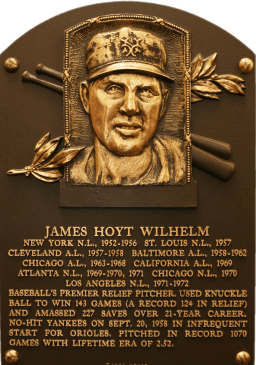
On the BBWAA’s newly-minted Relief Pitcher of the Year Awards

Hoyt Wilhelm

What’s this bland “Relief Pitcher of the Year” stuff? How about the BBWAA name their new (and overdue) reliever awards for Hall of Famers Billy Wagner (National League) and Hoyt Wilhelm (American League; yeah, I know he’s shown with a New York Giants hat, but he did pitch most of his career in the AL by a hair . . . )

Well. The Baseball Writers Association of America has decided that relief pitchers need a BBWAA award of their own. They’re calling it the Relief Pitcher of the Year Award. Maybe this is the one to which people will pay attention. Maybe not.

The name is about as inspired as when the BBWAA changed the name of the J.G. Taylor Spink Award for Hall of Fame baseball writers to the Career Excellence Award. At least MLB, which already awarded an annual prize to the men of the pen, named their awards for a pair of Hall of Fame relief pitchers, Trevor Hoffman (National League) and Mariano Rivera (American League).

Except that nobody pays real attention to the Hoffman and Rivera Awards, noted Jayson Stark (Hall of Fame writer), who’s been agitating for the Relief Pitcher of the Year Award for a very long time.

But Stark also noted that, well, nobody quite knew how to evaluate relief pitchers reasonably. “And why does that matter?” he asks, then answers:

Because if you look at Hall of Fame voting over the past couple of decades, it couldn’t be more obvious that voters can’t figure out how they’re supposed to go about determining what constitutes a dominant, Hall of Fame reliever.

We elected Rivera and Hoffman. We just elected Billy Wagner, but it took us 10 years to do that. So clearly, the voters need help. And the current awards aren’t providing any of that help because this trend is only getting worse.

This much we do know; or, at least, ought to know: the save statistic is close enough to useless. When writing Smart Baseball, Keith Law singled the save out for a chapter of its own to demonstrate it was nothing more than “[Jerome] Holtzman’s Folly,” named for the Chicago sportswriter who invented it in the first place. It was a classic case of the best intention yielding the worst result.*

“If anyone tried to introduce a statistic like the save today,” Law wrote, “he’d be laughed all the way to a cornfield in Iowa.”

The stat is an unholy mess of arbitrary conditions, and doesn’t actually measure anything, let alone what Holtzman seemed to think it measured. Yet the introduction of this statistic led to wholesale changes in how managers handle the final innings of close games and in how general managers build their rosters, all to the detriment of the sport on the field, and perhaps to pitcher health, as well.

Not to mention the health of common sense, what remains of it.

You think arguments involving Cy Young Awards to pitchers who “win” the most games instead of pitchers who were really the best pitchers in their leagues were somewhere between the ridiculous and the absurd? (Anyone who tells me Bartolo Colon deserved the 2005 American League Cy Young Award over Johan Santana had better come with stronger ammunition than Colon’s 21 “wins.” Colon’s fielding-independent pitching rate [FIP] of 3.75 and his ERA of 3.48 weren’t Santana’s major league-leading 2.80 FIP or his 2.87 ERA. There was also the little matter of Santana leading the Show with 238 strikeouts and the AL with an 0.97 walks/hits per inning pitched [WHIP] rate. Case closed.)

How about arguments over relief pitchers with a duffel bag full of “saves” versus the relief pitchers who actually pitched better? Remember Joe Borowski? As a Cleveland Indian in 2007, Borowski led the American League in “saves” with 45 . . . but his FIP was 4.12 and his ERA, 5.07. And that’s before you see where the guys at the plate hit .289 againat him. If that didn’t kill the save, Craig Kimbrel in the 2018 postseason should have.

Kimbrel pitched 10.2 innings and was 6-for-6 in save opportunities. Sounds like the future Hall of Famer he’s still seen to be by some, right? Now, look deeper: Cardiac Craig allowed nineteen baserunners, posted a 5.90 ERA, and a 5.07 FIP . . . and the World Series-winning Red Sox probably felt that was tantamount to the guy who threw the man overboard an anchor and then dove in to pull him out of the water.

Zach Britton

Zach Britton. Toronto still blesses then-Orioles skipper Buck Showalter for managing to the save stat instead of what was right in front of him in the 2016 AL wild card game, and leaving Britton—the 2016 season’s best relief pitcher—in the bullpen . . .

And I haven’t even mentioned the managers who take the nebulous save stat as such gospel they manage to it instead of to the game situation in front of them. The no — “save” situation kept Buck Showalter from even thinking about Zach Britton, baseball’s unarguable best relief pitcher in 2016, with two on and Edwin Encarnacion checking in at the plate in the bottom of the AL wild card game 11th in Toronto. Blue Jays fans still bless the name of Showalter when they remember the monstrous 3-run homer Encarnacion hit to send the Jays to the division series.

Based on what little has been revealed so far otherwise, my guess is that the voting writers will take anything but “saves” into consideration. As they should. If they were to ask me, I’d say it should be some sort of points combination based upon FIP, the batting averages against, their leverage situation pitching, their strikeout-to-walk ratios, and their WHIPs.

Let them have at it post haste.

Because the next time I hear someone tell me Chipper Flippersnapper was the best reliever in baseball because he got all those “saves” even if his ERA/FIP combination was higher than the moon, the batting average against him resembled Ralph Kramden’s weight, and he worked as though he’d learned leverage pitching at the Craig Kimbrel School of Anchor-Throwing, I’m going to throw an anchor or three. And a few other things.

(Maybe I’ll just throw two words out: Mike Williams. 2003: Williams, lifetime 4.49 FIP, named an All-Star because the rules said the woebegone Pirates needed one and he had 25 saves at the break. But he also walked three more than he struck out and carried a 6.44 ERA. One week later: ERA down to a mere 6.27; FIP down to a measly 5.55; the Pirates traded him to the Phillies for a rosin bag and Williams’s career ended after that season. )

And for God’s sake give the new BBWAA awards worthy names. How about the Billy Wagner Award for the National League? How about the Hoyt Wilhelm or Rollie Fingers Award for the American League? Relief Pitcher of the Year? That’s about as inspiring or spirited as a tub of chicken fat.

—————————————————————————————————–

* Historical revision: Longtime Pirates relief ace Elroy Face still inspires oohs-and-aaahs over his 1959, when he “won” eighteen games and “lost” only one. The aforementioned Jerome Holtzman dreamed up a save stat in the first place because of Face.

“Everybody thought he was great,” said Holtzman in 1992. “But when a relief pitcher gets a win, that’s not good, unless he came into a tie game. Face would come into the eighth inning and give up the tying run. Then Pittsburgh would come back to win in the ninth.”

According to Anthony Castrovince in A Fan’s Guide to Baseball Analytics, Holtzman “knew the dirty truth about Face: He had allowed the tying or go-ahead run in 10 of his 18 victories. In five of his eventual ‘wins,’ he had entered the game with a lead and left without one.”

It almost seems a tossup between which nebulous statistic is worse: the pitcher “win,” or the relief pitcher save. God bless all 97 years old of him still living, but Elroy Face’s 1959 is evidence on behalf of both.

—————————————————————————————————

First published in a slightly different version at Sports Central.

Way to go, Jen

Jen Pawol, Clayton McCullough

Jen Pawol (left) holding her face mask as she talks with Marlins manager Clayton McCullough just before Sunday’s game got underway, with Pawol the first woman to call balls and strikes in a major league game.

Ladies, gentlemen, and miscellaneous, a woman worked as a third base and then a first base umpire Saturday, then as a home plate umpire Sunday afternoon, all three games in Atlanta’s Truist Park, all featuring the Braves and the Marlins. Would you like to know what didn’t happen over those three games?

The world did not stop turning.

The flora did not shrivel up into cold death.

The fauna continued leaping, charging, swimming, lunging, diving, and gorging. (Sometimes upon nuts, berries, and vegetation; sometimes, upon each other.)

The sun rose on schedule and set on schedule; the Aurora Borealis auroraed.

And, the Braves won all three of those games.

It would be untoward for the Braves to believe Jen Pawol some sort of good luck charm after she suited up and took her positionings after they dropped the first game of the weekend to the Fish. But they did do her the courtesy of retrieving the ball thrown for the first pitch by Sunday’s Braves starting pitcher Joey Wentz and, upon authenticating it, giving it to her.

A cynic could snark with unfortunate accuracy that Wentz’s opening fastball went far enough inside to fly a drone between the ball and the plate, but that Pawol called it a strike. The same cynic could also snark that the Marlins might also have thought to send her a message, namely, “It’s okay, young lady, this won’t be the first pitch you blow, and it may not be the last, but just keep it consistent.”

Having proven that a woman can blow a call behind the plate at least as well as a man, there was but one thing for Pawol to do: pick herself up, dust herself off, start all over again.

If she thought to herself that she’d opened by blowing one, she kept it to herself. Perhaps the inner dialogue went something like this: Shake it off. One blown call doesn’t make you Angela Hernández. You worked your tail feathers off to get here. Now show both sides how you’re made.

She continued her Sunday assignment honourably. Her 91+ percent accuracy full game score wasn’t great, but you could certainly think of far worse. Pawol’s often radiant confidence and appreciation for where she was, was certainly contagious. (Truist Park fans greeted her both days by wearing and waving umpires’ masks, many hollering or showing signs saying, “Way to go, Jen.”)

She could also be forgiven because she did call the inside strike fairly and evenly to (or against, depending upon your point of view) both teams. She also seemed to call upon her earlier life’s calling on behalf of her umpiring work. Art teachers such as Pawol always appreciate painting the corners, as well as the main plots, and she did call just about all borderline pitches correctly.

“I think Jen did a really nice job,” said Marlins manager Clayton McCullough, obviously not steaming over a mistaken game-opening call against his leadoff hitter Xavier Edwards. “I think she’s very composed back there. She handled and managed the game very well. And big day for her. Big day for Major League Baseball. I congratulated her again on that because it’s quite the accomplishment.”

Marlins starting pitcher Cal Quantrill seemed nothing but impressed by Pawol’s cool. “I’m sure she was well prepared,” he said. “And like I said I think, you know, part of the game moving forward is that if this is normal then we’re going to treat it normal, too. So, you know, I thought it was fine. I think she did she did a quality job . . . And yeah, I think she’d be very proud of herself. And, you know, it’s kind of a cool little thing to be part of.”

Pawol certainly thinks so. “The dream actually came true today,” she told reporters Saturday “I’m still living in it. I’m so grateful to my family and Major League Baseball for creating such an incredible work environment . . . I’m just so thankful.” If she was tempted to include a playing of that vintage soul oldie, Mitch Ryder and the Detroit Wheels’s “Jenny Take a Ride,” you’d tell her, cheerfully, “Play it!”

She returns to the major league umpires’ rover ranks, the umps on call to fill in post haste. You may yet see Pawol out on the major league field again before this season ends. You will surely see her in spring training next year as this year and last year. And you will surely see her in the Show more than a time or two next regular season.

They may or may not make another fuss over Pawol’s next Show time. But unless they’re among the misogynistic contingent, they won’t put on their Chicken Little costumes, either. Way to go, Jen.

On Harper telling Manfred where not to go

Bryce Harper

Bryce Harper, a player who suffers neither fools nor commissioners (did I repeat myself?) gladly . . .

Once upon a time, when John Glenn’s Mercury space flight ran into a brief postponement,  then-Vice President Lyndon Johnson all but demanded he be sent through the phalanx of press outside Glenn’s home to have some television time with Glenn’s wife, Annie. Rebuffed before the postponement, Johnson now thought it’d be just the thing if he could “console” Mrs. Glenn over the airwaves.

Mrs. Glenn wanted no part of Johnson’s publicity hounding. NASA, as Tom Wolfe phrased it so deftly in The Right Stuff (the book, not the movie, you miserable pudknockers), wanted no part of Mrs. Glenn’s demurrals: “There’s John, covered with sweat, drawn, deflated, beginning to feel very tired after waiting for five hours for 367,000 pounds of liquid oxygen to explode under his back . . . and the hierarchy of NASA has one thing on its mind: keeping Lyndon Johnson happy.”

You remember the film version, no? John, we’ve got a problem with your wife, said NASA’s program chief to the astronaut. Oh, no you don’t, Glenn said, figuratively, when replying to his wife that, if she didn’t want Johnson or the networks coming in, “then that’s it, as far as I’m concerned, they are not coming in—and I will back you all the way, one hundred percent, on this, and you tell them that . . . you tell them astronaut John Glenn told you to tell them that.”

NASA program chief to Glenn: John, it’s the vice president!! Glenn to NASA chief: You are way out of line here!  NASA chief: Yeah? Well, I’m thinking of changing the order of flight assignments! Six other Mercury astronauts, not all of whom thought as highly of Glenn as the nation would after his orbital flight and gutsy re-entry, five of whom might well have given their left testicles to be the first American into full orbit (the first two Mercury flights were up to the wild blue yonder, a brief kiss of space, then right back down to the ocean), said that’s what you think: Oh, yeah, Who you gonna get?

Now, my question: If one astronaut could tell a pushy vice president where not to go and get away with it, why on earth couldn’t one baseball player tell a pushy commissioner—whose tricks and rhetoric stand athwart the good of the game he professes to have first on his mind—where to go and get away with it.

I’m not going to repeat the names of the philistines who’ve called for Bryce Harper’s suspension or at least formal and loud enough reprimand after last week’s confrontation with Rob Manfred. The one in which Commissioner Pepperwinkle visited the Phillies clubhouse (as he does with all major league clubhouses each year) with his economic agenda to discuss, and Harper—one of the game’s most intelligent as well as talented and accomplished players—told him flatly that if he wanted to talk salary cap, “you can get the [fornicate] out of our clubhouse.”

Manfred subsequently said that he and Harper shook hands near the end of the meeting. Other reports suggested Manfred tried to contact Harper the following day but Harper declined. To reporters afterward, Harper said, only, “Everybody saw the words and everything that happened. I don’t want to say anything more than that. I’ve talked labor and I’ve done it in a way that I don’t think I need to talk to the media about it . . . I’ve always been very vocal, just not in a way that people can see.”

Perhaps the worst kept secret in baseball right now has been Manfred’s subtle-as-a-jellyfish-sting push to put a salary cap onto the negotiating table for the next collective bargaining agreement, though he doesn’t use the specific phrase “salary cap” and prefers now to use such language as baseball’s “economics.” The lesser volume of talk involving the far more necessary (and viable) salary floor—a requirement that baseball’s owners whose teams aren’t named the Dodgers, the Mets, the Phillies, or the Yankees, among an extremely few others, should either spend a negotiated minimum on player payroll or sell to ownerships more than willing to spend—tells you all you need and more than you want.

Manfred thinks he’s baseball’s grand protector and preserver. But for every one smart thought or plan he devises (smart and thoughtful: the universal designated hitter; the Field of Dreams Games) he devises numerous dumb and dumbers: The free cookie on second base to open each half inning; the continuing City Connect uniform abominations; abetting the Oakland Athletics’ abandonment of a fan base who loved them, in favour of an owner who let the team and their old park go to seed absent “public financing” [read: public fleecing]; NASCAR-like ad patches on uniform jerseys; redefining “permanent” as “lifetime” regarding the late, flagrant Pete Rose; and, the Speedway Classic (please don’t say you couldn’t see this one coming), in which a baseball field was implanted and a baseball game was played inside a NASCAR track, all sit as evidence for the prosecution.

Did you really love looking at the sentence linking to ESPN’s story of the Speedway Classic game between the Braves and the Reds, pushed to Sunday when the rain washed it out in the first inning Saturday? After red flag, [Eli] White’s 2 HRs let Braves lap Reds. See if you can tell where such a sentence as that fits better, especially since no major league team is named for either cars or curs: the Daytona 500, or the Westminster Kennel Club Dog Show. Should Bristol Motor Speedway have sent a home run pace car around the track after every homer . . . or a pack of greyhounds?

Don’t tell me about the Speedway Classic crowd breaking a major league attendance record. American immunity to novelty didn’t end with the pet rock, the Garbage Pail Kids, the Macarena, Beanie Babies, Furby, Pogs, and Fidget Spinners. The good news, otherwise: It broke a major league attendance record. The bad news, further: Bristol Motor Speedway ran out of food and drink on Saturday night; stories abound about motorists stopping at convenience stations and being crowded by Braves and Reds fans allowed to bring their own provisions Sunday.

Maybe a player making nine figures on a thirteen-year deal with six years and $153.2 million yet to come, playing for a team whose owner actually does operate as though the common good of the game isn’t solely to make money for himself*, isn’t quite the ideal man to speak up. But Barnum’s Law has yet to be repealed, and Manfred has proven himself one of its least apologetic supplicants.

————————————–

* Hark back to spring training 2019, when Bryce Harper signed his thirteen year/$330 million deal with the Phillies, after talking directly with Phillies owner John Middletown and all but ordering his agent Scott Boras to sit down and keep his big trap shut. After impressing Middleton with his knowledge of the game’s play and its history, not to mention asking how Middleton himself made a long, happy marriage work, Middleton had this to say to Boras

Scott, I want to tell you something, I’m not interested in talking about marketing dollars, ticket sales, billboards, concessions. There’s only one reason I’m talking to you, and that’s because I believe this guy can help us win. I’ve made enough money in my life, I don’t need to make more. My franchise value has risen dramatically over the last 25 years. I don’t need it to rise more. If it does, fine. I’m here to win, and I think your guy can help me win.

You want to know why players think owners and even commissioners lie whenever their lips move? Middleton is the rare contemporary MLB owner who speaks as a man who’s in it for the love of the game and behaves as though it’s not a mere platitude, whether in Philadelphia or Pudknock. (For the record, too, Harper as a Phillie has more than lived up to his end of the bargain, a few injury disruptions notwithstanding.)