
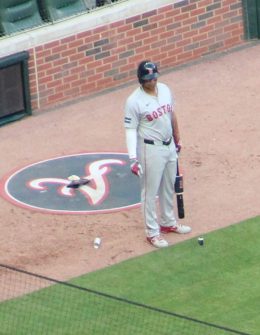
Devers in the on-deck circle. He now joins the Giants in a deal that may not bear immediate fruit for the Red Sox but manna at the plate for the Giants.
Even leading the 21st Century in World Series titles (four), the Red Sox haven’t lost their capacity to stun. They can sweep their eternal rivals and neutralize those rivals’ number one hitting threat one moment (they held Aaron Judge to 1 bomb, while striking him out 9 times during the sweep) and trade a slugging three-time all-star the next.
Yes, that sounds too simple. So we’ll flesh it out a big more. A relationship fractured by foolishness on both sides ends with Rafael Devers going to the Giants and left-handed pitcher Kyle Harrison, right-handed pitcher Jordan Hicks, outfield prospect James Tibbs, and minor league right-hander Jose Bello going to the Red Sox.
Almost five years after the Red Sox traded Mookie Betts rather than think much about paying him his true value, they’ve unloaded a far more problematic player than Betts ever was. That won’t make the deal go down any more smooth for a Red Sox Nation too much flummoxed by the team’s front office follies in recent seasons, alas.
The deal also means the last of the Red Sox’s 2018 World Series winners are gone. The Mookie Monster has since been a critical element in two Dodgers world champions; Xander Bogaerts has become a mainstay in San Diego and a few National League pennant races.
Say what you will about Devers, the man can hit. His to-date .858 OPS, his average 33 home runs per 162 games lifetime, both prove it. His batting eye improves with age; he led the American League in walks at the time of the deal. And he took care of the second of two runs the Red Sox needed to finish sweeping the Yankees with a hefty 2-out home run in the bottom of the fifth. The Giants may have a home ballpark nowhere near as hitter-friendly as Fenway Park, but they’re getting a guy to whom the dimensions don’t matter so long as he can tee it up and swing big.
Part of the problem, and a critical reason why things came to Devers’s transcontinental change of baseball address, is that when you play him at third base “poisonous” doesn’t begin to describe it. He led the league in errors in six of his first seven seasons and the entire Show for the first four of those. He was 80 defensive runs below league average. (Fair disclosure: Bogaerts hasn’t exactly been toxin-free at shortstop, not being 27 defensive runs below league average for his career to date.)
That’s a compelling reason why the Red Sox thought signing free agent third baseman Alex Bregman was a smart idea. The problem was that the Red Sox took the clumsy way to handle both that and the little matter of convincing Devers that the longer he stayed at third base the more likely the Red Sox were to declare the area off limits pending a hazmat cleaning.
How would Devers have done at first base? We won’t know, at least regarding the Red Sox, because Devers didn’t exactly pounce on the opportunity when it was offered as Triston Casas hit the injured list. He won’t be taking a new shot on third in San Fran, either, since the Giants have a verified Gold Glover holding it down (Matt Chapman). He may not get a crack at first, either, with the Giants having a willing Wilmer Flores to move over in case former Met Dominic Smith needs a break or can’t hold it down longer-term.
But Devers will provide the Giants with something they haven’t had since their freshman top executive, Buster Posey, was last seen behind the plate for the Giants — a great hitter. Posey may also give Devers what the Red Sox couldn’t for whatever reason, a clear presentation of the “why” behind any move without insulting Devers’s considerable pride. Posey had bloody well better, too, considering the Giants have taken on the remainder of Devers’s contract — running through 2033 and paying him a nifty $250 million plus.
What do the Red Sox get other than out from under Devers’s remaining money and maybe a little more egg on their faces considering they didn’t exactly handle Devers with graceful hands and heads?
Harrison — Considered highly talented and still only 23, so he has time to put things together despite his 4.56 fielding-independent pitching rate to date. Depending on the Red Sox pitching injury picture, Harrison just might be seen in Red Sox silks before the stretch drive arrives. And that might occur next to any pitching the team ponders acquiring at or before the trade deadline now that they have about $250 million to play with.
Hicks — Serviceable relief pitcher whom the Giants tried out of the rotation last year, but when that experiment imploded Hicks went back to the bullpen, and the Red Sox are liable to keep him there.
Tibbs — A first-round pick last June, he’s been showing plenty of upside in the minors, but the Red Sox will likely wait for his AA-level results before thinking of him as Show bound.
Bello — Has bullpen upside to burn, from the look of his minor league life to date.
The rest of the Sox — With Devers gone, it looks as though there will be plate appearances to spare to spread around especially in dispersing an outfield crowd partially. But it’s an open question as to just whom would replace Devers’s plate production. For now. And maybe longer. Which means the Red Sox’s re-entry into the AL East race picture may be an arduous re-entry to sustain.
Published originally by Sports Central.
 Throneberry Fields Forever