Robby the Umpbot wasn’t the end of the world

Robby the Umpbot

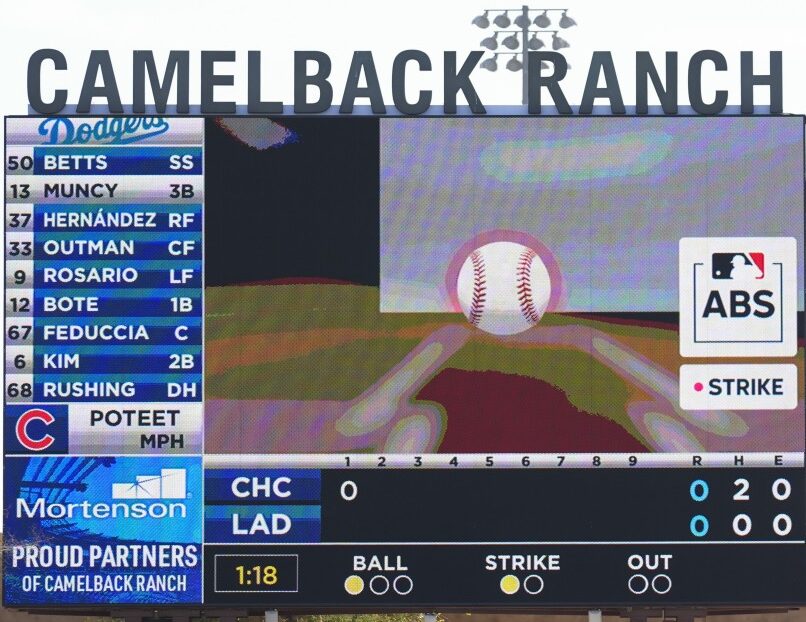
The first MLB deployment of Robby the Umpbot–Cubs pitcher Cody Poteet getting a ball call turned to a strike against the Dodgers’ Max Muncy.

Cody Poteet. Remember the name of this Cubs righthanded pitcher. No, he didn’t surrender three World Series home runs to Babe Ruth in the same game, he didn’t try to start a World Series game the day after pitching four innings in relief, and he didn’t pitch a no-hitter in which he got credit for such a performance despite his defense recording every last out in the game.*

No, Poteet was first on the mound to call for—and win—a ball/strike challenge with aid and comfort from Robby the Umpbot. Even if it was in a spring training exhibition game.

Poteet had Mookie Betts aboard and nobody out in the bottom of the first when he threw Max Muncy a fastball at the knees on 0-1. Home plate umpire Tony Randazzo called it ball one. Poteet said, “Not so fast” . . . and called immediately for Robby the Umpbot’s help. Well, now. The videoboard showed the pitch most certainly did hit the strike zone by the rule book. 0-1 went to 1-1. Muncy ended up looking at strike three not far from the same knee-high location.

Know what happened after that? How about what didn’t happen?

The sky didn’t fall. The earth didn’t move, under their feet or anyone else’s. There were no known tidal waves reported on any world coastline. Donald Trump and his predecessor Joe Biden didn’t suddenly become men of reason and wisdom. The flora and the fauna didn’t make mass entries on the endangered species lists.

About the only unlikely thing to happen from that overturned ball call was the Cubs going forth to batter the world champion Dodgers, 12-4, to open spring exhibition season. They turned a 3-0 Dodger lead after two into a six-run third, added two in the fifth, one in the seventh, and three in the eighth. The only Dodger response was an eighth-inning RBI double.

You might be happy to know that Poteet had an ally on his call for Robby’s review: Muncy himself. “When that ball crossed, I thought it was a strike right away and he balled it,” the Dodger third baseman said postgame. “I look out there and he’s tapping his head and I went, ‘Well, I’m going to be the first one’.”

And, just as with the advent of replay elsewhere, guess what else didn’t happen? The game itself wasn’t delayed unconscionably. Muncy certainly didn’t think so. In fact, he doesn’t mind Robby at all. Neither did Randazzo, seemingly.

“It’s a cool idea,” Muncy said. “It doesn’t slow the game down at all. It moves fast. The longest part was Tony trying to get the microphone to work in the stadium.” Meaning, Randazzo announcing the ruling to the Camelback Ranch crowd.

Come the eighth inning, the Cubs called for another challenge. This time, catcher Pablo Aliendo thought Frankie Scalzo, Jr.’s sweeper nicked the top edge of the zone for strike three with Sean McClain at the plate. Not quite, Robby ruled this time. Ball four.

The rule for deploying the automated ball/strike system (ABS), as it’s called officially, is that only three on the field (pitcher, catcher, or batter) can call for Robby’s opinion and each team gets only two challenges thus far. If the challenging team wins, as the Cubs did, they keep the challenge. When the system was brought online in the minors, the estimates became that the average such challenge was (wait for it!) seventeen seconds.

Neither Poteet nor Muncy were new to Robby, according to The Athletic‘s Fabian Ardaya. Poteet started ten times in the Yankee organisation last year, at Scranton-Wilkes Barre; Muncy saw it while on a rehab assignment off a wrist injury. Muncy’s only issue then was, as he put it to Ardaya, “the technology wasn’t entirely there.”

There’d be certain pitches that you would see and you’d look up on the board and it’d have it in a completely different spot . . . Even the catcher would come back and be like, ‘Yeah, that’s not where that ball was.’ The technology isn’t 100 percent there, but the idea of it’s really cool.

Critics (they were legion) feared Robby the Umpbot would penalise too many solid umpires while punishing not enough errant ones. One conclusion Robby’s early works has stirred is a revelation that might be just as jarring, as The Wall Street Journal‘s Jared Diamond puts it: the players themselves, from the mound to the plate, don’t know the strike zone as well as they think.

“Unlike the replay rules already in place, where managers initiate appeals from the dugout after having time to deliberate,” Diamond writes, “ball-strike challenges have two key differences: They can only come from the pitcher, catcher or batter—and they must happen immediately.

“The result is a format that inserts elements of both strategy and personality into the game even while adding automation. That’s because ultracompetitive, often emotional professional athletes aren’t always particularly good at knowing the right time to ask for a challenge.”

On-field embarrassment comes in infinite forms. Dodgers pitcher Landon Knack, who got knuked by the Mets in last fall’s National League Championship Series, told Diamond of times during his AAA-level days when he challenged pitches from frustration and regretted them at once. “All Knack could do,” Diamond writes, “was stand on the mound and watch the scoreboard animation showing the location of the ball, as everybody in the stadium saw that he was embarrassingly wrong.”

It’s something along the line of the store manager calling la policía after showing up at the bank without the bag full of the day’s cash proceeds, only to double back and realise he or she dropped the bank bag in the parking lot on the way to the car—with the whole thing caught on the store’s security cameras.

Other kinks in the system may well include the choice of players who get to call Robby for help. Diamond says AAA-level managers and players agree on the one who shouldn’t: the pitchers. Knack himself admits, “Pitchers are horrible at it.” Said a Dodgers AAA catcher, Hunter Feduccia, “We probably had a 90 percent miss rate with all the pitchers last year.” Admitted a Royals AAA pitcher, Chandler Champlain, “Being biased as a pitcher, I think anything close is a strike.”

Advises Jayson Stark, The Athletic‘s Hall of Fame writer, “Don’t be That Guy whose heat-of-the-moment challenge decisions leave your teammates shaking their heads and calling you names you won’t want to see displayed above your locker. Be smart. Be cool. Be thoughtful. And control those emotions!”

(Some hitters have been known to have dubious strike zone sense, too. Once upon a time, Hall of Fame catcher Yogi Berra had an impeccable strike zone sense behind the plate . . . and a notorious lack of it at the plate. Maybe the best bad-ball hitter of his time, Berra was questioned postgame about a pitch nowhere near the strike zone or even Yankee Stadium’s postal code that he’d smashed for a home run regardless. Bless his heart, Yogi insisted the pitch was a letter-high strike.)

Relax. Robby’s getting a spring training Show tryout only for now. He’s not expected to spread his wings over the regular season Show until 2026 at minimum.

But if the only kinks in the system other than coordinated calibrations thus far are figuring out who should make the challenges and who shouldn’t, you’d have to say Robby’s going to be in good shape and the umpires are going to be in better shape. (They’ll get immediate reminders of the rule book, as opposed to the “individual” strike zone.) And, the game is going to be in the best shape.

* For the record, the Cub pitchers who delivered those non-feats were, in order, Charlie Root (1932), Hank Borowy (1945), and Ken Holtzman (1969).

This essay was written for and first published by Sports Central.

Baseball’s sky isn’t falling, folks

Dodger Stadium

No, folks, this is not the home of the new Evil Empire.

Ken Rosenthal isn’t the only one who’s slightly staggered that Rob Manfred actually tried to speak reasonably about the current ponderings of a baseball salary cap. Slightly, but perhaps not irrevocably.

Said Commissioner Pepperwinkle when some owners began making some pro-cap noise, “I am a huge believer in the idea that there are always multiple solutions to a particular set of concerns.” Said Rosenthal, though, playing the trust-your-mother-but-cut-the-cards card, “It’s possible, perhaps even likely, Manfred was playing possum when he spoke of ‘multiple solutions’ for revenue disparity.”

Let’s remember, as Rosenthal does by way of Forbes, that baseball in 2024 generated $12.1 billion in revenues, a new record even if it’s not as ritzy a record as Aaron Judge’s American League single-season home run record. The math says that’s an average $400 million per major league franchise.

Alas, some owners and team executives have begun to bellyache well ahead of the current collective bargaining agreement’s 2026 expiration. Rosenthal cites a few who may or may not surprise you: the Orioles’ new owner, David Rubenstein; the Yankees’ veteran owner Hal Steinbrenner; the Mets’s president David Stearns:

Rubenstein has said he wishes baseball a salary cap “the way other sports do.” Steinbrenner says those profligate Dodgers it’s difficult “for most of us owners to be able to do the kind of things that they’re doing now.” Stearns says baseball has “a little tougher time” figuring out how to keep stars who came up through the smaller market organisations in those organisations.

Not so fast, Rosenthal rejoins:

Funny, Rubenstein is a private equity billionaire who last March, with no assurance of a cap, had no problem paying $1.735 billion for the control stake of the Orioles . . . Funny, Forbes last March valued Steinbrenner’s team at a major-league high $7.55 billion and the Dodgers at $5.45 billion . . . Funny, Stearns previously worked for the Brewers, who play in the smallest market in baseball, yet signed outfielders Christian Yelich to a nine-year, $215 million contract and Jackson Chourio–after Stearns departed–to an eight-year, $82 million deal. And the Brewers . . . consistently find a way to compete.

“There is no disputing that small-market teams are at a financial disadvantage, and often lose star players,” Rosenthal continues. “But it’s also true that those teams occasionally keep some stars long-term, and perhaps could invest more of their revenue-sharing dollars in major-league payroll.”

Perhaps they could take the cue from the late Peter Seidler, whose Padres have been “proof that small-market teams should not operate as if they are doomed.” Seidler may also have been one of the only exceptions (countable on a single hand) to the rule that no fan ever pays their way into the ballpark to see the team’s owner. That’s how fan friendly he was before his death.

The Padres may or may not have spent all wisely, all the time. But as Rosenthal notes, they do have three postseasons in the past five years (including and especially the thriller with the Phillies that climaxed in Bryce Harper’s mud-bowl home run) and four consecutive attendance rankings in the top five.

“Make the luxury-tax thresholds higher, but the penalties steeper; about 50 percent of luxury-tax proceeds go to small-market teams,” Rosenthal adds.

Redistribute draft picks to give small-market clubs better positions and additional selections. Force those teams to spend by instituting penalties for falling below certain payroll thresholds, similar to the ones that exist at the top of the luxury-tax structure.

Don’t like those ideas? Fine, come up with others . . . How would the sport revive from another stoppage? The owners advocating for a cap should not even want to flirt with that question. Their “sky is falling” act is already growing tiresome. Fix the sport some other way. Or sell your damn team.

Meanwhile, Rosenthal’s Athletic colleague Jayson Stark reminds one and all that playing the “competitive balance” card while agitating for a baseball salary cap is about as credible as calling the NFL the true parity league or the Trump Administration the true stewards of the Constitution.

How many baseball teams broke decades-long championship droughts, fifty years or longer, since 2001? Stark asks. And, answers: Eight—the 2002 Angels, the 2004 Red Sox, the 2005 White Sox, the 2010 Giants, the 2016 Cubs, the 2017 Astros*, the 2019 Nationals, and the 2023 Rangers. How many NFL teams have done likewise since 2001? Three—the 2009 Saints, the 2017 Eagles, and the 2020 Chiefs.

Stark has more myths to bust, and bust them he does, admirably:

Come Sunday, the Chiefs sought their third straight Super Bowl and fourth in the past six years. Meanwhile, among baseball’s behemoths whom some owners and a lot of witless fans claim are Ruining The Old Ball Game while the NFL is the Any Team Can Win league, Stark points forth:

“The Dodgers? They’ve won four World Series in the last 59 years.” Perspective: Those four began shortly after the Beatles performed their final-ever American concert . . . in what was then the home of the Dodgers’ hated rivals up north in the Bay Area.

“The Braves? They’ve won four World Series in the last 121 years.” Perspective: They won their first Series just a few months before Archduke Ferdinand’s assassination launched the world war that made the world safe for World War II.

“The Red Sox? They’ve won four World Series in the last 106 years.” Perspective: Before the first of those, the United States had sixteen presidents–from a former Princeton president named Woodrow Wilson to a former baseball owner named George W. Bush.

“The Giants? They’ve won four World Series in the last 91 years.” Perspective: Prior to 2010, the Giants hadn’t won a Series since the year of America’s first black radio network, the first mass polio vaccinations for children (in Pittsburgh, where the Pirates would finish dead last in the National League), and Edward R. Murrow handed Sen. Joseph R. McCarthy a television knockdown punch.

“The Cardinals? They’ve won four World Series in the last 60 years.” Perspective: You can make it five in the last 61, with their 1964 Series triumph against the Yankees . . . to whom their Series-winning manager would repair as their next manager following the disgraceful pre-ordained dumping of Yankee skipper Yogi Berra.

“The Phillies? The Astros? They’ve won four World Series combined in the history of their franchises.” Perspective: The Phillies had to beat the Astros to win the 1980 pennant that led to their first-ever Series triumph—32 years before the Astros were the team to be named later in the swap that sent the Brewers to the National League and the Astros to the American League.

The Yankees? Their dominance and dynasties are just so Twentieth Century, even if their wealth isn’t. Stark reminds us that we’ve seen 22 World Series since baseball decided to slap the big spenders with the luxury tax. The Yankees have won—wait for it!—exactly one of those Series.

Oh, yes: The Empire Emeritus and the Damn Dodgers have met in exactly four World Series since America’s bicentennial birthday bash. Want to know the score? Dead heat: two Series each . . . and the Yankees won both of theirs during the disco era–1977 and 1978.

Before last fall, Stark would like to enlighten or remind you, regarding tangles between two out of the five fattest payrolls in the game over the past 35 Series, “a World Series like that had happened precisely three times in those 35 years: 2018 (Dodgers-Red Sox) … 1999 (Yankees-Braves) … and 1996 (also Yankees-Braves). And that’s it.”

Meanwhile, what Stark calls the Sport That’s Broken has seen twelve 2024 teams with Opening Day payrolls less than $130 million, but he points out that 1) all but two of those teams played October baseball over the past five years; and, 2) all but four of them made the postseason in the past two years.

By the way, the salary-cap NFL has had eighteen distinct Super Bowl champions in the 49 years since the Messersmith decision ended baseball’s reserve era. Before you holler a-ha! be advised that baseball without the salary cap has had 24 distinct World Series champions in the same 49 years.

Repeat after me: Baseball’s sky isn’t falling. How can you tell an owner is lying? When his or their lips form the word “poverty” or synonyms thereof while forming the phrase “salary cap.” But how can you tell fans hollering for a salary cap are disingenuous? When their lips don’t form the phrase “salary floor.”

Written for and published at Sports Central.

Fay Vincent, RIP: Heart in the Right Place

Fay Vincent, Rollie Fingers

Then-commissioner Fay Vincent (right) with Hall of Fame relief pitcher Rollie Fingers at the latter’s Cooperstown induction, 1992.

Fay Vincent’s finest hours involved navigating a World Series through an earthquake and navigating George Steinbrenner out of baseball, for a little while, anyway. His worst hour involved overcompensatory overreach and lit the powder keg that imploded his commissionership.

Which was a shame, because Vincent—who died Saturday at 86, after stopping treatment for bladder cancer—usually had his heart in the right place when it came to baseball.

For better and for worse, Vincent in the commissioner’s office he’d never really sought actually believed that baseball’s commissioner was supposed to act in “the best interest of the game.” He also believed the best interest of the game wasn’t restricted to making money for the owners.

What Steinbrenner got from Vincent, for using a street gambler named Howard Spira to help harvest dirt against Hall of Fame outfielder Dave Winfield, was suspended from baseball, though Vincent cannily allowed the Boss his vanity and let Steinbrenner say he’d merely resign. Biggest favour anyone could have done the Yankees then. With Steinbrenner on justifiable ice, it left Yankee visionaries such as Gene Michael unmolested enough to rebuild the Yankees (“reduced to rubble by the ten-thumbed touch of their owner,” George F. Will wrote on the threshold of the suspension) to greatness.

When the Loma Prieta earthquake hit the Bay Area right smack in the middle of the 1989 World Series (wags took note of the quake’s effect on ramshackle, refrigerating Candlestick Park and called the joint Wiggly Field), Vincent split the difference between the grief of the Bay Area and the necessities of his business. He put the Series on hold for a week. Returned in the rhetoric of healing, the Series finished and the Athletics (hey, yes! they used to be a Bay Area team!) got to finish what they started, a sweep of the Giants.

“Vincent displayed,” wrote Thomas Boswell in the Washington Post of that belief and his actions upon it, when Vincent was forced to resign, “one unexpected tendency that frightened the owners so much that, in recent weeks, they plotted against him . . . ”

When the owners, after years of collusion, shut the spring training camps in 1990, Vincent was a force against the hard-line labour strategy of some owners . . . When many assumed that George Steinbrenner would get off with a light punishment for rubbing shoulders with unsavoury types, Vincent treated the Boss with no more respect than if the owner had been a mere athlete who had gone astray and damaged the game’s reputation for integrity. When he was asked to divide the [1993] expansion spoils, he divided them so fairly that no one was happy. When he thought it was healthy for the game to put teams from the West in the NL’s West division and teams from the East in the East division—a shocking notion that had been discussed for decades—Vincent actually did it, even though one team* (out of twenty-eight) really didn’t like it and threatened to cause lots of legal trouble.

Vincent got into baseball only because his close friend A. Bartlett Giamatti asked. Pretty please, with sugar on it, even. So this man who made his fortune as an attorney, as a chief executive of Columbia Pictures, and as a Coca-Cola honcho after Coke bought Columbia, heeded his longtime friend. (“Coca-Cola surprised even Columbia’s management team of Herb Allen and Fay Vincent by paying $750 million for the studio, the equivalent of nearly twice its stock value at the time,” wrote historian Mark Pendergrast in For God, Country, & Coca-Cola.)

He stood by his man when Giamatti dropped the hammer on Pete Rose. He accepted baseball’s mantle when Giamatti suffered his fatal heart attack eight days after winding up the Rose investigation, and the owners practically begged him pretty please, too.

Alas, the owners would learn the hard way that they hadn’t exactly bought themselves a yes-manperson. If only Vincent hadn’t built them the guillotine into which they’d force him to put his head in 1992.

Vincent’s most wounding flaw was as John Helyar (in The Lords of the Realm) described it: “passively waiting for [some] issues to become a mess instead of getting ahead of the curve on them.” Then, when he did involve himself, enough owners could and did smear him as a stubborn tyrant. Then came the Steve Howe mess.

Once a formidable relief pitcher, Howe became the near-poster boy for baseball’s 1980s cocaine epidemic. And, a six-time loser while he was at it, in terms of baseball standing. Then, in 1991, Howe applied for reinstatement and Vincent gave it to him. Then the Yankees gave him a shot after he set up an independent tryout at their spring camp. The aforementioned Gene Michael said, just as magnanimously, “He’s been clean for two years. I asked a lot of people a lot of questions about him, his makeup, the type of person he is. I feel there’s been a lot worse things done in baseball than bringing Steve Howe back. If it was my son or your son, you’d want to give him another chance.”

At first, Howe more than justified Vincent’s and the Yankees’ magnanimity. He pitched his way onto the Yankee roster and posted the second best season of his career: a 1.68 ERA, a 2.34 fielding-independent pitching rate, and an 0.96 WHIP. A hyperextended elbow ended his season in August 1991, but when Howe opened 1992 with a 2.42 ERA and a 0.45 WHIP, he made Vincent, Michael, and the entire Yankee organisation resemble geniuses.

Except that there was this little matter of Howe being busted in Montana during the off-season on a charge of trying to possess cocaine. Howe had little choice but to plead guilty in June 1992. Almost unprompted, Vincent barred Howe for life.

The Major League Baseball Players Association filed a grievance based on Howe’s having passed every drug test he was called upon to take. Howe’s agent Dick Moss handled the union side of the grievance and brought in a few heavy Yankee hitters—Michael plus manager Buck Showalter and a team vice president named Jack Lawn—as character witnesses.

Oops.

Thinking that Vincent felt as though Howe had just made him resemble a fool after going out on a very long limb for him was one thing. But he struck back like a man whose knowledge of fly swatting involved a hand-held nuclear weapon. He tried to strong-arm Michael, Showalter, and Lawn into changing their testimony the following day. He ordered them flatly to be in his office no later than eleven that morning, never mind that Showalter was already in his Yankee Stadium office prepping for the day’s game against the Royals.

Vincent sent the same orders to Michael and Lawn at home. Michael picked up Lawn, then Showalter, and an attorney Michael called warned them: don’t go to Vincent without a lawyer present unless you’re taking suicide lessons. When they arrived, Vincent told them they’d each “effectively resigned form baseball” because they had dared to “disagree with our drug policy” by acting as Howe’s character witnesses.

Lawn, an ex-Marine who once worked for the federal Drug Enforcement Agency, told Vincent he was sworn to tell the truth and “only testified in accordance with my conscience and my principles.” The commissioner whose conduct rankled those owners who essentially told him, “We don’t need your steenkin’ conscience and principles,” told Lawn—who wrote it on an index card so he wouldn’t forget it—“You should have left your conscience and your principles outside the room.”

An attorney privy to the Yankee trio’s session with Vincent said, “This guy has cooked his own goose.”

Showalter didn’t get back to the Stadium until four minutes before the first pitch. It hit the New York media as hard as the home runs that began a 6-0 Royals lead and helped end things with a 7-6 Yankee comeback win. Three guesses which part of the day mattered more postgame.

If Vincent wanted to mop the floor with The Boss, that was fine by the scribes. But if he wanted to mop the streets with Showalter, Michael, and Lawn, they were going to raise a little hell. They forced Vincent to back off his disciplinary threats. He was also forced, more or less, to order notices posted in baseball clubhouses saying no one should fear retaliation for testifying candidly during grievances.

Those among the owners already itching to dump Vincent got new impetus by his “manhandling of the Yankee Three,” Helyar wrote. “More no-confidence [in Vincent] memos came across [then-Brewers owner Bud Selig’s] fax machine. The conference callers turned to two big questions. One: How much support did they need to fire Vincent? Two: Could they legally fire him?” In order: 1) A two-thirds majority. 2) Yes, long as they paid the man the rest of his contract terms.

After vowing to fight to the end but gauging his falling support, Vincent saved the owners the trouble of executing him when he resigned in September 1992.**

“He vowed,” Boswell wrote, “to fight his backstabbing, leak-planting, disinformation-spreading enemies all the way to the Supreme Court. But, in the end, Jerry ‘I’m Michael Jordan’s Boss’ Reinsdorf of the White Sox, Bud ‘Me? Plot against Fay?’ Selig . . . and Peter ‘I’m Just as Powerful as Dad’ O’Malley of the Dodgers got their way . . . Vincent resigned rather than than drag baseball through the indignity and distraction of a long legal brawl . . . His final act ‘in the best interests of the game’ was, he wrote, ‘resignation, not litigation’.”

Long before the Howe mess, enough owners believed Vincent was too much of a players’ commissioner. Vincent himself said often enough that his largest regret after leaving office was being unable to build what he called “a decent relationship” between the owners and the players.

“I thought somebody would take over after me and get that done,” he told a reporter in 2023. “If I died tomorrow, that would be the big regret, is that the players and the owners still have to make some commitment to each other to be partners and to build the game.”

Selig, of course, became the head of the owners’ executive council, which made him in effect baseball’s acting commissioner. After the owners under his watch forced the 1994 players’ strike, they elected to make him the new commissioner, where he stayed until 2015.

“To do the job without angering an owner is impossible,” Vincent once said. “I can’t make all twenty-eight of my bosses happy. People have told me I’m the last commissioner. If so, it’s a sad thing. I hope [the owners] learn this lesson before too much damage is done.”

Vincent didn’t exactly go gently into the proverbial good gray night, either. His memoir, The Last Commissioner, was a bold if futile wake-up invitation to the game he loved. His later interviews with assorted Hall of Famers and surviving Negro Leagues players led to three books worth of oral history (The Only Game in Town, We Would Have Played for Nothing, and It’s What’s Inside the Lines that Counts).

He tried to leave baseball better than when he found it. If he couldn’t do that, it wasn’t because he failed to speak or act but because enough who mattered failed to listen when he was at his best and overreacted the one time he overreacted himself.

Vincent deserved better than to be pushed out the door under the lash of one bad mistake. May the Elysian Fields angels grant his family comfort and himself a warm homecoming.

————————–

* For the record, that team was the Cubs.

** Steve Howe was reinstated, again, after all. Arbitrator George Nicolau ruled that baseball failed to test Howe “in the manner it promised based on Howe’s documented case of attention deficit and hyperactivity disorder,” as Forbes’s Marc Edelman wrote in 2014. Howe had a none-too-great 1993 but got himself named the Yankee closer for 1994, having a splendid season, the near-equal of his striking 1991-92 work.

His 1995 was anything but, alas. Moved back to a setup role in 1996, he would be released that June after 25 appearances and an obscene 6.35 ERA. He tried one more season in the independent Northern League, with the Sioux Falls Canaries, but called it a career after that 1997 season, after the Giants backed away from signing him following an airport incident in which he was found with a handgun in his luggage.

Almost ten years after his pitching career ended, working his own Arizona framing contracting business, Howe was leaving California for home when his pickup truck rolled over in Coachella, ejected him, and landed on him, killing him at 48. Toxicology reports said there was methamphetamine in his system.

————————-
Note: This essay was published first by Sports Central. A very few small portions were published previously.