Not now, Snakes

Arizona Diamondbacks

The Diamondbacks fell in this World Series, and losing the final three at their own Chase Field really stings. But . . .

Stop right there. I mean you, everyone who thought “Bill Buckner” the moment Diamondbacks center fielder Alek Thomas over-ran Jonah Heim’s top of the ninth RBI single into an extra Rangers run, two outs before Marcus Semien slammed an exclamation point down upon the season and the Diamondbacks’ fate.

For one thing, the Diamondbacks still had three outs to play with coming at the plate. For another thing, these Snakes were that resilient bunch who usually found ways to overcome when absolutely necessary, no?

Not this time. Just as they couldn’t quite close a Game Four blowout into a possible tie and overthrow, they couldn’t turn a near-eleventh hour Game Five deficit into another tie or overthrow. It hurt even more losing the World Series with a three-sweep at home after splitting the first pair in Arlington.

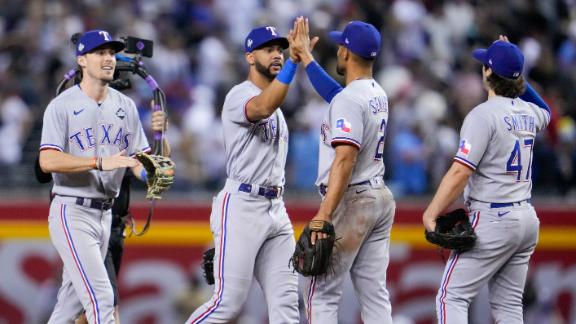
At last, as Semien’s two-run homer off Diamondbacks finisher Paul Sewald disappeared over the left center field fence in the top of the ninth, that Diamondbacks resiliency failed them even as the Rangers’ equal resiliency hurtled them to the Promised Land in five arduous World Series games.

“I definitely could have done a better job of getting in front of the [Heim] and calming down and just fielding it,” Thomas said postgame, refusing to shrink away, “but I think I rushed it and just didn’t get the glove down. I think I made an error on that two times last year and this year, and I think by now I should learn my lesson on how to go about that ball. But definitely gonna work on that in the offseason, make sure that doesn’t happen again.”

Long before Thomas had his moment of ill fate, the Diamondbacks failed to rise to several occasions. Their gallant starting pitcher Zac Gallen took a no-hitter through six innings while his Rangers counterpart Nathan Eovaldi pitched into and out of heavy traffic yet refused to surrender so much as a single run.

They loaded the bases on Eovaldi in the first and the fifth and left them that way. They had to know Eovaldi didn’t have his best stuff to throw and couldn’t do more than four hits despite also drawing five walks on the veteran righthander.

Then the most they could do against the Ranger bullpen was a seventh-inning walk, an eighth-inning base hit, and nothing else to show for it while that pen struck them out five times, including Ketel Marte looking at strike three from Josh Sborz to end Game Five and the Series whole.

“To get a taste of postseason baseball and the World Series,” said veteran Snakes designated hitter Tommy Pham, “if this doesn’t motivate you, I don’t know what will. This is a young team. There’s a core you can build around. And now everybody knows what it takes to get here.”

Pham surely didn’t mean backing into the postseason in the first place, as the Diamondbacks did claiming a wild card slot after finishing well back of the National League West-owning Dodgers on the regular season. Once they got there, though, they swept two division winners (the Brewers, the Dodgers) out of the wild card and division series rounds, then fought the Phillies to a seven-game National League Championship Series conquest.

Then they ran into the Rangers. Except for their 9-1 Game Two win, for the Diamondbacks this was like running into a pack of snake hunters unwilling to show much in the way of mercy. Even when they fought back from a 10-1 blowout in the making to make it 11-7 in Game Three, the Rangers were too much for the Diamondbacks to handle.

These Snakes didn’t have the star power of their 2001 World Series-winning predecessors. They kind of liked it that way, too. “I felt like we’re definitely a bunch of misfits,” said relief pitcher Ryan Thompson after Game Five ended.

That’s what makes us special. We got a bunch of young guys who are hungry, doing it for the first time. We got a bunch of veterans who have been there, done that, but not quite won the whole thing. It’s awesome being able to put our names on the map.

Gangs of misfits have won World Series in the past, with or without star power. The 1934 Cardinals, that shameless brawling Gas House Gang, was one. The Bronx Zoo Yankees of 1977-78 were another. The 2004 Red Sox called themselves the Idiots as though it were a badge of high honour. The 2010 Giants—managed by now-triumphant Rangers manager Bruce Bochy—thought of themselves as a bunch of morons.

What these Diamondbacks had was future star power. Corbin Carroll, Gabriel Moreno, Zac Gallen, Merrill Kelly, and Thomas himself. You could say it wasn’t their fault the Rangers hunted, pecked, pounded, pricked, and pulverised them. But you’d also have to say these Diamondbacks made enough of their own mistakes to enable that Ranger romp, too.

You credit the Rangers for such seizures. But you hand it to the Diamondbacks for making a showing for themselves before the World Series arrived. In a sane world, ruled by a sane commissioner and group of owners, they wouldn’t have reached the postseason in the first place.

But under the way things are set now, the Diamondbacks made the most of their entry. They left the Brewers looking brewed to a fare-thee-well. They left the Dodgers to a winter of self-re-examination. Then they ran into a Texas chainsaw massacre, more or less. There was no shame in that.

Oh, sure, they looked foolish a few times. Especially when manager Torey Lovullo talked early in the postseason about all those “receipts” the Diamondbacks kept to stick right back up the rears of those who doubted, the cynics who figured they were due for an early and painful postseason exit, the snorters who figured the big bad Phillies would make rattlesnake stew out of them.

They outlasted the Phillies. It wasn’t really easy to do. But the Rangers were another proposition entirely. The Diamondbacks really didn’t stand much of a chance no matter how bravely they hung in for five games, no matter that this Series matched two of baseball’s best defensive teams on the season.

The Rangers were only too happy to stuff those Diamondbacks receipts right back where they came from. But the Diamondbacks have no reason for shame otherwise.

“I’m so proud of what they’ve done,” Lovullo said. “And we have to step back for a minute and tell ourselves that we’ve done a lot of really amazing things this year. And then we got on this really fun ride through the course of the postseason. You just never want it to stop.”

But that’s the problem. They can never rescind the rule that somebody has to lose games.  The good news further is that the Diamondbacks are a comparatively young franchise and lack the kind of snake-bitten history that once plagued such antiquities as the Cubs, the Red Sox, and even the 63-year-old Rangers. And still plagues the Guardians, who haven’t won a World Series since the Berlin Airlift.

Barring unforeseen calamity or brain damage, the Diamondbacks will be back soon enough. For now, let them mourn lost opportunity while celebrating how they got to have the chance in the first place.
Of great misfortune and unforeseen reward

Texas Rangers

Big man lost? No problem, so far . . .

Maybe, as much as he loathed the original move of the second Washington Senators to Texas for 1972, the late Frank Howard put a good word in when he arrived in the Elysian Fields Monday. On the same day he departed, the Rangers got just what they needed to win World Series Game Three. On the day after, they got a lot more of what they needed to end Game Four one win shy of a franchise-first Series title.

Rest assured, however, that the gentle giant nicknamed Capital Punishment did not arrange for the Rangers to lose Max Scherzer and Adolis García for the rest of the Series.

The Rangers needed anything Scherzer had left in Game Three and got it, until his back tightened after three shutout innings to open. They needed their bullpen, paced by usual starter Jon Gray, to keep the Diamondbacks from getting frisky at the plate, and they got that, too, other than one late excuse-us! run.

They needed just enough runs to make a difference and to stop a couple of potential runs with their arms and leather, and they got both. They even needed the usually mistake-conscious Diamondbacks to make a critical mistake and got that, too. But they didn’t need García straining his left oblique after an eighth-inning swing at the plate.

Losing García for any length after everything he did to get and keep them here could have been even more grave than losing Scherzer, who wouldn’t have expected to see further Series action until a possible Game Seven. But the Rangers didn’t just rise to the Game Four occasion on Halloween, they smothered it.

“What good is it,” asked Howard once, “to be able to throw a ball through a brick wall if you can’t hit the wall?” The Rangers didn’t expect Scherzer to throw anything through a brick wall, just elusive enough to Diamondbacks bats or enough to compel them to hit them where they were. He’s not Max the Knife anymore, but he didn’t have to be. So long as he kept the Snakes from biting, he set a tone for the Ranger pitching staff. He set it well enough to leave room for the Rangers to win Monday night, 3-1.

Of course, he and they got more than a little help from their friends. Shortstop Corey Seager provided an early blast plus a late defensive double play that probably saved Game Three. Adolis Garcia took advantage of a critical Diamondbacks baserunning mistake, Christian Walker running through his third base coach’s stop sign, to help save it defensively, himself.

Then came the news that García wouldn’t be in the Game Four starting lineup at least. Then, later, came the news he’d be off the Rangers roster along with Scherzer the rest of the set, barring divine (Howardian?) intervention. Their replacements: a relief pitcher named Brock Burke and a utility player named Ezequiel Durán.

Durán can hit a bit and with some long-ball power, and he can handle shortstop especially if Seager needs a break or matchup relief. Burke is a testy proposition at best; he can miss bats but when he doesn’t it can be disaster. (4.37 ERA; 4.90 fielding-independent pitching rate; 5.78 K/BB ratio but 9.7 hits per nine and 2.0 home runs per nine.)

Thus did the Rangers plug difficult-to-impossible holes, not to mention inserting Travis Jankowski into right field in García’s place, and reach for a bullpen Game Four. As did the Diamondbacks. Andrew Heaney opening for the Rangers, Joe (Be Fruitful and) Mantiply for the Snakes.

What was it that Don Vito Corleone once said about great misfortune sometimes leading to unforeseen rewards?

First, García himself gave his teammates a pre-game talk that began with telling them how much he loves them and finished with a call to go out and win two more Series games he had no doubt they could do. Then, stirred by that address from a guy who isn’t known for clubhouse speeches just yet, the Rangers went out and got half the job done Tuesday night.

They made early work of the Snakes with a five-run second, the runs scoring on a wild pitch by Mantiply’s relief Miguel Castro, then a two-run triple by struggling Marcus Semien to chase Castro in favour of Kyle Nelson, and then a two-run homer from Corey Seager on Nelson’s dollar.Then they got nastier in the third: a two-run double (Jankowski, maybe doing a García impression) and a three-run homer. (Semien—did he figure out ways to break out of a postseason slump, or what?)

Meanwhile, it remained a bullpen game on only one side of the field. Surprising maybe everyone watching, Heaney pitched well into the fifth inning, his only blemish until then a second-and-third, nobody-out jam in the fourth out of which he escaped with only one run coming home on a sacrifice fly.

The Diamondbacks only thought they could out-smart the Rangers by staying with a bullpen game and using their lowest-leverage bulls to try sneaking outs through the basement. Until Ryne Nelson entered and swallowed five innings that went unblemished but for Josh Heim’s leadoff bomb in the eighth and Seager’s leadoff ground rule double in the ninth, the Snakes bulls got snaked but good early and too often.

“You’re throwing different looks at guys the whole game,” said Mantiply postgame, after getting the game’s first four outs. “Each hitter never really sees the same guy twice. Obviously, what Ryne did tonight was huge; he stepped up and ate five innings for us. But the strategy is to limit the amount of at-bats guys get off the same guy.”

If only Miguel Castro (the run-allowing wild pitch), Kyle Nelson (Seager’s blast), and Luis Frias (the third inning mayhem) could have followed the script. Then manager Torey Lovullo could have reached for his higher-leverage relievers such as Kevin Ginkel, Paul Sewald, and Ryan Thompson instead of having to ride the Ryne. But the Rangers’ early slashing and smashing turned out to be more vital than thought in the precise moments.

That’s because hese pesky Diamondbacks don’t give up without a good hard fight. The 11-7 final score still seemed lopsided because the Rangers led it 11-1 after seven and a half, but the Snakes rattled a four-run eighth (Tommy Pham with the one-out, bases-loaded sacrifice fly; Lourdes Gurriel, Jr. with the two-out three-run homer) and a two-run ninth (Gabriel Moreno with the two-out, two-run single) before it finally ended.

It just wasn’t enough to overthrow a Rangers team that spent the regular season finding ways around the injured list, never mind get the game to the Diamondbacks’ bigger bullpen bulls.

At various times they lost García himself plus Seager, Josh Heim (who hit a solo bomb in the Game Four eighth), Mitch Garver, Josh Jung, and Leodys Taveras. That was six lineup mainstays. They also had to make do at various times without Game Five starter Nathan Eovaldi plus starter-turned-Series-relief ace Jon Gray plus closer Jose Leclerc and fellow high-leverage bullpen bull Josh Sborz.

They lost free agency signing Jacob deGrom to Tommy John surgery and for the season. They landed Scherzer at the trade deadline but lost him to a shoulder injury in late September and—before the back tightness taking him out Monday—didn’t see him at work again until the American League Championship Series.

The Rangers could have buckled under any one of those injuries. They could have collapsed outright after losing García for the rest of the Series. The Diamondbacks might only wish that they had. Maybe now their fondest wish might be to keep García’s pre-game big mouth shut.

At least one good thing came forth for the Snakes. If Game Five starter Zac Gallen falters or gets torn up early, they’ll have Ginkel, Sewald, and Thompson fresh enough for service. Their second-fondest wish behind possibly muzzling García in the Rangers clubhouse might be getting those three to work in time enough to send the set to a sixth game at minimum.

“We put ourselves in a very tough spot right now,” Pham said postgame. “It’s going to take a lot.”

But Heaney, maybe an unlikely hero for the Rangers, did his team a favour just as big. His five one-run innings saved the meat of the Ranger pen for Game Five. Meaning Gray, Leclerc (who only worked a third of an inning to end Game Five), and Sborz ready to rumble if the Rangers strike early enough and often enough. They did pry three runs out of Gallen in Game One, after all.

What they did to the Snakes’ opening corps Tuesday was a lot more than just prying.

“Five runs in the second inning there, really takes a lot of pressure off,” said Heaney, a veteran who could be both remarkable and vulnerable as an Angel, a Yankee, and a Dodger, before joining the Rangers as a free agent but spending September and most of the postseason in the bullpen. “And then putting up five the very next inning, we had a ten-run lead. It’s a lot easier to go out there, attack the strike zone and not feel so confined to having to make perfect pitches.”

Just hope someone in the Elysian Fields reminds Frank Howard that Game Five doesn’t have to be even half as insane as Game Four.