
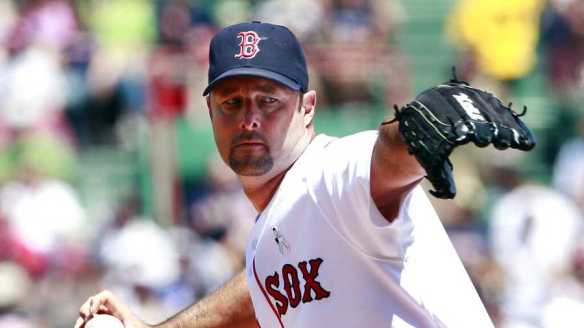
Armed with a decent if tough to handle knuckleball, Tim Wakefield was a good pitcher and a better man. He spent the most time of any pitcher with the Red Sox—seventeen seasons.
Tim Wakefield’s death at 57 struck more than a few chords around baseball Sunday. Not just because a decent man with a decent knuckleball and a philanthropic heart was taken too soon. Not just because he and his wife were robbed by a narcissistic old teammate of their right to fight two insidious diseases with dignity and courage and out of the public eye.
How decent was Wakefield? Decent enough that—when his 2004 Red Sox overthrew the Yankees in that staggering American League Championship Series run after being down to the last couple of outs in a prospective four-game sweep—Yankee manager Joe Torre called Wakefield before he called anyone else in his dark hour.
A year earlier, Torre showed him empathy after the first pitch he threw to Aaron Boone in the ALCS Game Seven bottom of the eleventh flew into the left field seats with a meal, a stewardess, and the American League pennant aboard: He had done nothing but get us out in that series, and, all of a sudden, he’s got to walk off to that.
Now, wrote the New York Times‘s Jack Curry, “Torre was alone with his disappointment. He could have called his wife for comfort or he could have called George Steinbrenner, the principal owner, for discomfort. He lifted the receiver and, surprise, called Boston pitcher Tim Wakefield instead. ‘I just told him I wasn’t happy,’ Torre said, ‘but I was happy for him’.”
Few baseball goats get to redeem themselves as swiftly as Wakefield did. He went from surrendering a pennant-losing home run one year to standing on the mound as a pennant- and World Series-winning pitcher the next. Not to mention a pennant- and World Series-winning pitcher three years after that.
It wasn’t exactly pretty—he threw threw shutout relief innings in 2004 ALCS Game Five but surrendered five earned without harm in Game One of that World Series. Then, he pitched four and two-thirds surrendering five earned in Game Four of the 2007 ALCS but didn’t appear in the Red Sox World Series conquest to follow.
Wakefield was a competitor who never refused the ball, taking a reasonable knuckleball and a quiet but powerful will to the mound. Reasonable, but hard to handle: one of his catchers, Victor Martinez, actually used a first baseman’s mitt behind the plate when catching him. Wakefield did the best he could with it for a long career including those two World Series rings, and earned nothing but respect and affection for his effort.
He could have shriveled after Game Seven of the 2003 ALCS, when he pitched a shutout bottom of the tenth inning in relief of Mike Timlin but saw his first pitch to Boone disappear to open that bottom eleventh and close out that ALCS. But like his fellow Red Sox, he simply picked up, dusted off, and started all over again. All the way to the Promised Land no Red Sox team had seen since the end of both World War I and the Austrio-Hungarian Empire.
Perhaps, as I once wrote, arguing that the sports goat business should have gone out of business long enough ago, Wakefield having been to four postseasons prior to 2003 built a survival mechanism in him to call upon when Boone swung.
It might also have helped that Red Sox Nation heaped its scorn upon manager Grady Little misreading Hall of Famer Pedro Martinez’s emptied fuel tank and leaving him aboard a Yankee or two too many to send Game Seven to the extras in the first place.
Wakefield’s steadiness probably had as much influence as any of the freewheeling, fun-loving Idiots as the 2004 Red Sox called themselves. (“We’re just a bunch of idiots who love playing baseball”—center fielder Johnny Damon, who swore it also meant they weren’t going to let the Red Sox’s star-crossed history to that point get to them.)
It wasn’t enough to enable him to overcome the brain cancer he and his family hoped to keep out of the public view before his Red Sox teammate Curt Schilling outed him last week. Schilling took an appropriate beating all over social media for revealing what Wakefield and his family hadn’t permitted him to do, and the Red Sox issued a public statement of empathy without saying outright what Wakefield fought.
We just didn’t think the battle would end so soon after Schilling’s idiotic doing.
The eulogies speak more about Wakefield the man than Wakefield the good if not quite great pitcher who was good enough to pitch nineteen major league seasons, seventeen with the Red Sox. “I only knew him off the field,” Xtweeted former Red Sox outfield star Fred Lynn, whose career beginning predated Wakefield’s by a couple of decades, “but he was a very good guy. Class act. Gentleman.”
Wakefield was a 2010 Roberto Clemente Award winner for his community and charity work off the field in Boston. (He was nominated eight times for that award.) He was the charitable Red Sox Foundation’s honourary chairman as well as being heavily involved with the New England Pitching for Kids group that aims to improve children’s lives. He also became a well-liked Red Sox broadcaster after he stepped off the mound for the final time, and habitually asked fans who met him about their own lives and doings first.
“The best guy you could want to be your friend,” Xtweeted former Pirates manager Clint Hurdle, who managed the team long after Wakefield began his career with them. “The baseball player was a great teammate and competitor. Another true ambassador of our game. The husband, father and friend cannot be replaced. He cared and he loved.”
He loved only three people above and beyond baseball. He loved his wife, Stacy, who’s reportedly battling pancreatic cancer herself, and his two children, Trevor and Brianna. May the Lord in whom he devoutly believed have welcomed him home happily, while lending His love and strength to his family.
And, perhaps, more than a few hard raps across the mouth of the teammate who saw fit to deny him and his family the dignity of their final hours together without publicity’s prurient blare.
 Throneberry Fields Forever
RIP Tim Wakefield! You will be missed by all!!
LikeLike