
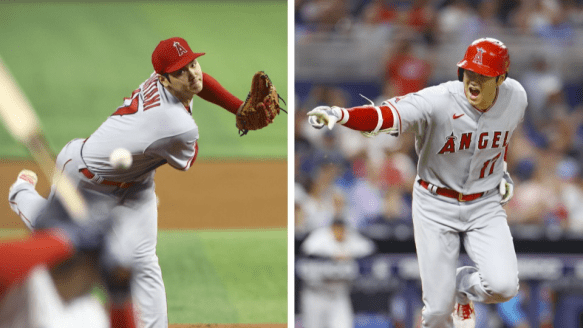
Shohei Ohtani could bring back a trade deadline haul that might push the Angels (and their trading partner, depending) into the postseason at last. But it would serve their owner right for failing to deal him and then letting him walk as a free agent bringing back . . . nothing.
Unless there is something festering in the deep background that nobody can expose, I have a contrarian thought for everyone insisting Angels owner Arte Moreno absolutely must trade Shohei Ohtani. I ask only that you save your ammunition until you read whole.
If Moreno’s that insistent upon keeping Ohtani until that very day when he becomes a free agent for the first time after the season ends, let him.
If Moreno insists upon remaining the kind of owner whose sense of marketing is more acute to the tenth power than his sense of baseball and of his team’s true competitiveness, let him.
If Moreno is that bent upon receiving nothing in return for Ohtani by letting him walk this coming winter, rather than receive the kind of value whose terms his baseball people can all but dictate, considering the prize Ohtani is, let him.
It would serve him right, even if it might serve long-enough-suffering Angel fans not so right.
Remember, this is the owner who was “exploring options” to sell the Angels almost a year ago. When that news broke, the sigh of relief from Angel fans could be felt from the Newport Beach coast to the farthest-planted lighthouse in Maine.
Moreno even let it slip that he had a pair of offers that would have eclipsed what Steve Cohen paid to buy the Mets. The problem was, Moreno let that slip this past March, when he also announced he simply couldn’t bear to part with the Angels just yet. Not while there was (ahem) “unfinished business” to tend.
“[We] feel we can make a positive impact on the future of the team and the fan experience,” he said in a formal statement when announcing his sale plans were done for who knew how long. “This offseason we committed to a franchise record player payroll and still want to accomplish our goal of bringing a World Series championship back to our fans. We are excited about this next chapter of Angels baseball.”
As of this morning, the Angels had gone from a season-opening 18-14 to a dead-even 48-48. The last time they had a four-or-more-games-over-.500 standing was when they were nine games over following a two-out-of-three winning stand against the Royals in mid-June. They’ve been 7-15 since.
The culprits have been the usual ones for this team—inconsistent pitching by one and all not named Ohtani; inconsistent hitting by one and all not named Ohtani (or Mike Trout); and, a near-consistent parade of patients for the injured list. Somehow, the Angels are four and a half games back in the American League wild card race, and nine out of first in the AL West.
That’s close enough for a major trade deadline deal to maybe make a difference, for the wild card hunt if not the division hunt. Right now, the biggest deal of deadline season could be Ohtani for whatever prime enough talent he’ll bring back, even if the acquiring team knows he might be just a rental for the rest of the way. (Even if that means a division, a pennant, maybe even a World Series ring.)
For a contending team loaded in surplus, that rental could still mean a deep postseason dive. For the Angels, it might mean surviving into the postseason, even through the back door, but just enough to give Ohtani (and Trout) a taste of postseason action neither has been granted to see since Ohtani became an Angel in the first place.
No, Ohtani won’t return a whole qualified starting rotation, a whole bullpen full of more than bull, or an entire additional lineup of Ohtanis (or Trouts). But he would return pieces solid enough to keep the Angels in this race and maybe, just maybe, a race or two to come.
“Ohtani is a once in a lifetime player, and moving off of him is akin to trading Babe Ruth,” writes Deadspin‘s Sean Beckwith. “You hold onto that kind of talent for as long as possible, and hope for the best.” And that last part, Beckwith knows, is the most problematic part:
Considering “hoping for the best” is the Angels’ entire organizational strategy — it’s why they’re in this current predicament — they will inevitably be crippled by indecision, or disillusioned by the “LA” on the hat, and stand semi-firm that Ohtani will stand by them.
This is, of course, an asinine strategy, and antithetical to the thinking of front offices, and sports media. The pleas for trade destination slideshows are being heeded everywhere you click, and all the big market teams are tallying their assets to see how much they could offer in a trade, because [general manager Perry] Minasian said he’s not going to trade Ohtani if they’re still in contention.
The thing is, contention is subjective, and four-and-a-half games back of the final wild card spot is more than enough for the Angels to grasp onto the belief that Shohei Ohtani will stay regardless of no tangible reason to do so.
It’s more than enough, too, to prevent Moreno—an owner who thought (erroneously) that his life’s success in marketing qualified him as a baseball man, when it only meant he could put (the old George Steinbrenner creed) “name guys who put fannies in the seats” on the field first and worry about rhyme, reason, cohesion, and performance (an awful lot of which his own capriciousness obstructed) second—from doing the sensible thing. Or, from letting Minasian do the sensible thing.
So let him cling to Ohtani until the two-way unicorn’s Angels deal expires this winter. Let him get less than nothing in return for the unicorn if that’s the way he wants it. Ohtani has been at least as sensational a baseball talent as Mike Trout was before the injuries became a near-annual thing for him. He (and Trout) deserve better than to be kept prisoners to merely hoping for the best.
Let Moreno explain why clinging to his unicorn to the very last was more important than letting his unicorn bring back what just might have pushed the Angels into their first postseason since they were swept out of a division series by the Royals, in the first of Mike Trout’s three Most Valuable Player Award seasons. Nine years ago, if you’re scoring at home.
That explanation should prove the funniest and saddest monologue since the Marvelous Mrs. Maisel first wandered onto the stage of a fleabag nightclub to schpritz about her husband dumping her for his secretary. Mrs. Maisel got laughs and a brilliant career out of it. It would serve Moreno right to get nothing back for the unicorn to whom he sold an illusion.
 Throneberry Fields Forever