Missing: The MLBPA leader who didn’t like to wait

Michael Weiner

Michael Weiner, watching pre-game activity at the 2013 All-Star Game, four months before his premature death. Would the late MLBPA leader have helped things be very different now if he could have lived longer?

This much we know about baseball’s current paralysis: The owners and their trained parrot (it’s almost impossible to think of Rob Manfred as a proper commissioner) think both the players and (most) fans make a bag of hammers resemble the Harvard Classics. The Major League Baseball Players Association, however, did commit one barely discussed but crucial error.

Musing about how the owners and the players might, maybe, be able to straighten their priorities out, ESPN’s Buster Olney remembered a not-too-distant time when the players, at least, did a lot more advance work with a collective bargaining agreement’s expiration on the horizon.

“Why didn’t we start this sooner?” Olney thinks the players should ask themselves, before remembering someone on their side who actually did, once upon a time.

“The late union leader Michael Weiner constantly engaged with Major League Baseball in the months leading up to the CBA expiration, working through the complicated puzzles,” Olney writes. “[Current MLBPA director Tony] Clark has taken a very different approach in the past two CBA negotiations, waiting and waiting before diving into the core issues.”

Earlier in the essay, Olney remembers Manfred speaking of “wanting to forge relationships with individual players” upon becoming commissioner but failing to do precisely that. Further down, Olney suggests the players with Weiner’s successor (and former first baseman) Clark could do with doing similar, among themselves and with the commissioner’s bosses.

“The players are rightly furious about some of the owners’ tactics and PR spin,” Olney continues. “But is it possible the union would be better served by a Weiner-style engagement? Moving forward, could the business relationship be improved by more consistent dialogue?”

Weiner’s death of an inoperable brain tumour in November 2013 saddened a sport that came to love him back as much as he loved the game. He was known as a geniune baseball fan, who didn’t let that stop him from both reasonableness and deep-diving preparation. He was practically the union’s version of a commissioner who’d died prematurely, too.

Weiner was a man with vision though not a proper professional scholar. But he had this much in common with A. Bartlett Giamatti: Whatever particulars confronted them otherwise, Giamatti didn’t seem to believe the good of the game equaled little more than making money for the owners, and Weiner didn’t seem to believe the good of the game equaled little more than making money for the players.

Both men grew up as polar opposite baseball fans. Giamatti grew up loving the Red Sox; Weiner grew up loving the Yankees. Giamatti became a baseball executive in 1987, as president of the National League; Weiner joined the Players Association in 1988, the year before Giamatti became commissioner. Surely the two looked upon each other, measured each other’s lifelong rooting commitments, and concluded, “Well, that doesn’t make him a terrible person.”

Both men loved the game itself too deeply to isolate to single passions or by way of single quoted commentaries. They also loved the game too deeply to let either the owners or the players push it to the point of no return.

Giamatti could be seen visiting spring training camps and mingling with players, umpires, managers alike. He could also be seen in the stands, itching to shake his fist and cheer, when Hall of Famer Nolan Ryan blew Hall of Famer Rickey Henderson away for Ryan’s precedent-setting 5,000th career strikeout. “Giamatti knew,” wrote the New York Times‘s George Vecsey upon his death, “that baseball is about rooting, about caring.”

Weiner could be seen in the spring camps every year, too, spending as much time just enjoying the sounds and sights of players rounding into season’s shape as he did picking their brains. You just knew Weiner, by then wheelchair-confined, unable to walk or use his right arm, was dying to leap if he could and holler with the Citi Field masses when Hall of Famer Mariano Rivera—entering with the field left empty by both sides, allowing him to stand for tribute before throwing eight warmups alone—became the 2013 All-Star Game’s ceremonial and baseball story alike, and its most valuable player.

The Pete Rose case overwhelmed too much of the commissioner’s other business. But Giamatti’s handling and disposition showed baseball’s government was in good hands. The second case of Ryan Braun and actual/alleged performance-enhancing substances plus the Biogenesis/Alex Rodriguez case didn’t overwhelm Weiner’s union business quite so heavily. But his handling of both—and, especially, his shepherding of the union’s emerging stance athwart such substance users—showed the union was in hands just as good.

Said former major league general manager Jim Duquette upon Weiner’s death, “It was almost ridiculous. You’d be negotiating contracts with agents, or just talking shop, and you’d always hear it: ‘The most reasonable guy in the union, the guy with the best rationale, is Michael Weiner.’ Then they’d go on to explain how he thought about something, and you’d think, ‘Wow—this guy really gets it’.”

He even delivered what might have proven only a beginning toward a redress of certain injustice had he lived to build on it further. He worked with then-commissioner Bud Selig to give pre-1980, short-career major leaguers—frozen unconscionably out of the 1980 pension re-alignment—a $625-per-quarter stipend for every 43 days’ major league service those players actually had, up to four years’ worth. (Reminder: The owners’ lockout also blocked their February payments; the payments are covered by CBAs.)

Weiner’s death prevented any further, more advanced redress for those players. Clark seemed distinctly disinterested in pursuing further such redress even prior to the current owners’ lockout. Never mind that the players in question often walked pickets and supported the union’s battles themselves, on the path toward ending the abusive reserve era.

But Weiner believed in advance and continuing dialogue and in preparation going in. He knew that waiting until somewhere too close to the eleventh hour did neither the players nor, truly, the owners any big favours.

Nothing here should be construed as saying baseball’s present paralysis is anyone’s fault other than the owners’. But it’s only too possible that a far different commissioner and a far different union leader would have avoided it. Even if they’d agreed, as should have been done this time, to just operate and play under the terms of the expired CBA while wringing forth a new, better one.

“Rational thinking can be hard to find in baseball, with so many competing interests among—and within—the ranks of the players and the owners,” wrote another New York Timesman, Tyler Kepner, upon Weiner’s death. “Weiner always had it.” Had he lived, he might even have persuaded Manfred and the owners that a lockout equaled the next best thing to a suicide mission.

Above and beyond what they used to call the vision thing, and each man’s genuine love for the game, Weiner has one more sad thing in common with Giamatti. Both men were the same age upon their deaths—51.
Baseball’s death wish?

Rob Manfred

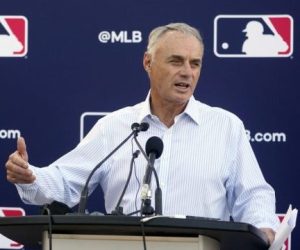
Rob Manfred announcing the cancellation of the 2022 regular season’s first two weeks. He has made clear his vision for the good of the game is making money for the owners and too little more.

I’ve quoted it often but it all but screams now. “We try every way we can think of to kill this game,” said Hall of Fame manager Sparky Anderson once upon a time, “but for some reason nothing nobody does never hurts it.”

That’s Anderson’s body among many now performing imitations of washing machine spin cycles in their graves, while their beings in the Elysian Fields pray today’s baseball owners haven’t pushed the game closer to its own.

“I had hoped against hope,” commissioner Rob Manfred said Tuesday evening, “I wouldn’t have to have this press conference where I am going to cancel some regular season games. I want to assure [baseball] fans that our failure to reach an agreement was not due to a lack of effort by either party.”

It was to laugh that you might not wish to commit manslaughter.

That was the man whom we are, as one Twitter denizen tweeted, “old enough to remember [saying] cancelling regular season games over his MLB #Lockout would be a disaster.” The disaster is of Manfred’s own and his bosses’s making.

That was the man whose bosses, the owners, compelled him to impose a lockout, just after midnight 1 December, when baseball’s previous collective bargaining agreement expired, rather than allow themselves and the Major League Baseball Players Association to continue operating the game under the former agreement while negotiating a new one.

That was the man who presided over 43 days’ worth of absolute dead silence from the owners’ side to follow. Dead silence, including nothing in the way of an offer from the owners to the players. Dead silence, but not oblivion.

Eyes unclouded by either cataracts or selectivity saw this was not dismissable as mere  billionaires versus millionaires. Eyes thus unclouded saw that Manfred claiming major league baseball franchises return less on what is invested to buy and run them was a shameless and shabby lie.

Eyes at full strength see that only 31.4 percent of the players’ union’s active major league membership earns more than a million dollars in a season, that 28.2 percent of that membership are minor league players on teams’ forty-man rosters who earn no more than $40,500.

“Player pay has decreased for four consecutive years, even as industry revenues grew and franchise values soared and the would-be stewards of the game pleaded to anyone who would listen that owning a baseball team isn’t a particularly profitable venture,” wrote ESPN analyst Jeff Passan on the day of Manfred’s first deadline for a deal without cancelling games.

Players’ service time has been manipulated to keep them from free agency and salary arbitration. The luxury tax, instituted to discourage runaway spending, has morphed into a de facto salary cap, and too many teams are nowhere near it anyway, instead gutting their rosters and slashing their payrolls because the game’s rules incentivize losing. The commissioner has called the World Series trophy a “piece of metal,” and the league has awarded the team that did the best job curtailing arbitration salaries a replica championship belt.

Eyes open wide saw that Manfred and his bosses are the (lack of) class attempting nothing short of its level best to push players further back toward what they were prior to 1975-76.

That was then: Curt Flood, in his courageous but failed bid to break the ancient abused reserve clause, proclaimed, “A $90,000 a year slave is still a slave.” And, Andy Messersmith, who finished what Flood started: “I was tired of players having no power and no rights.” This is now: Owners and their administrators, enough of whom originate in the corporate world, refer to baseball players as assets, commodities, elements, liabilities, pieces.

They wish you to forget that baseball is unlike the typical industry in which the worker bees make the products sold, because in baseball the worker bees are the product sold.

They also wish you to forget that a small market is in the eye and the adjusted ledger of the beholder. “There is no such thing as a ‘small market’,” tweeted Ben Verlander, an actor and the brother of future Hall of Fame pitcher Justin Verlander. “If you want a bigger market. Put more money into your team and make them competitive.” (The “small market” Pirates, believed among baseball’s premiere tankers, are worth $1.2 billion.)

Last weekend, negotiations dragged before Monday’s marathon sessions deep into the night enabled exactly what the players thought would occur, the owners refusing to budge more than milliliters if that far on any concessions the Players Association wanted to sign on the proverbial dotted line—and then propagating as Manfred ultimately did that by God they’d gone to the mattresses trying to get a deal.

This time, however, the players had an invaluable weapon in the PR wars. They weren’t shy about taking it to social media, any more than serious fans were shy about hitting the Internet running to fact-check any and just about every one of Manfred’s claims about the owners in serious binds. Finding them very wanting.

“If times are so tough for these clubs financially over the last five years,” tweeted Giants third baseman Evan Longoria Tuesday afternoon, “show us the financials. Be transparent.”

From the moment the lockout began through the moment Commissioner Nero announced the first two series of the regular season were cancelled—if not for his entire commissionership—he’s been very transparent about his view of the good of the game: making money for the owners, and precious little else.

Another future Hall of Fame pitcher, Max Scherzer, whose plainspokenness and willingness to put in sixteen-hour days at the bargaining table has impressed as much as he impresses on the mound, makes plain he’s not thinking purely of himself or the considerable dollars he’ll lose for every regular season day with an unplayed game.

“It’s about everybody else. I’m in a position to fight for those guys and sacrifice my salary to make this game better,” Max the Knife insisted to USA Today baseball columnist Bob Nightengale.

We all want to make the game better for the next generation behind us, and we’ll do whatever it takes to make that happen. The former players that fought for the game and fought for the players, I realized the benefits from that. I had an unbelievable career for all of the rights that everybody fought for, going back to Curt Flood. Now I have the opportunity to do that for the next generation.

“Scherzer and the union are fighting for pay for the young players who aren’t eligible for salary arbitration, seeking large raises in minimum salary and bonus pools,” Nightengale continued.

They are fighting to make sure that teams are actually trying to win and not to collect draft picks with a draft lottery. They are fighting to make sure that every team can freely sign free agents without a restrictive luxury tax, pointing out the absurdity of the San Diego Padres having a larger payroll than the New York Yankees. They are fighting to make sure the integrity of the regular season is not compromised, willing to accept a twelve-team playoff system, but not fourteen teams.

It would be even better if Scherzer and his fellows, and Nightengale and his fellows in the baseball press, also remembered a particular group among the former players who fought for their brethren and for the game itself and who deserve considerably more attention than either the Players Association or the owners have paid.

There remain 525 former major leaguers, playing prior to 1980 but whose careers were short for assorted reasons, frozen out of that year’s pension re-alignment, but who were gained $625 per 43 days’ major league service time in a 2011 deal between the late Players Association director Michael Weiner and then-commissioner Bud Selig, worth up to $10,000 a year for them depending on their actual major league time.

Those players—including 1969 Miracle Mets Rod Gaspar and Bobby Pfeil and former Rangers fresh-from-high-school pitching phenom turned mishandled David Clyde—didn’t receive those annual stipends as they should have in February, also thanks to the owners’ apparent baseball death wish.

“The owners . . . still they couldn’t help themselves, couldn’t resist going for the throat,” writes The Athletic‘s Ken Rosenthal. “They, too, could end up net losers, depending upon how much [baseball’s] place in the entertainment landscape is diminished. But they seemingly would rather take that risk than satisfy the players who pitch and hit and make teams so valuable.”

The day you see baseball fans walking about wearing jerseys with names on the back such as Angelos, Crane, Lerner, Liberty, Monfort, Moreno, Nutting, Guggenheim, Reinsdorf, Ricketts, or Steinbrenner, among others, is the day you should see swine in the colours of American Airlines.

“They may not break the union,” writes Rosenthal’s fellow Athletic scribe Andy McCullough of Manfred and his bosses. “But they will break something.” They already have. They’ve broken the heart of a nation starved for the sort of post pan-damn-ic normalcy that baseball alone might provide.