On the other hand . . .

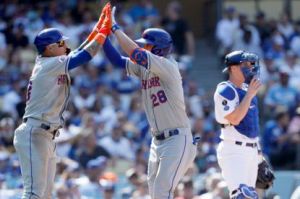
Javier Baez, J.D. Davis

The Good Javy (left, after scoring on J.D. Davis’s [center] two-run bomb in the seventh) returned from the injured list and doubled down against the Dodgers Sunday afternoon.

This time, J.D. Davis didn’t shrink. Either with one man on or with the bases loaded.

This time, too, trade deadline addition Javier Baez came off the injured list, swung like a pro, scored like a pro, and doubled down, literally. He put a small shot of rocket fuel into a team looking like the living dead too often this month.

This time, the Mets may have left eight men on but they also sent seven runs across the plate. They’ve now done that only twice since 21 July. And, this time, too, they didn’t let the Dodgers take a single lead all Sunday long.

The bad news is that Sunday’s 7-2 win to stop the Dodgers’ winning streak at nine probably won’t be enough to salvage the Mets’ 2021. They’d need a finish from here that you can describe politely as miraculous to do that. Losing eleven games in the standings this 6-15 doesn’t leave room for miracles.

But let’s worry about that later. Right now, let’s savour Baez cashing in Brandon Nimmo (leadoff full-count walk, on which he sprinted up the line to first) with one out, sending one ricocheting off the left center field fence in the top of the first, with Nimmo gunning home all the way from first.

Let’s savour Davis shooting one the other way up the right field line to send Baez home, and Jonathan Villar with two outs punching a quail into short center, Davis scoring when Cody Bellinger’s throw in brought Dodger catcher Will Smith well out in front of the plate.

Let’s savour Villar trying to take second on the throw in and Smith throwing wild enough to let Villar have third on the house, before a foul out caught by Dodger starter David Price ended the inning at three for the Mets.

Let’s savour the Dodgers getting only a pair back in the fourth, when Bellinger reached Mets starter Marcus Stroman for a two-out, two-run line single to right, making Stroman pay for walking the bases loaded ahead of Bellinger—whose season has been compromised badly by a couple of nagging leg issues and not having been able to recuperate properly from off-season shoulder surgery.

Let’s savour the Mets catching Bellinger in an inning-ending rundown out, catcher to short, Baez playing his old position in Francisco Lindor’s absence, feinting a throw toward third to keep A.J. Pollock from even thinking about a score before tagging Bellinger as he tried turning back toward second.

Let’s savour Stroman managing to keep the Dodgers at bay long enough for Baez to hustle a single into a double after two swift outs in the top of the seventh and Davis, right behind him, hitting the first pitch he saw from Dodger reliever Phil Bickford on a line over the left field fence.

Let’s savour the Mets loading the pads with one out in the top of the ninth off Dodger reclamation project Shane Greene—Nimmo’s base hit to right, Pete Alonso taking another plunk for the team, then Baez taking another plunk for the team.

And let’s savour Davis yet again, a day after he’d swung through a Max Scherzer meatball with the bases loaded for a strikeout. This time, Davis recovered promptly from falling into an immediate 0-2 hole. He wrung his way from there to a walk on four straight balls, resisting the temptation to pull the trigger on a sinker that sunk just a little too far below the strike zone floor for ball four and Nimmo trotting home.

But let’s not fool ourselves. These Mets may have a few energy reserves left, but there’s just a little too much still missing to give them much more than prayers. On paper, they’re only seven games out of first in the National League East. On the field and at the plate, Sunday’s showing is what they’ll need only every day from now on, practically, to have the prayer of even a prayer.

It may require what they may not have the rest of the way.

So just spend today thinking about Baez maybe playing his way into an extension that would keep him around the keystone with Lindor, when Lindor returns days from now.

Think about the Good Javy re-joining Lindor to turn the second base region into the swamp where base hits get sunk into ground outs. Lindor may have struggled at the plate this year but he remained a shortstop Electrolux. (Thirteen defensive runs above the league average shortstop before he was injured.)

Think about the Good Javy who turns the plate into his personal game-changing playpen, providing an energy jolt through this team that not even Con Edison could deliver, just the way he did Sunday afternoon.

Don’t think about the Bad Javy who chases pitches that deserve to escape, the one who tries a little too often to hit eight-run homers on pitches that provide the power just by the bat giving them a kiss. Not until or unless he shows up again, that is.

Think about the Good Javy outweighing the Bad Javy enough to convince Mets owner Steve Cohen it’ll be worth it to keep him around and use him as the perfect out to purge Robinson Cano, who’s due back for 2022.

Don’t say the Mets “will eat” Cano’s money for the final two years of his deal. That meal already went through the digestive tract and out the other end. They accepted him as part of the deal when they wanted relief pitcher Edwin Diaz that badly from the Mariners. Once his current suspension ends, Cano’s going to get paid whether or not he suits up for the Mets again.

Cano isn’t the defensive second baseman he used to be. He hasn’t been the hitter he once was since 2016, either. That’s something to ponder especially if wisdom finally prevails otherwise and the designated hitter finally becomes universal to stay.

The Mets may not be that inclined to have back a 38-year-old millstone drydocked an entire season over actual/alleged performance-enhancing substances, his second such suspension in four years. The Good Javy showed up in time Sunday to start helping make that decision so simple for the Mets that even Joe Biden could make it without screwing the proverbial pooch into a blood bath.

Bases full of Mets? You’re off the hook.

J.D. Davis

J.D. Davis would love to have back that Max Scherzer meatball with the bases loaded in the fifth.

You hate to add to whatever inner misery comes into play for him. But J.D. Davis has spent this weekend making himself a prayer for the opposition. Bases full of Mets? Pray that Davis is the next man up. You can breathe again.

Missing about two months from May through past the All-Star break with a wrist injury has hurt like hell. It’s done Davis no favours, and it’s hurting the Mets in places where they need help, not hurt.

Friday night: Dodgers ace Walker Buehler left first and third for his relief Alex Vesia, after Pete Alonso caught a huge break when a ball he hit off his foot was ruled no foul and enabled him to beat out a run-scoring grounder. Vesia promptly walked Michael Conforto to load the pillows.

Up came Davis with the Mets down now by a single run. Ahead in the count, 2-1. Fastball rising—swing a shade too soon, swish. Fastball falling—Davis kept the bat on his shoulder and the ball barely hit the strike zone floor. Side retired, 3-2 Dodger win held up.

Saturday afternoon: The Mets down 3-0 to open the top of the fifth against Max Scherzer. Make that 3-1, after Brandon Nimmo hit one out. Jeff McNeil doubles to right. Alonso himself gets hit on the arm by a pitch. Conforto goes from 1-2 to three straight balls.

Pads padded. The Mets have Max the Knife going rope-a-dope. Up steps Davis. Another 2-1 count. Looks at a pitch just off the middle—called strike. Gets an unlikely meatball down the pipe—fouls it off. Gets damn near the same pitch next—swings right through it for strikeout, side, and the Dodgers clinging with their lives to that 3-1 lead.

That lead became 4-1 after Mets reliever Miguel Castro, relieving starter Rich Hill to open the Los Angeles sixth, surrendered a leadoff base hit to Dodger pinch hitter Matt Beaty, then walked the bases loaded and a run home. Leaving Jeurys Familia to enter the burning building and get the Mets out alive with a pop out behind second base, a fly out to somewhat deep right, and a force out at second.

Leaving Nimmo himself wondering perhaps what he might have to do, short of bribery, to arrange men on base when he’s at the plate later in the game. He ended his day a triple short of the cycle, the Dodgers unable to get rid of him until reliever Blake Treinen caught him looking at a third strike barely on the floor of the zone in the seventh. His first-inning double opened the game; his third inning single came with one out and nobody on in the third.

And, of course, no Met managed to reach base in the fifth until after Nimmo fouled off a fastball to open with two out in the first before pulling an inside Scherzer service into the right field bleachers.

There’s no point in singling one long-haul culprit out. These Mets overall have been a mess since Jacob deGrom went down for the count yet again, and maybe for good this season, in early July.

One big reason is their inability to hit with the bases loaded: holding a .208 average in that situation, the fifth lowest in the Show, isn’t the way to win games. Especially when the other guys are hitting .292 against them with the bases loaded.

Castro walking the bases loaded and then walking Beaty home ended up being the difference Saturday—Alonso’s two-out, seventh-inning blast into the left field bleachers with McNeil aboard gave them their second and third runs. The Mets put a man aboard in each of the eighth and the ninth and stranded both.

Things weren’t exactly helped when Hill opened by surrendering a leadoff bomb off the top of the left field fence to Trea Turner opening the bottom of the first and, one fly out to deep center later, a first-pitch yank over the center field fence to ancient Albert Pujols, to put the Mets into an almost-immediate 2-0 hole.

At 41 years old each, Hill vs. Pujols weren’t quite the oldest pitcher-batter matchup to end in a home run in Show history. That belongs to Julio Franco and Hall of Famer Randy Johnson. Thanks to my sabermetric friend Jessica Brand, I learned The Big Unit was a young turk at 43 when Franco, then a measly 49 and a Met, no less, turned on an 0-2 service in the top of the second and drove it over the left field fence. It was the 173rd and final home run of Franco’s career.

With 92 years of age between that pair, there’s something to be said for respecting your elders.

Davis himself is 0-for-6 with six strikeouts when he hits with the bases loaded this season. If you take Mets manager Luis Rojas at his word, Davis is pressing it too hard when he checks in at the plate with chances to do major damage. “Sometimes, guys tend to get anxious,” the skipper told MLB.com’s Anthony DiComo after Saturday’s loss.

I use J.D. as an example with the bases loaded in that situation; he was trying to do too much. He was trying to gather a little bit too much. It caused him to be late on a fastball. That’s probably from a mental standpoint what happens, you just get a little anxious because you have the bases loaded. It’s a key situation. There’s an adrenaline rush, and sometimes you drift away from your approach of being aggressive in the zone, which is what we preach here.

Davis wasn’t even trying to murder the ball. As peculiar as this might sound to those dismissing this year’s game as just a bomb-or-bust offensive game, neither the Mets nor the Dodgers tried hitting six-run homers in every plate appearance. Even with six of the game’s seven runs scoring on home runs, there was about as much hard ground contact as air lifting between the sides Saturday afternoon.

It’s not that the National League East is a division full of invincibles. But the Mets held the division’s ownership papers despite their glandular injury issues until very recently. They’ve now lost seventeen of twenty-three; they’ve fallen two games below .500; they’re seven back of the now division-leading Braves almost a month after they led the division by four.

It got bad enough for the Mets at the plate that new owner Steve Cohen—who’d shown the patience of Job up to that point—zapped them for their inconsistent hitting aboard Twitter during the week just finished. In cold print, it looked like a mini-tirade. In actuality, we’re not exactly talking about a certain late Yankee owner.

Cohen didn’t throw out the first manager of the year. He didn’t even really single any particular Met out for embarrassment. He didn’t demand an apology to the city of New York or build a guillotine outside Citi Field. He didn’t compare any pitcher to a horse who spit the bit; he didn’t dismiss his best power hitter as Mr. May.

He didn’t do anything, really, except get Rojas and injured shortstop Francisco Lindor—the off-season splash signing whose bat’s been inconsistent but whose defense has been off the chart (he was worth thirteen defensive runs before his injury)—to say he was right about the bats.

The fact that the Mets didn’t exactly hog the headlines at the trade deadline lingered in the back of some minds, too.

The Mets’ immediate response to Cohen’s comparatively benign bop was to beat the Giants in twelve with a three-run homer (Kevin Pillar) and an RBI double (freshly called-up Chance Sisco, pinch hitting). From there, it’s three straight lost to the Dodgers with one more to play Sunday before a cross country trip home to host the Giants.

It may also be one of the only periods in which you might hear Met fans saying to themselves, “We have the bases loaded? We’re doomed.”

Bauer wins . . . nothing much, really

Trevor Bauer

Bauer in the shadows. He isn’t even close to being off the hook yet. Nor should he be.

Read very carefully. Under MLB’s formal domestic violence policy, commissioner Rob Manfred can still discipline Dodger pitcher Trevor Bauer. Even if a woman accusing him of taking consensual rough sex into non-consensual territory was denied a permanent restraining order Thursday. Even if no criminal charges end up being filed.

Bauer’s been on paid administrative leave since 2 July. The leave was extended yet again, with full agreement between MLB and the Major League Baseball Players Association, this time through 27 August. With Pasadena police still investigating—criminal charges remain a distinct possibility—and Manfred’s office doing likewise, it’s fair to assume Bauer won’t pitch again this season.

Los Angeles Superior Court Judge Dianna Gould-Saltman agreed that “injuries as shown in the photographs” the woman’s legal team provided of her aftermath from Bauer encounters “are terrible.” The judge went on: “If she set limits and he exceeded them, this case would’ve been clear. But she set limits without considering all the consequences, and respondent did not exceed limits that the petitioner set.”

I seem to remember the victim saying it was one thing to have a mutually brutal round of rough sex with Bauer but it was something else again for him to keep it up when she was out cold. Unless I’m very wrong, when you’re out cold or sound asleep you can’t exactly say “yes” to something, anything, competently or with knowledge. You don’t need to be a legal beagle to know that.

At the moment,” tweeted Bill Shaikin of the Los Angeles Times, “MLB and police investigations continue, with focus not on whether Bauer should be restrained from contacting accuser going forward, but on whether previous conduct alleged by accuser merits criminal charges and/or MLB suspension.”

Sheryl Ring, an attorney who devotes a considerable amount of her time to watching and analysing baseball, writes that—pace his social media sycophancy crowing that he beat the rap and should be back on the mound post haste—the only thing Bauer really won Thursday was the right not to be blocked from contacting the lady in question in the future.

He’s not even close to being off the hook for what he did to her in the past. Yet.

Ring agrees the lady and her legal team tripped over themselves a few times during the hearings, particularly over the consent issue. “You can lose a case on an inaccurate statement in a sworn pleading, even on a collateral issue, and that clearly weighed heavily on the judge here,” she writes. “Finally, they elected not to have their expert witness testify on the issue of consent even after briefing the issue and winning that briefing, which I think was also a mistake.”

But Gould-Saltman also made a crucial mistake in her ruling, Ring continues:

Right after saying at the beginning of her ruling that future harm was not necessary to the issuance of a restraining order, she talked about how there was no need for a restraining order because there was no risk of future harm. She also, in my opinion, incorrectly applied the law of consent when it came to this line:

If she set limits and he exceeded them, this case would’ve been clear. But she set limits without considering all the consequences, and respondent did not exceed limits that the petitioner set.

Given a phone call was played in which Bauer admitted to punching the petitioner whilst she was unconscious, what the court stated is an incorrect statement of the law. You cannot give consent to anything when unconscious. In my opinion, that’s reversible error and grounds for a potentially meritorious appeal.

If Gould-Saltman could rule the lady didn’t make her boundaries “clear,” perhaps the judge would like to explain how she was supposed to keep making them clear, or to stop Bauer from crossing the line further when she was in dreamland—when she was in dreamland in fact after Bauer choked her unconscious with her own hair—while he crossed that line.

One of the worst-kept secrets throughout this entire disgrace is that there may be no one in a Dodger uniform who wants Bauer back with the team no matter how well he pitched before 2 July. The Dodgers themselves have legal recourse to rid themselves of him.

The standard, uniform player’s contract includes 7(b)1: they can terminate Bauer’s deal if he “fail[s], refuse[s] or neglect[s] to conform his personal conduct to the standards of good citizenship and good sportsmanship or to keep himself in first-class physical condition or to obey the club’s training rules.”

Paragraph 7(b)1 isn’t exactly an obscure or a previously-unapplied contract clause. When pitcher Denny Neagle got caught soliciting a woman for oral sex in 2004, the Rockies invoked the clause to terminate his five-year, $51 million deal. (Neagle missed pitching in 2004 due to ligament and elbow injuries.)

The players association filed a grievance in that case and it was settled in due course with the Rockies paying about 7/8ths of Neagle’s 2004 salary. Neagle’s marriage ended over the incident; he signed a deal with Tampa Bay for 2005 but didn’t pitch because of elbow issues and subsequently retired.

The Dodgers stand on far more solid ground if they elect to terminate Bauer’s deal with them. If they want to invoke 7(b)1 and cite MLB’s domestic violence policy, all they have to do, as Ring points out, is ask MLB’s permission—and if it’s permission denied, the Dodgers can do it anyway.

A man who likes his sex on the rough side and a lady who wants it likewise from and with him are merely kinky, in politest possible terms. A man who’d choke her out cold, then take her from the rear and punch her between the legs, is beyond mere depravity.

“This is, by far, the most serious case yet for MLB of an alleged violator, and it’s not close,” Ring writes.

No other person was accused of multiple violations against multiple victims. No other case . . . had this much court evidence. No other alleged violator so dramatically attacked their accusers in the press, either. The longest suspensions ever meted out for violations of the domestic violence policy were to Sam Dyson (a full season) and Jose Torres (100 games); as horrifying as the allegations were in those cases, this is somehow worse than both of those cases, and it’s not close. Notably, in none of the other domestic violence cases were multiple orders of protection sought by multiple people against the same player.

The last alludes to the revelation from the Washington Post, last week, that an Ohio woman also sought a restraining order against Bauer in 2020. She, too, accused Bauer of punching and choking her without consent during sex. Some winner.

Bauer prevailed regarding the restraining order in California, Ring writes, “by arguing that he is so dangerous that a woman who agrees to have sex with him assumes the risk of being harmed when doing so. And he made a great spectacle of dragging through the mud the woman he admits to having punched whilst she was unconscious.” Some model citizen.

Ring may not be the only legal-minded, legal-oriented baseball analyst to think it’s not out of the question that Manfred might consider suspending Bauer for two years. Effectively, that would wipe him out as a Dodger, since his current deal has two more seasons to go.

Practically, it might end Bauer’s life as a major league pitcher, period. But that would assume no other team would even think about plighting its troth to a man for whom women are little more than playthings with targets on their lady parts. We’ve known only too well what happens when you [ass][u][me].

“The inconsistencies Bauer’s attorneys elicited from the accuser spoke to secondary and surrounding matters — how she reacted to the assault — and not at all to the assault itself,” writes Craig Calcaterra, formerly an NBC Sports baseball analyst now writing the newsletter Cup of Coffee.

The text messages show a person who is at turns confused, angry, sad, depressed, or desiring vengeance, but those are all understandable feelings for a person in her situation to have. What Bauer’s attorneys did not do at all was discredit the central claim that he assaulted her in horrible ways.

. . . [T]he central truth of this entire affair — the stuff that Major League Baseball will look to regarding Bauer’s behavior, irrespective of whether [criminal] charges are brought — points pretty clearly to Bauer doing exactly what his accuser said he did. Everything else is secondary.

After 12 hours of testimony, his accuser said, under oath, “I did not consent to bruises all over my body that sent me to the hospital and having that done to me while I was unconscious.” There was zero evidence presented which explained how those bruises appeared in a way that was benign or refuted the idea that the woman was unconscious when Bauer inflicted them. That, in my mind, is all that matters.

Small wonder Brewers pitcher Brett Anderson could and did tweet, “Crazy to think that I could never get anyone out ever again and still feel better about my career than Trevor Bauer’s.” Indeed it is better to surrender six runs in three and a third innings than to be known for abusing women, violently or otherwise.

Crazy Joey Votto, Cooperstown bound

Joey Votto, looking like a man infected with a combination of St. Vitus Dance and laughing gas. If it helps get him to Cooperstown, he won’t complain.

This is the kind of person Joey Votto can be. One minute, he’s his own kind of crazy. Especially with a bat in his hands. The next, he’s . . . well, the word is onorevole in Italian. In Yiddish, the word is mensch.

On 19 July, in San Diego, Votto fumed over a call at the plate in the first inning, resulting in himself and Reds manager David Bell being tossed. Votto thought he’d checked his swing on a 1-2 pitch missing up and away. The plate umpire sought help; the third base umpire said Votto went. Replays showed it was hair-thin close. It could have gone either way.

Votto and the arbiters kept it civil until the third base ump, apparently, said something to trip Votto’s trigger. Votto could be seen (and heard?) saying, “what the (fornicate)?!?” The plate ump interjected, as if to suggest Votto had no business talking to the third base ump. Bell hurried out to protect his player to no avail. Both got sent to bed without their supper.

In the Petco Park stands (the Reds were playing the Padres), a six-year-old Los Angeles girl named Abigail—wearing a Votto T-shirt, attending her first live major league game—cried because she wouldn’t get to see her hero play all game long. Another fan tweeted a photograph of Abigail in tears.

Somehow, someone on the Reds caught the tweet and made Votto aware of her. So he sent Abigail a ball he signed, “I am sorry I didn’t play the entire game. Joey Votto.”

The next afternoon, there were Abigail and her family in the Petco field boxes, courtesy of Votto and the Reds. Votto went out of his way to meet her, in her Reds T-shirt and a large bow with baseball stitching in her hair. He signed anything she handed him and left her with a grin about equal to the distance of a textbook Votto line drive hit.

Now, this is the kind of baseball player Abigail picked as a hero: As the irrepressible Jayson Stark has exhumed, Votto’s one of only six players in Show history to lead his league in on-base percentage seven times or better. He’s done it seven times. The other five: Ted Williams (twelve), Babe Ruth (ten), Barry Bonds (ten), Rogers Hornsby (nine), and Ty Cobb (nine). You may have noticed all but one of them are Hall of Famers.

A Canadian who grew up with a poster of Williams tacked on his bedroom wall, Votto will be a Hall of Famer in due course.

Spare me the lack of three thousand hits (he isn’t likely to reach that number) or five hundred home runs (he isn’t likely to get there, either). The Hall of Fame was supposed to be about greatness, not raw totals. With two more years on his current Cincinnati contract and at age 37, Votto isn’t going to join the 500 bomb club or the 3,000 hit club unless he swings a telephone pole for a bat before he’s Jack Benny’s (alleged) age.

But he’s going to be remembered for all-around greatness. The sole legitimate question around Votto’s Hall of Fame case is whether he’ll make it on the first try or have to wait a few.

As of Wednesday morning Votto’s was A Space Odyssey hit total: 2,001. Guess what. According to my Real Batting Average (RBA) metric (total bases + walks + intentional walks + sacrifice flies + hit by pitches), if Votto’s career ended the instant I wrote the words he’d become the number three Hall of Fame first baseman whose career came entirely or mostly in the post-World War II/post-integration/night-ball era:

HOF First Base PA TB BB IBB SF HBP RBA
Jim Thome 10313 4667 1747 173 74 69 .653
Jeff Bagwell 9431 4213 1401 155 102 128 .636
Joey Votto 7978 3433 1265 143 46 63 .620
Willie McCovey 9692 4219 1345 260 70 69 .615
Harmon Killebrew 9833 4143 1559 160 77 48 .609
Orlando Cepeda 8698 3959 588 154 74 102 .561
Eddie Murray 12817 5397 1333 222 128 18 .554
Tony Perez 10861 4532 925 150 106 43 .526
HOF AVG .597

Stark narrows his seven-or-more OBP titlist list to those who won seven in any ten-year period. The list shrinks to Hornsby (eight), Williams (seven), Ruth (seven), Cobb (seven), and Votto (seven). “How’s that,” Stark asks, knowing the answer good and well, “for a Mount Rushmore of OBP?”

How’s this, too, for a winning player? Baseball-Reference says the Reds would win 75 percent of their games if they could run a lineup of nine Joey Vottos to the plate. Since they’re playing a 162-game season this year, that would equal 122 wins. A Reds lineup of nine Vottos wouldn’t be eight and a half games behind the National League Central-leading Brewers. But they might be about 28.5 games ahead.

You might care to know, too, that among active players the guy Reds fans call Vottomatic is number two for career OPS+ with 148. That’s 27 points behind the active leader. A fellow (albeit still on this year’s injured list) named Mike Trout. You can do an awful lot worse than pull up second behind Trout.

Allow me to tell you what RBA says about Votto by leverage. We’re talking about the most game-on-the-line moments in which Votto’s checked in at the plate over his entire career through this morning. No one can premeditate the situation in which a batter will step up to the plate at any time–unless he’s being sent out to pinch hit. But RBA says Votto’s one beast you wish you could save for premeditated high-leverage plate appearances:

Joey Votto PA TB BB IBB SF HBP RBA
High leverage 1510 687 274 77 19 13 .709
Medium leverage 2769 1140 442 30 22 21 .598
Low Leverage 3699 1606 549 36 5 29 .601

Essentially, he’s the same batter overall in low as in medium leverage, adjusting for a few particulars. (His combined RBA in those two situations: .600.) But he’s 109 points more monstrous in the highest leverage moments, the moments when the game’s likely outcome is most squarely on the line or close to it.

As a defensive first baseman? A guy who’s 55 defensive runs saved above his league average, lifetime, isn’t exactly lame with the leather out there. He’s not the rangiest first baseman ever to patrol the pad—but neither was Lou Gehrig. He’s gotten the job done and then some. He’s probably also used the position to keep fans at home and on the road entertained with more than a few amusing quirks and tricks.

Small wonder fans in road ballparks forgive Votto his periodic needles and horseplay at their expense. (He once needled a friendly road fan with, “I remember you when you used to be thin.”) Small wonder young fans like little Abigail in San Diego weep when he gets tossed too early for arguing with umpires who still think (erroneously) that they’re Gods, Jr.

Small wonder, too, that fans such as another young girl in Atlanta last week think they can will Votto to prolific evenings.

A week ago, the Braves beat the Reds in eleven in Truist Park, 8-6. Votto did everything he could think of, short of spiking the Braves’ Gatorade with a liquid sedative, to enable a Reds win. He had a little help from his new young friend, to whom he gave his game jersey as he walked off the field following Ozzie Albies’s game-ending three-run homer.

What a surprise he’d do that: She coaxed him all game long. Votto swore the young girl called every one of his four hits on the night: a line single to somewhat deep center in the top of the first, a two-run homer in the top of the sixth, a line single to right setting up first and third in the top of the seventh, another two-run homer in the top of the ninth to tie the game at five. (Apparently, she didn’t call the full-count, bases-loading walk he coaxed out of Braves pitcher Touki Toussaint in the top of the third.)

The fact that both homers made Votto the first Red since Hall of Famer Frank Robinson to hit fourteen bombs in a twenty-game stretch—after becoming the eighth in Show to hit one out in seven straight games—was almost irrelevant. Almost.

“We made an agreement before every at-bat,” Votto told the press after the game. (When you like us, we’re the press. When you hate us, we’re the media.—William Safire.) “I talked to her a little bit mid-at-bat and she was screaming at me and supporting me. I’m not sure if it’ll end up on social media, but she was incredibly supportive despite lots of people that were not on her side. We almost did it together.”

Just another night at the park for Crazy Joey Votto, also known as future Hall of Famer Onorevole Mensch.

To improve or not to improve, that is the question

Field of Dreams Game

The Field of Dreams Game in Iowa got boffo ratings on Fox Sports . . . but Iowans who don’t subscribe to Fox still couldn’t watch on other TV/streaming outlets. Blackouts are just one thing baseball needs to fix.

“Congratulations,” ESPN’s Website begins, “you’ve been named acting commissioner of Major League Baseball for a single day.” That’s the way the site presented eight of its major baseball writers presenting eight individual propositions answering the question of what they’d change to improve the game on field and off.

I’ve got some thoughts of my own about the eight and maybe one or two more that weren’t discussed during that symposium published Tuesday morning. It’s not that I’m angling for Rob Manfred’s job, never mind how often it appears that a paramecium could do it better than he does.

But here goes, with the ESPN writer who addressed the matter in parentheses:

1) Shortening the season. (Jesse Rogers.) I’m on board . . . with a 154-game season. The 132-game season suggested almost in passing is too short. I get the impetus: football arrives, other sports’ seasons begin during baseball’s postseason. Unless you have skin in a team’s game it’s no fun to watch them out of the race playing games with no real meaning other than watching the prospects.

Now, make the shorter season mean something above and beyond the necessary considerations of player health: fix the postseason. Be done with the wild card system. Make it mean real championship play again. More after taking on . . .

2) Expansion and geographic re-alignment. (Bradford Doolittle.) Thirty-two teams isn’t necessarily a terrible idea. Neither is the thought of two leagues with eight-team divisions aligned according to their home regions.

But there’s no need to change the names of the National League and the American League as the writer suggests. (I’m all in favour of doing away with “traditions” whose legitimate usefulness disappeared well before the Edsel came and went, but this one’s not exactly begging for extinction.)

I’m not on board, either, with two four-team “pods” within each division or with allowing what the writer suggests further: six teams per league playoffs. That’s knocking on the door of the postseason mishmosh polluting the NBA and the NHL.

Now we can talk about being done with the wild card system. In two-league, four eight-team-division baseball, we can return to the original divisional era postseason format: the division champions meeting at once in a best-of-five League Championship Series, and the World Series remaining its seven-game self.

Voila! You’ve also solved one of the main reasons why even thinking people become exhausted with the thinking person’s sport—saturation. By the time we get to the World Series now, even the most stubbornly die-hard baseball fans have all but had it for the year. Shorter season, shorter postseason with real championship play? All aboard!

You also have a fine reason to do away with regular-season interleague play once and for all. Save it for the All-Star Game and the World Series. Regular-season interleague play’s become a “tradition” even the most stubborn modernist shouldn’t mourn.

All the above might also put to permanent bed the idea of tanking teams. Let’s see how anxious they are to tank when they realise you now have only two choices: finish the regular season with your butts parked in first place, or wait ’till next year.

3) The pitch clock. (David Schoenfield.) Make it 25 seconds and I’m in. (It’ll keep the batters in the box, too.) But continue to refuse eliminating the broadcast commercials for every pitching change (one more time: it takes less time for relief pitchers to come in from the bullpen than to run those spots), and I’m out.

You can’t have one without sacrificing the other. The overall good of the game is not the same thing as just making money for it.

Hey, want another way to speed up the game that wasn’t born to be played according to a time clock? How about eliminating the eight warmups on the mound when a pitcher comes into a game in the middle of a jam?

Think about it: He’s already thrown the possible equivalent of a four- or even five-inning assignment getting warmed up. He’s already hotter than hell when he comes in from the pen. Let him get right to work, he’s ready. You’ve just shaved another 30 seconds to a minute off the time of the game. Incredible, ain’t it?

4) Bring in the robo umps. (Jeff Passan.) Too much has been too much more than enough. I’m sick and tired of watching a game, seeing too many blown calls, and umpires with their individual “interpretations” of the strike zone. The umps need to be reminded—with a ball-peen hammer to their heads if need be—that, pace the late Ron Luciano, they are not God out there.

There’s only one man on the field who actually does get to make an individual strike zone—the batter, with his stance at the plate. There’s no uniform batting stance. But there is a rule book definition of the zone. If Robby the Umpbot’s going to get right what Evil Angel Hernandez, Country Joe West, and their ilk can’t or won’t, then finish ironing out the bugs and put Robby on the job at last.

“It is not easy,” Passan notes, “because umpires who get 95% of ball-strike calls correct are considered the best of the best, and umpires who get 85% right remain employed, and every single day there are manifold examples of balls that are called strikes and strikes that are called balls.”

Luddites who refuse to allow technological assistance on behalf of getting it right—especially when championship advance or consummation is squarely on the line—are hereby invited, with apologies to the late William F. Buckley, Jr., to send their complaints in stamped, self-addressed envelopes.

5) End streaming blackouts and loosen video rights restrictions. (Joon Lee.) Sound as a nut. Ancient history teaches how trepiditious owners then were when broadcasting came to baseball in the first place. Their fears were proven unfounded.

But the blackouts remain, wrongly. There’s no reason why Iowans who couldn’t afford to trek to and buy their way into the Field of Dreams field for last week’s Yankee-White Sox game there should have been denied the chance to watch live on MLB.tv or any other network.

There’s also no reason why Iowans still can’t watch the White Sox, the Cubs, the Twins, the Brewers, the Cardinals, or the Royals. Or even the Tigers. There’s no reason why people in Vegas can’t watch the Dodgers, the Angels, the Padres, or the Diamondbacks. It’s not like they can just jump in the car and make that quick-and-dirty four- to five-hour trip to the ballpark.

Let television and the Internet ring. Let any fan anywhere watch any game he or she damn well pleases. While we’re at it, Lee is right about this, too: Social media’s here to stay, for better or worse. Baseball should “make creating baseball-themed videos using game content as seamless as possible by loosening its reins on copyright violations — similar to the NBA, which treats user-generated content like free advertising for the sport.”

It also helps baseball solve knotty problems in the bargain. Or did baseball’s government forget how social media’s more deft denizens helped provide incontrovertible corroboration for what became Astrogate?

6) Allow trading of draft picks. (Kiley McDaniel.) Why the hell not? If you thought this year’s draft got more attention than prior baseball drafts, imagine the attention (and the concurrent revenue jolts) when you can see baseball teams dealing picks the way they do to a fare-thee-well in other team sports.

It’d also give scouting a badly needed booster shot and pump up even more interest and intrigue around the College World Series.

7) Pay minor leaguers a living wage. (Alden Gonzalez.) There should be no argument here. It’s one thing to insist players need to make their bones and put in their development time, but it’s something else to continue insisting they should do it while starving to death in roach motels. Especially with the pan-damn-ic exacerbating minor leaguers’ housing issues.

The romance of the long bus trips and the cheap sandwiches is long gone. We don’t have to make what’s left of the minor leagues life on the Riviera to acknowledge reality and compel baseball’s government to break the synonymity between dues-paying development and depraved deprivation.

8) Rethink the commissioner’s role. (Tim Keown.) The commissioner shouldn’t be just the owners’ manservant. On the other hand, neither should he or she (and if Kim Ng can do a grand job in her first year as the Marlins’ general manager—she did boffo business at the trade deadline—who says a woman can’t oversee the entire game?) be anyone’s man- or maidservant?

To do that, of course, would require a shift in the choosing: There’s no reason on earth why the commissioner shouldn’t be chosen from a vote of the owners, the players (through their team representatives), and the umpires. They’ve all got the skin in the game; the commissioner should be the steward of the entire game, not just its owners and administrators.

And who should be the next commissioner? Keown says it better than I could: a man or woman “whose relationship to the game goes deeper than financial concerns, someone who stands for something other than sponsorships and real-estate deals for billionaire owners. Someone who understands there are constituents–in the game’s operations departments, in the clubhouses, in the stands–who actually like the game for what it is, and not for how much can be extracted from it.”

It sounds a lot like A. Bartlett Giamatti, no? Well, we can’t bring Giamatti back from the Elysian Fields, but if we can’t find a man or woman who comes close enough to that spirit, then we’re as hopeless as this year’s Diamondbacks, Orioles, and Pirates.

I’ve got a ninth proposition. Sorry, but you knew I wasn’t going to let this one pass:

9) Make the designated hitter universal, once and for all, no looking back. The pitchers’ 2021 slash line as of this morning is .107/.147/.138. Since the last decade of the dead ball era, they’ve hit .154 overall. I’ve said it before, I’ll say it again: they’ve made Mario Mendoza and Willy Miranda resemble Mickey Mantle and Willie Mays.

One more time, from the now-retired Thomas Boswell: “It’s fun to see Max Scherzer slap a single to right field and run it out like he thinks he’s Ty Cobb. But I’ll sacrifice that pleasure to get rid of the thousands of rallies I’ve seen killed when an inning ends with one pitcher working around a competent No. 8 hitter so he can then strike out the other pitcher. When you get in a jam in the AL, you must pitch your way out of it, not ‘pitch around’ your way out of it.”

It’s also not. fun. to see them drop sacrifice bunts that waste precious outs to work with, give the other guys a little extra breathing room, with no guarantee that the guy who was just pushed along one base is going to come home. (Prove Keith Law wrong, too: “I have yet to meet the fan who bought a ticket to a major league game,” he’s written, “because she really wanted to see guys drop some sac bunts.”)

Not when you’re sending about 99.9 percent pool-noodle bats to the plate to kill rallies when their counterparts can pitch around good number-eight bats to strike their asses out for the side under normal circumstances.

And forget the idiot who commented in The Athletic‘s comment section that the most “exciting” thing in baseball in the five years was Bartolo Colon’s home run in San Diego five years ago. (Clearly, the idiot slept through a few postseasons, 2016’s and 2019’s in particular.)

It was unlikely. It was once in a lifetime, literally: Colon ordinarily couldn’t hit with a telephone pole. It took him from the beginning of the second Clinton Administration to just before Donald Trump’s consecration as the 2016 Republican presidential nominee to hit it. It was a laugh and a half, watching Colon run the bases at the speed of snail resembling a beach ball with legs.

And it was no more a mic-drop reason to keep sending pitchers to the plate than it is to drop Nolan Ryan’s or Warren Spahn’s outlying names whenever you mourn the loss of the complete game that began dying before the end of the Berlin Airlift. (Think back to the so-called Good Old Days when you read those words “arm fatigue,” “shoulder fatigue,” or “dead arm.” Those were code words for injuries, often as not injuries that shortened and ended far more careers than the “purists” have the will or the common sense to acknowledge.)

A few of baseball’s best pitchers—especially Jacob deGrom and Jack Flaherty this year—have missed major season time due to injuries that began with those incurred while they were at the plate where they don’t really belong. Was it really worth it to see them at the plate when their teams ended up losing them for long enough to matter in the pennant races?

Please tell me you’re not answering yes to that.