Astrogate messages at last?

2020-07-28 JoeKellyCarlosCorrea

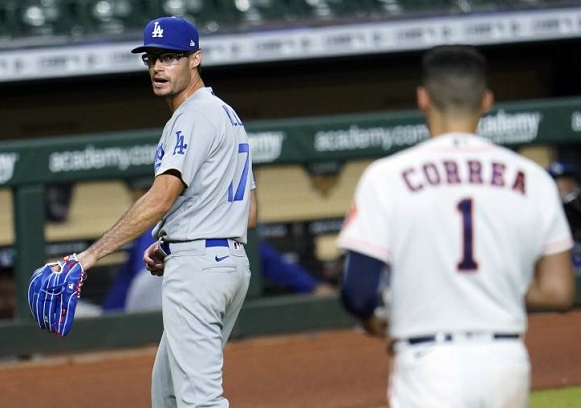
Joe Kelly (left) jawing with Carlos Correa, whom he brushed back twice in the same plate appearance Tuesday night. Should the Astros be shocked that somebody sent them post-Astrogate messages at last?

It’s not that you didn’t expect it to happen, but no matter how you feel about the Houston Astros and their extralegal electronic cheating you merely hoped it might not happen. Even if Tuesday night was the first time the Astros and the Los Angeles Dodgers met since that now-tainted 2017 World Series.

They weren’t expected to meet again unless they might tangle in another World Series. Then, the coronavirus world tour happened. When the Show returned at last, the pandemic and its mandate for extraordinary health and safety protocols prompted its governors to sketch regional scheduling featuring the Dodgers and the Astros in Houston this week, in Los Angeles come September.

You might think things are tough enough playing coronaball (reference, especially, the afflicted and drydocked-for-now Miami Marlnis) without the Dodgers having to face the team now believed to have cheated their way to that World Series title.

You might think things were tough enough without other Astro opponents still thinking in the backs of their minds that the Astros need to be taught a few little lessons in manners and in accepting responsibility in the sometimes-forgotten Astrogate wake.

You might have thought so until Joe Kelly relieved fellow Dodger reliever Brustar Graterol for the bottom of the sixth in Minute Maid Park Tuesday night.

With one out, Kelly had Houston third baseman Alex Bregman 3-0 when he decided ball four should be a fastball sailing up and past Bregman’s shoulders. The next batter, outfielder Michael Brantley, forced Bregman at second on a ground ball but made a point of stepping on Kelly’s foot as the pitcher covered first base on the play.

Kelly lingered just a little bit near the base after Brantley’s step-on and a voice was heard in the empty ballpark. It may or may not have been Astros manager Dusty Baker, but it hollered, “Get back on the mound, [maternal fornicator].” Kelly did return and go back to work.

Known to be erratic at times, and un-allergic to brushback pitches when he thinks they’re mandated, Kelly walked Astros first baseman Yuli Gurriel on four straight pitches, then opened to Astros shortstop Carlos Correa with a breaking ball behind Correa’s head and all the way to the backstop.

Officially, of course, it was ruled a wild pitch. Unofficially, even the cardboard cutouts in the otherwise empty stands knew good and bloody well that Kelly wanted to remind the Astros once again that it wasn’t nice to set up a furtive closed-circuit, off-field-based television network for stealing opposing pitch signs and think they could get away with it.

Commissioner Rob Manfred helped them think they could get away with it. Foolishly or otherwise, Manfred handed all Astro players immunity from discipline in return for spilling about the Astro Intelligence Agency after former Astro/current Oakland Athletics pitcher Mike Fiers finally blew the whistle on the AIA to The Athletic‘s Ken Rosenthal and Evan Drellich last November.

The AIA cost three managers (the Astros’ A.J. Hinch and two 2017 Astros-turned managers, Alex Cora in Boston, Carlos Beltran in New York, before he had a chance to manager even one Mets game) and one general manager (the Astros’ Jeff Luhnow) their jobs. (Any thought of Hinch possibly returning for 2021 was vapourised when the Astros exercised Baker’s 2021 club option.)

Astros owner Jim Crane was asked for no accountability beyond being fined for what amounts to maybe a year’s worth of tip money for him. Called upon to stand when spring training opened, Crane and assorted Astros players weren’t exactly apologetic for the AIA’s operations. Numerous opposing players fumed that, one way or the other, they’d find ways to administer justice, and no official edict was going to stop them.

2020-07-29 AlexBregman

“That’s dirty baseball,” Astros manager Dusty Baker fumed over this pitch to Alex Bregman from Joe Kelly. Would Baker call the Astros’ electronic sign-stealing  good clean baseball?

After Kelly struck Correa out swinging for the side, with a couple of more inside pitches in the mix, Correa was distinctly and, apparently, vocally unamused as Kelly walked off the mound and crossed the third base line to his dugout. Prompting Kelly to shoot a couple of mock crybaby faces and choice words Correa’s way.

That may have been the specific flash point under which both benches emptied and milled around the plate area. They forgot some of the social distance protocols, meaning a fine or three might be forthcoming. The dispute was bark, no bite, unless the Astros and the Dodgers were willing to dissipate the tension with some six-feet-apart pantomime boxing, but neither side was in the mood for comedy.

Baker was quoted by USA Today‘s Bob Nightengale thus: “What really enraged everybody was what he told Carlos when he struck him out, ‘Nice swing bitch!”’ Not nice. Send the message, sure. Taunt them no matter what they did or didn’t jaw your way, not so fast. Naturally, one of the Twitterpated couldn’t resist defending Kelly’s taunts thus: “Should have said something along the lines of ‘hard to hit when you don’t know what’s coming’.”

The warnings were handed to both sides after the second Correa duster. Perhaps naturally, Kelly said of the Bregman shoulder kisser, post-game, “It was a ball, obviously. It wasn’t my best pitch. Ball four, I walked him, never good to put a guy on when you’re leading the game.”

Of the breakers bending Correa, he said, “I guess he didn’t take too kind to a curve ball [inside]. It is what it is. I finally made one good pitch for the punchout . . . I pitch competitively, but with the no fans here it’s easy to hear some stuff.”

You stick to that story, son.

Some observers seemed to think, too, that the Astros were more infuriated by the buzzer  off Bregman’s shoulders than the two breakers dusting the otherwise non-entertained Correa. For his own part, Bregman merely shrugged it off when Kelly’s heat ricocheted off his shoulders and took his base. Almost as if he was well enough prepared for the incoming messages Tuesday and yet to come.

“The history obviously is out there,” said outfielder Joc Pederson before the series began. “Everybody knows what’s at stake and what happened. For being no fans, maybe sometimes the energy could be lacking a little bit. I don’t think that will be the case for this series.”

That doesn’t necessarily mean Pederson urged or condoned any message from any Dodger pitcher to any Astro hitter. Nor does it mean the Astros went into the game expecting nothing more than balls, strikes, hits, and outs, considering the jawing between the two teams before spring training was cut off at the coronavirus pass.

Recall: Dodger center fielder Cody Bellinger saying the Astros cheated for longer than affirmed and that their second baseman Jose Altuve stole the 2017 American League Most Valuable Player award from New York Yankees right fielder Aaron Judge. Recall, too: Correa rejoining that Bellinger thus spoke recklessly.

Just don’t kid yourselves that the Astros forgot for even a moment that a brushback or a knockdown was liable to come from any arm, at any time, in any game, no matter how much it seemed the pandemic pushed the long toxins of Astrogate to one side.

Until Tuesday night, only Gurriel and Correa were hit by pitches, both in the second game of the truncated season, at home against the Seattle Mariners. Until Kelly decided to lay down the law, however, all anyone thinking clearly probably thought was that the Astros were so thoroughly roasted in the immediate public Astrogate wake that throwing brushback or knockdown pitches would be as foolish as it would be unnecessary.

Like the Rogue Sox and their 2018 Replay Room Reconnaissance Ring, the Astro Intelligence Agency wear the stain of their extralegal cheating all season long, however long the season, whenever the season began. There but for the lack of grace of the coronavirus would fans and commentators alike remind both teams, good and strong, that crossing the proper gamesmanship line is filthy pool.

Only three Rogue Sox have been plunked on the truncated season thus far. But don’t fool yourself that they’re immune to thoughts that a little extra payback might be coming, too. It may not be quite as pronounced as any the Asterisks face, since they merely used what was available, predicated it with a man on base to transmit the pilfered intelligence, and didn’t install an illegal camera to begin their dirty work.

Baker himself seemed more enraged at the Kelly bullet that almost grazed the back of Bregman’s shoulders. “You don’t throw at a guy’s head,” the manager said. “That’s playing dirty baseball.” Baker’s in the unenviable position of having to help his team past the  Astrogate mess he wasn’t part or parcel of, but what would he call the AIA—good clean baseball?

Kelly wasn’t a Dodger when the AIA’s espionage operated. But he was one of the 2017 Red Sox downed by the Astros in the American League division series and the 2018 Red Sox who beat the Astros in that ALCS. You bear in mind that neither Astro nor Red Sox pitchers were co-operators of those teams’ Spy vs. Spy operations.

Kelly was also the hapless Dodger who served the pitch Washington Nationals second baseman Howie Kendrick destroyed for a tie-breaking, Dodger-burying, National League division series-winning grand slam in the Game Five top of the tenth. The last thing he needed even in abbreviated spring training was his Dodgers and the Astros getting into an Astrogate-inspired jawing contest.

Otherwise, Kelly was a pitcher in need of some kind of redemption, any kind of redemption in the eyes of Dodger fans in Los Angeles and elsewhere. The taunts were more than a little out of line. Perhaps Kelly didn’t need to send more than one brushback Correa’s way, but those weren’t half as juvenile. Well, boys will be boys, even in a time of pandemic.

Still, somewhere in that fan base they’ll remember the Dodgers beat the Astros, 5-2, to open this series, but it’ll be a by-the-way remembrance. One that has to be rushed into the conversations, swiftly, amidst the hot take that Kelly made himself something nobody in Los Angeles thought he’d become to Dodger fans after last October. A hero.

Commissioner Nero fiddles while MLB burns

2020-07-28 MarlinsPark

Marlins Park, which won’t host the Marlins vs. the Baltimore Orioles for a second day in a row after the Fish were flogged with COVID-19.

A month and a half ago, I wrote that Major League Baseball commissioner Rob Manfred had to go. The grounds already were several. Now, you can add that Manfred won’t even think about closing the Show for the season unless the coronavirus infects enough players on a team to rule it out of competitiveness.

Just when you thought you’d seen and heard everything from Manfred, the spectre of several Miami Marlins COVID-19 positive, of the Philadelphia Phillies’ clubhouses infected, and of games cancelled over positive tests, prompted this commissioner to put the competition ahead of health and safety.

MLB Network interviewer Tom Verducci, who normally writes for Sports Illustrated, asked Manfred just what it would take to close the Show, whose early performances have already run the gamut from farce to foolery and back under several Manfred-pushed rules experiments.

Those weren’t what the interviewer addressed, though. The issue was COVID-19 outbreaks among one team at minimum. Forget dropping the ball. Manfred threw it from the mound over the outfield wall. It only began with the commissioner saying the Marlins’ outbreak wasn’t “a nightmare,” before four more Marlins tested positive, raising the total number to seventeen—fifteen of whom are players.

“A team losing a number of players, making it completely noncompetitive, would be something we would have to address and have to think about making a change,” he said. “Our first concern is the health of the players and their families. And making sure we do everything possible to minimize the spread of the virus to our employees.”

Do you really need me to suggest that Manfred spoke out of both sides of his mouth while making clear enough that a team rendered futile on the field took even a slight priority over that “first concern” about player health and that of their families?

The Marlins outbreak, which may or may not have been seeded in Miami, prompted the Phillies to test en masse on Monday, while the same day’s scheduled Marlins home opener against the Baltimore Orioles was cancelled, as was the Phillies’ scheduled game against the New York Yankees. Tuesday morning came word that the tested Phillies tested negative. Their Tuesday game against the Yankees is postponed anyway. So is the second scheduled game between the Marlins and the Orioles.

Four of the Marlins’ infected were pulled away before the Sunday game against the Phillies, including scheduled starting pitcher Jose Urena. Manfred could and should have stepped in to cancel it if the Marlins’ administration didn’t. He didn’t, either. Indeed, that the game got played not after a call from competent medical and health observation but in a group text-message vote.

Last Friday, around the time the Fish began to flail, and two Atlanta Braves catchers were sent home showing symptoms but testing COVID-19 negative, Thomas Boswell fumed over the sense that Manfred already put the coffers of his bosses, the owners, ahead of the good of the game with his gimmicks such as a sixteen-team postseason, a free man on second to open each extra half-inning, and a three-batter minimum for relief pitchers.

Concurrently, though, Boswell hammered Manfred’s apparent lacking when it comes to his sport’s taking the pestiferous pandemic seriously enough to be the adult in the room when need be.

“You don’t measure disaster for a country — with refrigerator trucks lined up with corpses — the same way you measure it for a pro sport,” he wrote. “But how do you measure it for a sport? I don’t know . . . League bosses, who are not at risk, and athletes, who think they are invulnerable, are both going to be tempted — to keep playing chicken with the virus until it makes them stop.

“As most of the world already knows, by then it is usually disastrously too late.”

Manfred chose the media platform MLB itself owns to say he’d close the Show first and foremost if any team loses enough players to leave it non-competitive. (Resist the temptation to remind him of a pre-existing condition, Marlins fans.) He put that ahead of “our first concern” of the health and safety of players, their loved ones, and other MLB team employees.

A certain American president of dubious repute is often seen and even heard believing the coronavirus world tour has been nothing more (and nothing less) than a plot cooked up somewhere, anywhere, to thwart his re-election campaign. Now a baseball commissioner of dubious repute can be seen as possibly believing the pandemic has been a plot cooked up to keep the owners from making money.

Dave Martinez, the manager of the defending world champion Washington Nationals, looked upon the Marlins outbreak and shivered. “I’m going to be honest with you, I’m scared. I really am,” Martinez told Washington’s ABC news affiliate.

I go from here, home, back here every day, that’s all I do. I wash my hands, I went from 47 times a day to probably 99 times a day. Wear my mask everywhere I go. But there’s always that concern, you know. You don’t know, because of my heart condition, what happens to me if I do get it. I have to be extra careful. With that said, sometimes I tend to put myself aside and worry about other people more than me. I think that’s why I’m here, because I worry about those guys before I put myself first.

Martinez’s Nats were scheduled to travel to Miami to play the Marlins this coming weekend. “He says the players are his family, and he’s already lost a lot of sleep this month,” tweeted the Washington Post‘s Nats beat writer, Jesse Dougherty. “When asked about whether he has doubts about going to MIA this weekend: “Hopefully they make the right decision. That’s all I’m going to say.”

And, from among the players who opted out of playing this season over the pandemic, Los Angeles Dodgers pitcher David Price is probably more secure in believing he did the right thing. Especially considering baseball’s health and safety protocols have had issues and hiccups tracing back to the beginning of that delayed spring training called “summer camp.”

Now we REALLY get to see if MLB is going to put players health first,” the lefthander tweeted after the Marlins news exploded Monday. “Remember when Manfred said players health was PARAMOUNT?! Part of the reason I’m at home right now is because players health wasn’t being put first. I can see that hasn’t changed.”

That and more is what the commissioner says isn’t “a nightmare.”

Manfred and only too many within and without MLB thought any COVID-19 hits would strike maybe one, two, three players or MLB employees in just a sixty-game season. “Time to blow up that assumption,” Boswell wrote this morning.

If half of the Marlins team can test positive within a few days, then the scale of danger to health — the number of people who may get sick and the severity of the damage they may suffer, including prime-of-life pro athletes — just shot through the ceiling.

Our assumptions, while well-intentioned, have been blown to pieces. And in short order, so will the season of one, or perhaps several, of our sports.

So has been Manfred’s reputation, what’s left of it. The commissioner showed what kind of leader he was operationally, factually, and even morally before the coronavirus went on world tour. It wasn’t a great showing.

He’s never been able to bring himself to address complete umpire accountability. He slapped the Yankees and the Boston Red Sox on the wrists over illegal dugout phone and AppleWatch sign-stealing cheating in 2017 and handed down a nebulous directive rather than demand an immediate rule book change and clarification.

He let Red Sox and Houston Astros players walk in return for information rather than bring the powers of his office to bear on them over their off-field-based, illegal sign-stealing cheatings. He suspended two managers for this year (Carlos Beltran, a 2017 Astros player, was forced out of managing the New York Mets before he managed even a spring training game for them) but never even thought of holding the teams’ ownerships to real account.

The cheating players skated, their owners paid what amounted to tip money (for them) in fines, their fan bases were forced (sometimes kicking and screaming) to come to terms with chicanery that compromised each’s recent World Series titles, and Manfred dismissed the World Series championship trophy—which many thought should be stripped from both the Astros (2017) and the Red Sox (2018)—as just a hunk of metal.

He never quite suggested he might be interested in investigating whether the Astros and the Red Sox might be right in suggesting they weren’t exactly the only ones willing to flout rules against off-field-based electronic sign-stealing, either.

Nor did he demand the Yankees explain why they’re so desperate to challenge a judge’s ruling that a disciplinary letter over their 2017 sign-stealing cheating be made public, either, or said anything else about the letter itself. “[I]f the infractions cited by Manfred [in the letter] were as minor as originally claimed,” asked Beyond the Box Score writer Sheryl Ring in mid-June, “why are the Yankees so reticent to turn the letter over?”

Don’t forget Manfred’s push on behalf of his bosses, the un-impoverished owners, to try reneging on that March agreement and gaming the players out of their full pro-rated 2020 salaries if and when the season got underway.

Now that COVID-19 has taken out about half the Marlins’ playing team, Manfred is slightly more concerned for teams’ competitive ability—which can also be viewed as making money for the owners—than their health?

Here’s something on which the owners and the players might unite if put to them properly. Manfred’s successor, and every commissioner to follow, should be anyone except another owner, his hand-picked successor, or other baseball official. The successors should also be elected by representatives of all ownerships and by the players through their team player reps.

But I’m convinced even more that Manfred must go. Commissioner Nero’s been fiddling while MLB and the country that loves it burn. His music is cacophonous.

Be prepared for Show over

2020-07-27 MiamiMarlins

The Marlins players—not team management, not health/safety experts—elected to play Sunday despite COVID-19 already hitting some of them. Now eleven players at least plus two coaches are COVID-19 positive. Where were the adults in the room?

MLB and the players’ union,” tweeted ESPN’s Buster Olney early Monday morning, “made the mutual decision to try to play a season this year, and those two entities share the ethical responsibility of pausing, postponing or cancelling if that’s what is in the best interests of players and staffers. The Marlins’ situation tests this.”

The Miami Marlins’ situation is that fourteen people with the team, mostly players but a few coaches, tested COVID-19 positive while the Fish opened the truncated regular season in Philadelphia. Including their scheduled Sunday starter against the Phillies, Jose Urena. The team has postponed at least their Monday home opener against the Baltimore Orioles.

A series postponement may not be unlikely. Which might disappoint the Orioles purely on baseball terms, having just accomplished the unlikely feat of beating the Boston Red Sox two straight (7-4, 7-2) on opening weekend, after getting their brains beaten in 13-2 to open the set.

Exactly where the Marlins so affected caught the infections is still, pardon the expression, up in the air. They played an exhibition against the Braves in Atlanta the day before the regular season finally began, and the infected players and coaches could have been hit either in the Truist Park clubhouse or in the Citizens Bank Park clubhouse.

The New York Yankees were supposed to open in Philadelphia Monday night and station themselves in the same visitors clubhouse the Marlins just vacated. Says ESPN, “Sources told . . . Marly Rivera that the Yankees have been informed that the visitors’ clubhouse has been completely fumigated several times. The Yankees also brought their own clubhouse personnel down from New York City to work the game, if it happens. No decisions have been made yet, sources said.”

That was early Monday morning; now as I write it’s later Monday morning. A season postponement? It may happen. Major League Baseball convened an “emergency meeting” Monday in the wake of the Marlins’ situation. The Yankees-Phillies game for Monday is postponed, too. And, yes, this is getting quite out of hand.

But a season postponement may not happen yet, either. USA Today‘s Bob Nightengale reports, “There will be additional priority testing for teams who have an outbreak, MLB officials say, but no serious talks as of yet cancelling or pausing the season. In the words of one owner on the conference call: ‘Obviously, the situation is fluid’.”

How brave and bold of them.

With the coronavirus world tour still playing and only too many people still treating it from somewhere between carelessness and ignorance, getting a major league baseball season going from any point this summer was going to be tricky enough. We knew that right out of the proverbial chute, when young Washington Nationals star Juan Soto tested COVID-19 positive on Opening Day, though he’s asymptomatic just yet.

For all the fun and folly accompanying the season’s long-delayed opening, it’s no kind of fun when fourteen Marlins test positive over opening weekend. That followed two Braves sent home after testing positive but no symptoms showing yet.

When the Nats hosted the Yankees to open the delayed season, there was commissioner Rob Manfred sitting on national television talking more about . . . his sixteen-team postseason array. The designated hitter wasn’t even a millionth of the gimmick that idea is. It only begins with removing more than half the urgency of a regular season whose competitive urgency was already diluted by its wild card system.

Sure we’ve loved it when wild-card winners turn up the last team standing with the World Series trophy hoisted high. Including the Nationals, who did it last October after a staggering regular-season comeback. But we’re not fools. We know damn well that the wild card system has equaled asking fans to sit on edge over the thrills, spills, and chills of teams fighting to the last breath for . . . second place.

Manfred and his Major League Baseball Players Association counterpart Tony Clark have a genuine burden on their hands trying to navigate the sport through a terrible pandemic that’s yanked their country and half the world over, under, sideways, down. And the big thing for Manfred opening was a postseason array that might, maybe, probably see the sport’s best teams knocked out early and often.

“If Manfred’s judgment is this bad or if he is this pliant to the money lust of his bosses,” fumed the Washington Post‘s most valuable player, Thomas Boswell, “then what chance is there that he will have the backbone or the leadership skills to shut down this season if needed?”

Backbone? Leadership skills? Like the New York Police Department brass who sooner sent a few flunky cops to trial rather than root out the bottom-top corruption it took Frank Serpico and David Durk going to The New York Times to even try rooting it out, Manfred didn’t have the backbone to bring the powers of his office to bear and drop real hammers against the Houston Astros and the Boston Red Sox over their caught-red-handed, off-field-based, electronic sign-stealing cheatings.

Manfred slapped three managers and a general manager—whose teams executed them without Manfred—but the owners allowing it on their watches and the players availing themselves of it got away with it. You think that’s the Manfred who’s going to have the backbone to stop the season if the viral infections metastasise among the troops?

At his bosses’ behest, Manfred forced Clark and his charges to fight a ridiculous-sounding counter-battle against the owners using the coronavirus tour’s shutdown of spring training and the regular regular season to shove a de facto salary cap for the season down the players’ throats. That’s Manfred’s idea of backbone.

“The scary core of MLB’s predicament — and soon the NBA’s and NHL’s, too — is: Playing our sport is what we do, who we are and how we make our money,” Boswell wrote. “We’re going to try to do it until the virus stops us.”

From all over the world we’re learning the lesson that this is a terrible basic assumption. You get ahead of this virus before it even looks like a problem, or it ends up crushing you. South Korea, Japan, Australia, Canada and Germany, with a combined population of 325 million (the United States has 330 million) had 15 deaths Thursday. Arizona, with 7.2 million, had 89 dead.

You don’t measure disaster for a country — with refrigerator trucks lined up with corpses — the same way you measure it for a pro sport. But how do you measure it for a sport? I don’t know . . . League bosses, who are not at risk, and athletes, who think they are invulnerable, are both going to be tempted — to keep playing chicken with the virus until it makes them stop.

As most of the world already knows, by then it is usually disastrously too late.

You saw it yourself watching the games that finally arrived. Enough players, coaches, managers were playing chicken. Please. There’ve been how many ballplayers who played through injuries, “manning up,” earning their praises, and ultimately hurting their teams because they were fool enough to play through injuries? What’s trying to play unmasked and unsafe through a pestiferous pandemic, then? Supermanning up?

That was before the depth of the Marlins’ infections emerged. And now emerges, from the Philadelphia Inquirer, that deciding to play Sunday’s game in Philadelphia wasn’t decided by MLB, by Marlins team leadership, by the union, by health and safety experts, but by . . . Marlins players, by way of a group text message. Fish playing chicken. Bet the Phillies clucked, too, if not necessarily with unanimous approval.

I admit it. It was easy enough to bask in the Show’s return and either forget or keep as an aside the risk that the coronavirus would have innings enough to play among the games and the teams. Even while some of the worst ramifications of baseball’s gimmicky 2020 season experiments—the free runners on second to start each extra half-inning; the three-batter minimum for relief pitching appearances—delivered things uncomfortably between the rock of disaster and the hard place of farce.

Taking a few small but profound safety precautions doesn’t exactly mean the end of the world as we know it. No matter how many would-be God, Juniors in government from the top down really do want to use it as cover for their next nefarious real attacks on what remains of our freedom.

What a country. We were the “can-do” people for so many generations. When somebody told Ben Franklin to go fly a kite, Ol’ Ben said, “Hell, yes. Who cares if it looks like rain?” And lightning struck.

We gave the world the lightning rod, swivel chairs, automatic flour mills, suspension bridges, fire hydrants, compression refrigeration, coffee percolators, circular saws, dental floss, lathes, doorbells, lock-stitch sewing machines, combine harvesters, solar compasses, Morse code, circuit breakers, sleeping cars, ice cream makers, rotary printing presses, jackhammers, safety pins, dishwashers, fire alarm boxes, elevator brakes, burglar alarms, breast pumps, and submarines.

We gave it condensed milk, light bulbs, mass-produced toilet paper, electric stoves, escalators, vacuum cleaners, motorcycles, refrigerator cars, air brakes, fire sprinklers, mimeographs, synthesisers, air brushes, phonographs, cash registers, metal detectors, electric irons, electric fans, thermostats, photo film, electric mixers, fuel pumps, stop signs, smoke detectors, and zippers.

We gave it medical/surgical gloves, mufflers, remote control, batteries, the assembly line, hearing aids, air conditioning, offset printing, the powered airplane, automatic transmission, traffic lights, toggle light switches, hydraulic brakes, toasters, polygraphs, garage doors, radio arm saws, audiometers, instant cameras, electric razors, freon, sunglasses, car audio, electric guitars, bug zappers, and the Richter scale.

We gave it programming languages, fluorescent lamps, digital computers, fiberglas, xerography, Teflon, deodorant, cruise control, microwave ovens, space observatories, Tupperware, credit cards, transistors, defibrillators, supersonic aircraft, cable television, and correction fluid, a.k.a. Liquid Paper. (Hey, hey, she was a Monkee’s mother!)

We gave it bar codes, the artificial heart, voltmeters, lasers, LEDs, weather satellites, jumbo jets, personal computers, microprocessors, e-mail, cell phones, the Heimlich maneuver, digital cameras, ethernet, stealth aircraft, and the Internet.

For openers.

We fought and beat dreaded diseases past, and we made a few of them extinct while we were at it. We also fought and won a couple of world wars and finally defeated the most ruthless and bloody tyranny ever to rule anywhere on earth. We also invented baseball as the world’s known it roughly since the year before one of us invented pressure tape.

You’re telling me that the “can-do” people are now the “don’t-even-think-about-it” people? You’re telling me the people who invented all the above now consecrate and abet leadership and neighbourly luddism that tries to rule us without knowing a coronavirus from a computer virus?

All of a sudden it looks easier for the Cleveland Indians and the San Diego Padres to think about winning a World Series than it did for us to beat smallpox and polio. (You don’t want to know the bureaucratic loop-de-loops Edward Jenner and Jonas Salk would be put through today to get their vaccines to, you know, the people who need them.)

God forgive me, it was too easy to get lost in the thought that the Show was really back no matter what. Even with the piped-in crowd noise. Even with the cockamamie-looking empty ballparks other than cardboard cutouts of humans and other living creatures. It was even easier to laugh our fool heads off when Adam Duvall’s home run Saturday bopped the cutout of Jeff McNeil’s Alaskan malamute puppy right in the snoot.

Well, it was just as easy to anticipate the return and itch for major league ball no matter the lingering risks. It’s not so easy or funny anymore. As much as I might enjoy the games themselves, for all the gimmickry and all, I’d rather wait till next year than continue the risk that more than just a school of Marlins have to fight the damn virus.

Mr. Manfred, Mr. Clark, show some real backbone and be ready to just say no to the rest of the season. To pay the players their pro-rated 2020 salaries, thank them for giving it the old college try, and call it sick pay. Then—assuming more of them haven’t tested positive in the interim—to send them home to safety and their loved ones.

Don’t even think about how the owners can’t possibly afford it. Everyone from the rock-bound coast of Maine to the smoggy shores of California knows that’s only slightly less of a lie than anything out of a politician’s mouth.

We went almost four months without the Show. If we have to, we’ll survive without it the rest of the year. Because too many people still aren’t wising up and living safe just yet, and too many leaders are still using it as an excuse to play Gods, Jr. And, from the early look of it, too many players, coaches, and managers still do think or act as though they’re invulnerable.

In more than one way, the Marlins just told baseball world otherwise. “[H]ere we have it,” writes a rueful Stephanie Apstein for Sports Illustrated, “the least surprising possible outcome of MLB’s decision to fly some 1,500 people around the country, from one coronavirus hotspot to another, buttressed by a hope and a prayer and instructions not to spit, in service of playing baseball: They have to stop playing baseball.”

We have to have adults in the room. Now.

Sunday, bloody Sunday

2020-07-27 RickPorcello

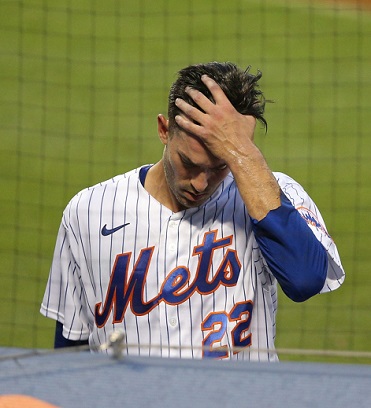
Rick Porcell wasn’t the only person in Citi Field smacking his head over Sunday’s carnage.

If the coronavirus doesn’t get the New York Mets, their pitching staff might based on Sunday’s lack of results. With apologies to Clark Griffith, Mets fans like home runs as much as the next fans, and—Jacob deGrom excepted—they seem to have assembled a pitching staff that is certain to please them.

Especially in the middle of the 14-1 massacre.

When Hunter Strickland, a relief pitcher who has surrendered a few significant launches in his past, is the first and only Mets pitcher to work an inning without surrendering anything more than a base hit that wasn’t cashed in one way or another by the Atlanta Braves, something is amiss.

Reviewing the Mets’ maiden season of 1962, Jimmy Breslin (in Can’t Anybody Here Play This Game?) ruefully observed, “For a Mets pitcher in 1962 only two things were certain. Either he was going to be hit for some of the longest home runs in baseball history, or he was going to have to stand helpless and watch his teammates make those amazing plays.”

Reviewing Sunday afternoon, any writer old enough to have seen the Original Mets is liable to write likewise. Except that Sunday’s Mets committed only one error through eight innings. They’re definitely not going to cut the mustard in Marvelous Marv Throneberry’s rumpus room at his Elysian Fields residence.

Four Braves hit for distance against the Mess Sunday, and they started that bombardment after the Mets already helped the Braves to a 7-1 score. The Braves started building that score on a pair of first-inning RBI singles and three RBI doubles in the third. The lone rude interruption was Brandon Nimmo doubling home Tomas Nido in the second. Why, the nerve of him.

The cardboard cutout of Jeff McNeil’s Alaskan malamute pup, Willow, was joined by cutouts of five more Mets doggie friends. Maybe manager Luis Rojas should have sent Willow and her friends out there to pitch.

Instead, he started Rick Porcello, the erstwhile Boston Red Sox pitcher and very erstwhile Cy Young Award winner. The good news: Porcello didn’t give up a single home run. The bad news: His afternoon only began with those back-to-back RBI singles, with two out in the first, escaping only when former now-you-see-him/now-you-don’t Met Matt Adams—who hit one of those RBI singles through that delicious open meadow created by an infield overshift—was thrown out trying to take third on the second of those.

Porcello shook off back-to-back one-out singles in the second by tricking Ronald Acuna, Jr. into dialing Area Code 5-4-3. Nimmo returned the favour in the bottom of the inning when he drove Atlanta starter Sean Newcomb’s 1-2 meatball to the back of left field to send home Nido, who’d walked with two outs.

Then, after McNeil mishandled a throw from short on Ozzie Albies’s inning-opening grounder, the third inning is where the fun really began. For the Braves. With one RBI double to left center by Marcell Ozuna and, a walk to Adams later, a two-run double to the same neighbourhood by Dansby Swanson on a meatier meatball.

Rojas finally decided Porcello was punished enough for punishing the Mets and brought in Corey Oswalt to relieve him. Remember, the three-batter minimum for all relief pitchers this season, which can prove dangerous if the reliever in question hasn’t got much to deliver. Oswalt didn’t. Except as far as the Braves were concerned.

Did the Mets have to find a young pitcher who was especially certain to please the home run lovers among their fans? Oswalt was making his twentieth major league appearance. When it ended at last, he could claim to have given fans eighteen major league home runs worth of pleasure.

Met fans would prefer that he’d hit them instead of served them.

He fought Austin Riley to a full count before walking him. He threw Endier Inciarte a canteloupe down the middle and Inciarte ripped it to the rear end of right field, sending Adams and Swanson home on poor Porcello’s dollar. That’s how Porcello’s box score ledger shows seven earned runs allowed and only six outs obtained. Oswalt isn’t likely to appear on Porcello’s Christmas list this coming winter.

Then Oswalt got three straight outs to escape further use, misuse, and abuse. But the poor young man was sent out to pitch the fourth. Just when it looked as though he’d escape Freddie Freeman’s leadoff double, with two outs and a full count on Swanson, he threw Swanson a sinker that rose instead of sinking. And Swanson sunk it over the right field fence. Unlike his teammate Adam Duvall on Saturday, Swanson’s bomb didn’t hit a single doggie cutout in the seats. Oh, well.

Same old song and dance in the Atlanta fifth. Almost. Again Oswalt had two outs and a man on second. Only this time it was two outs to open the inning and Acuna doubling to left. This time, Oswalt threw the canteloupe to Albies for the RBI double to the back end of right.

The worse news was that Oswalt seemed too anxious to get the worst of it over with in the top of the sixth. Ozuna must have sensed it, too, because he drove a 2-1 service over the left field fence to open the inning. Oswalt then got two swift outs that looked soon enough as though he were just dying to serve up the next cantaloupe, this time to Riley, who sent it likewise over the left field fence.

Rojas finally decided Oswalt had suffered enough for his sins and sent Paul Sewald out to pitch the top of the seventh. We may be using “pitch” facetiously here.

Sewald had William Contreras 1-2 when he served something just enough for Contreras to whack into right for a leadoff hit. He tricked Acuna into forcing Contreras out at second on a grounder to third. To which Albies said, “It’s not nice to trick Junior Nature,” driving a 3-1 fastball over the center field fence.

Sewald escaped with a ground out, a walk, and a swinging strikeout. The scoring ended on the day. The final two and a half innings must have seemed like simply trying to put the Mets out of their misery once and for all. You didn’t even have the heart to tell them they’d faced four Atlanta pitchers, gone 1-for-8 with runners in scoring position, and left ten men on base.

Nor did you have the heart to remind them that Newcomb was taken out of the game after three and a third innings, despite an eight-run lead, because he was actually erratic enough to start seven of his first nine batters faced with balls instead of strikes, threw only slightly more than half his 82 pitches for strikes, plunked two, and threw a wild pitch. Because it would have reminded the Mets that they had but one run to show for such generosity.

The Mets didn’t waste any time after the game sending Oswalt to their alternate training site in Brooklyn after he worked those four horrific innings to be saddled with the official loss. Far as Oswalt’s concerned, it just might be the sweetest relief he experienced all Sunday long. Might.

The word emerged when the game was just about over that, presumably for safety’s sake, the Mets planned to travel to Boston for an engagement with the Red Sox aboard six chartered buses. Outfielder Michael Conforto said lots of Mets planned to bring their XBoxes and/or PlayStations for lots of Call of Duty play.

They may miss things like team dinners or dinners among groups of teammates on the road, but better to be safe than sorry and, anyway, they’ll have lots of Call of Duty players to help ease the burden. Except that what they need most in Boston is lots of baseball players. On Sunday afternoon, they didn’t seem to have many.

That’s the way the cookies crumble

2020-07-26 McNeil'sDog

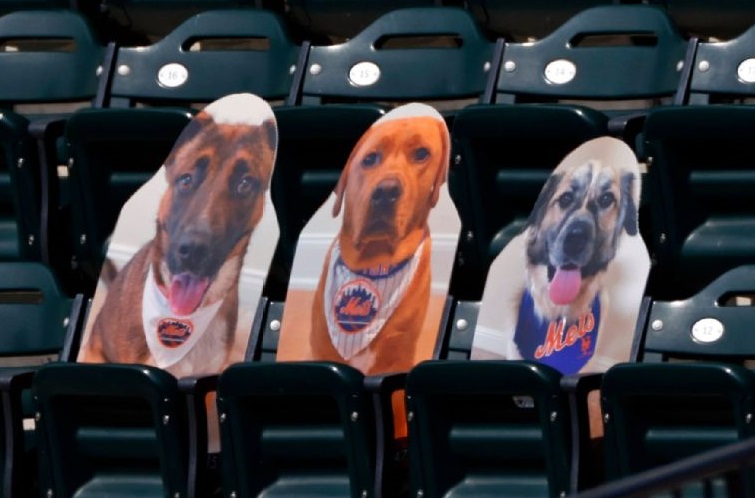
I’ve heard of Bark in the Park but this was ridiculous, sort of: Cardboard cutouts of (left to right) Griffey (belonging to Michael Conforto), Kali (also Conforto’s), and Willow (belonging to Jeff McNeil), watching from the right field seats in Citi Field Saturday . . . moments before Adam Duvall’s home run caught Willow right in the snoot.

So you’re still not thrilled about those new rules this year about the free runner on second to open the extra inning or the three-batter minimum for relief pitchers? You’re not alone. Cleveland Indians righthander Mike Clevinger is on your side. (And mine.)

You could say Clevinger has solid reason. In the Indians’ second game of the new truncated season, after his rotation mate Shane Beiber came up one short of the Opening Day strikeout record, Clevinger saw his seven-inning Saturday start (ruined only by a pair of Kansas City Royals homers back to back in the first) laid waste by the cookie on second.

He also got to see the Royals’ new manager Mike Matheny roll serious dice and come up boxcars. The Royals got what proved the game-winning run without a single official at-bat on the ledger. We tried to warn you this kind of mischief was possible.

It went like this: Since the free cookie on second is the guy who batted last for the team, Kansas City veteran Alex Gordon opened the top of the tenth on second. Until he didn’t; Matheny sent reserve outfielder Brett Phillips to run for him to open. He ordered Erick Mejia to bunt Phillips to third, before Matt Franco sent Phillips home with a sacrifice fly to break the two-all tie.

After Royals second baseman Nicky Lopez walked, he got thrown out stealing with center fielder Bubba Starling at the plate. Then Greg Holland—the prodigal Royals reliever, far enough removed from the days he anchored their once-feared H-D-H bullpen (Holland, Wade Davis, Kelvim Herrera)—shook off plunking Indians center fielder Bradley Zimmer leading off and struck out the side in the bottom of the tenth.

Clevinger thought it was all about as amusing as a boom box aboard a hearse.

“This isn’t travel ball,” he told reporters after the game. “You know how hard it is to get a runner on second base off the back end of any bullpen, how incredibly hard that is? I’m not happy about it. I’m sure when other teams face the situation and this happens to them, you’re going to get similar reactions.”

Calling the New York Mets. They got burned but good Saturday afternoon. It was bad enough that closer Edwin Diaz followed an excellent save on Opening Day with having the Atlanta Braves down to their final strike—after he fell behind 3-0 on Marcell Ozuna—only to have Ozuna send one over the right field fence to send the game to the tenth tied likewise at two.

Then Mets manager Luis Rojas, knowing the three-batter minimum, sent Hunter Strickland (erstwhile Giant and National) out to pitch the tenth. This was something like naming Mrs. O’Leary’s cow the official mascot of the Chicago Fire Department.

The good news was that, unlike on outings past, Strickland didn’t have long balls to serve, a la carte or otherwise. The bad news was that, since the Braves didn’t exactly have bunts on their minds, Rojas didn’t think to order Strickland to put the inning’s leadoff hitter, Dansby Swanson, aboard—with Adam Duvall, the last Brave to bat in the ninth, as the free cookie on second—to set up a prompt double play.

Instead, Rojas let Strickland pitch to Swanson and the Braves’ shorstop lined a Strickland slider just above the middle floor of the strike zone into center field, sending Duvall home promptly with the tiebreaking run. Johan Comargo, the Braves’ lesser-hitting third baseman, bounced one up the middle that Mets late-insertion second baseman Andres Gimenez couldn’t spear to send Swanson to third.

If Rojas ordered Swanson a free pass to open the inning, Gimenez might instead have speared that bouncer for either a step-and-throw double play or a quick flip to shortstop Amed Rosario to dial Area Code 4-6-3. Leaving the Braves no recourse but a base hit to get Duvall home.

And the inning would have gone 3-2 to the bottom of the tenth, and the Mets’ run would have tied the game. Sending it to the eleventh and . . . oops. Free cookies on second and three-batter relief minimums to open each half inning there, too, if each skipper reached for a fresh bullpen bull.

Stuck now with Strickland having to face a third batter at minimum by current law, Rojas could only watch helplessly when Strickland got the Braves’ late-insertion center fielder Endier Inciarte to bounce one right back to the box but bobbled the ball before having to take the sure out at first. Now it was 4-2, Braves, and Rojas had all the legal room on earth to get Strickland out of there before playing with another match.

Oops.

Even with Drew Smith up and ready in the Mets’ bullpen, Rojas stuck with Strickland. And Strickland played with another match. William Contreras, the younger brother of Chicago Cubs catcher Willson Contreras, smashed a first-pitch slider to the back of right center for an RBI double.

Then Rojas brought in Smith. And Smith promptly got Ronald Acuna, Jr. to look at strike three before Ozzie Albies grounded out to first base for the side but a 5-3 deficit the Mets couldn’t overthrow in the bottom of the tenth. Not even with free cookie Jeff McNeil on second to open and Jake Marisnick (erstwhile Houston Astro) and Pete Alonso singling up the pipe to load the pads for pinch hitter Dominic Smith.

That was last year: Smith returning from the injured list for the Mets’ final regular season game, pinch-hitting with two on in the bottom of the eleventh, and hitting a game-winning three-run homer. This was Saturday afternoon: The best Smith could get this time was a measly sacrifice fly. Not enough. Mets catcher Wilson Ramos grounded to short to force Alonso at second for the game.

It only takes one game to make a manager go from resembling a genius, which Rojas resembled when the Mets beat the Braves on Opening Day, to a nut, which Rojas resembled trusting the top of the tenth—after his closer blew the ninth in the first place—to a once-decent relief pitcher whom the eventual world champion Washington Nationals practically ordered held hostage out of sight after he surrendered three homers in last year’s division series.

But if Braves manager Brian Snitker thinks he’s liking the extra-inning free runner and the three-batter relief minimum now, wait until his Braves get burned likewise by it in a game. He may have something different to say about it then.

I have something to say about it now: if commissioner Rob Manfred is still foolish enough to insist on using the free cookies on second to start the extra innings this season, then he should declare the three-batter-minimum for relief pitchers void for those innings. No questions asked.

At least there was one amusement for both sides before the game ended. Duvall smacked a home run off Mets starter Steven Matz in the top of the second. With Citi Field empty beyond a smattering of cardboard cutouts in the seats, Duvall’s blast sailed into the right field seats . . . where it smacked the cardboard cutout of one of McNeil’s dogs, an Alaskan Malamute puppy named Willow, sitting next to cutouts of outfielder Michael Conforto’s dogs, Griffey and Kali.

Right in the snoot.

If you’ll pardon the expression, the wags said it was the easiest game of fetch Willow played all year so far. The game result, however, had some thinking the poochie took such postgame requests as “Willow Weep for Me.”