Marvin and Ted, a love story

2019-12-08 TedSimmonsMarvin Miller Press ConferenceWhen all was said and finally done, Marvin Miller got what he no longer wanted. He’d said it expressly and pointedly enough, citing specifically the assorted Veterans Committees he believed with certain merit were often enough stacked for certain results. “At the age of 91,” he said, “I can do without farce.”

Miller’s name turned up on the Modern Era Committee ballot now concluded, and there emerged a bristling debate as to whether Miller’s express wishes did or didn’t supercede the prospect that, at long enough last, he would attain even posthumously the honour many believed too long overdue but his family believed should be set aside according to his very own wishes.

More than most baseball men Miller knew that the Rolling Stones were right about one thing at least, namely that you can’t always get what you want, but if you try sometimes, you just might find you get what you need. What he needed from this year’s Modern Era Committee to go into the Hall of Fame was twelve votes, and he got them, one shy of the thirteen awarded to enshrine former catcher Ted Simmons.

Wherever he reposes in the Elysian Fields now, Miller didn’t get what he wanted but got what he needed, and it’s to lament that previous Veterans Committees or their 21st Century successors-by-category didn’t give it to him while he was still alive and well enough to accept and appreciate it. But there’s a nice synergy in Miller going in however posthumously with Simmons who is very much alive, well, and working as an Atlanta Braves scout today.

Even as Curt Flood’s reserve clause challenge awaited its day before the Supreme Court, Simmons himself came close enough to challenging the clause himself, entering his second year as the St. Louis Cardinals’ regular catcher, who thought establishing himself thus even at age 22 was worthy of just a little bit more than a $6,000 or thereabout pay raise.

Simmons refused to sign for 1972 for a penny less than $30,000. The Cardinals’ general manager, Bing Devine, said not so fast, son, and held in the lowest $20,000s. Simmons opened the season without a contract, the Cardinals renewed him automatically as the rules of the time allowed, and everyone in baseball cast their jeweler’s eyes upon the sophomore catcher who defied the athletic stereotype (among other things, he’d serve time on the board of a St. Louis art museum and a knowledgeable one at that) and the clause that owners abused for generations to bind their players like chattel until they damn well felt like trading, selling, or releasing them.

This wasn’t a veteran who’d seen too much and heard too much more; this was a kid whom you might have thought had everything to lose but who lived as though principle trumped even a three-run homer. He played onward and refused any Cardinals entreaty that didn’t equal a $30,000 salary, then went to Atlanta the selected All-Star choice as the National League’s backup catcher. He’d barely landed and checked in when Devine rang the phone. Would Simmons kindly accept $75,000; or, the $30,000 he asked for for 1972 and $45,000 for 1973?

Miller watched Simmons very nervously, knowing the kid pondered taking it to court if things came that way, never mind that Flood had yet to get his Supreme Court ruling. (And lost, alas.) He understood completely when Simmons accepted Devine’s new proposal, but the Simmons case handed Miller intelligence you couldn’t buy on the black market or otherwise: the owners would rather hand a lad $75,000 than let any arbitrator get to within ten nautical miles of the reserve clause.

A former United Steelworkers of America economist, Miller won skeptical players over in the first place by being just who he was, and he wasn’t the stereotypical union man with a bludgeon instead of a brain, pressing hardest on the point that no concern of theirs was out of bounds and that the doors to the Players Association’s office would remain open whenever they wanted. His mantra was, “It’s your union,” a mantra one wishes was that of numerous other American labour unions to whom the rank and file were and often still are, generally, to be seen and not heard.

Ahead of the Simmons issue still lay Hall of Fame pitcher Catfish Hunter to shine a light on what a fair, open market portended for baseball players, when Oakland Athletics owner Charlie Finley reneged on insurance payments mandated in Hunter’s contract, and an arbitrator hearing Hunter’s grievance ruled in favour of the righthander. At once, Hunter’s Hertford, North Carolina home hamlet became baseball’s hottest address, teams swooping in prepared to offer him the moon, the stars, safe passage through the Klingon Empire, and grazing rights on the planets of his choice.

Hunter merely astonished one and all by finally signing the third-richest offer in front of him, at seven figures plus for the next five seasons, and one that came at almost the eleventh minute, because the Yankees—whose representative Clyde Kluttz went back with Hunter his entire career to that point—were willing to divide the dollars according to his wishes, right down to an annuity to guarantee his children’s education. After writing the division on a napkin in a diner nook, Hunter’s first question ahead of the dollars to be done was whether the Yankees could or would do that. They could. They did.

And ahead of that, still, lay Andy Messersmith, one of the game’s best pitchers, pitching for and haggling contract with the Los Angeles Dodgers in spring 1975. When those hagglings turned a little too personal for Messersmith’s taste, thanks to general manager Al Campanis injecting personal and not baseball issues and stinging the pitcher to his soul (and to this day he refuses to discuss it), Messersmith refused to talk to any executive lower than heir apparent Peter O’Malley and demanded a no-trade clause in the contract to come.

Like Simmons, Messersmith refused to sign unless he got the clause, out of refusing now to let the Al Campanises dictate his future if he could help it. Like Simmons, Messersmith played on in 1975, pitching well enough that when fans and artery-hardened sportswriters weren’t needling him about his unsigned contract the Dodgers were trying to fatten his calf in dollar terms. They offered him princely six-figure annual salaries at three years, but they refused to capitulate on the no-trade clause.

“I never went into this for the glory and betterment of the Players Association,” Messersmith, ordinarily what John Helyar (in The Lords of the Realm) described as happy-go-lucky and a little flaky, said much later. “At the start it was all personal. Al Campanis had stirred my anger, and it became a pride issue. When I get stubborn, I get very stubborn.” Indeed not until August 1975 did Miller reach out to the still-unsigned Messersmith, the last man standing among six players who opened 1975 without signed contracts. Only then did Messersmith agree to file a grievance seeking free agency if he finished the season unsigned.

Messersmith followed through. (Retiring pitcher Dave McNally, technically unsigned but intending to stay retired, agreed to join the grievance as insurance in case the Dodgers’ dollars seduced Messersmith, who wouldn’t be seduced.) The owners refused to listen when such representatives of their own as their Player Relations Committee leader (and then-Milwaukee Brewers chairman) Ed Fitzgerald, pleaded with them to consider negotiating a revision of the reserve system. “We need to negotiate while we’re in a power position,” he pleaded. Plea denied with the very pronounced sound of a gunshot’s bullet going through the owners’ feet.

And—abetted among other evidence by a newspaper article, in which no less than Minnesota Twins owner Calvin Griffith acknowledged a proper reserve clause application would make a player a free agent after one signed season and one option season, properly applied—arbitrator Peter Seitz ruled in Messersmith’s favour. “Curt Flood stood up for us,” Simmons would say. (Helyar described him as choked up.) “[Catfish] Hunter showed us what was out there. Andy showed us the way. Andy made it happen for us all.”

Miller was smart enough not to demand immediate free agency for all, recognising as he did that teams did have certain rights in players they developed even as he knew, and insisted, that baseball players should have the same rights as any other American from the greenest labourer to the most seasoned executive to test themselves on a fair, open job market when they were no longer under contract.

It did more for the good of the game than the artery-hardened hysterics of the day would have allowed, especially in their lamentations over the coming death of competitive balance. (Pace Mark Twain, the reports of its death were extremely exaggerated, and still are: among other things, more teams have won World Series since the Messersmith ruling than won the Series before it.) But few things were more astonishing than the owners’ subsequent chicaneries, unless it was seeing the years go passing by with the idea of Miller in the Hall of Fame not as popular with many of his former clients as his work on their behalf.

Simmons, of course, went forward to enjoy a career that should have gotten him elected to Cooperstown; his peak value matches that of the average Hall of Fame catcher. He went one and done in his only year’s eligibility on the Baseball Writers’ Association of America ballot. Exactly why never seemed clear, other than perhaps residual ill will over Simmons’s late-career tangle with Whitey Herzog (who traded him to the Brewers citing defensive shortcomings, after he declined repositioning the field), but the advanced metrics show Simmons the tenth best catcher to strap it on, ever. Maybe they had a problem marrying baseball’s most honorific museum to an art museum board director.
Whistling under Fiers

2019-12-08 MikeFiers

“Hero or snitch? Depends on the lighting, and maybe Mike Fiers doesn’t care which.”—Tim Brown, Yahoo! Sports.

We know now that both the book and the film Eight Men Out are somewhat riddled with errors, shall we say, but one thing they got right. That was 1919 White Sox third baseman Buck Weaver’s refusal to partake of the payoffs to tank the World Series and to tell what he knew of the fix, which was plenty enough and hazardous to his baseball health.

In the film Weaver was scripted to say that a guy who didn’t “stand by his friends” was no good, enunciating part of a code by which men and women customarily live in professions great, modest, and dubious alike, sometimes all at once. It’s a code for which those who live it evoke honour even as practising it often protects or invites dishonour. Weaver living and practising it cost himself a baseball career when Kenesaw Mountain Landis, the original baseball commissioner appointed because of the Black Sox scandal, banished him specifically for “guilty knowledge.”

“[T]here was a method to Landis’s harshness. By making an example of Weaver, Landis sent a message to the rest of Organized Baseball that any player who learned of a fix was guilty in the eyes of baseball unless he immediately reported it,” wrote Weaver’s Society for American Baseball Research biographer David Fletcher.

The effect of this policy is readily apparent: Prior to Weaver’s banishment, baseball authorities usually only discovered game-fixing schemes after they had already occurred. After Weaver’s suspension, some attempted conspiracies were brought to light before they ever unfolded on the field, thanks to the honesty of players frightened by the Weaver precedent.

“A murder even serves his sentence and is let out,” Weaver told James T. Farrell soon before the former third baseman died in early 1956. “I got life.” In a sense Weaver was sentenced for refusing to be a whistleblower, which might or might not have imposed upon him another kind of hell.

Often as not whistleblowers are viewed paradoxically, depending upon whether they’re honest men and women who happened upon dishonest and even criminal activities or whether they’re among the dishonest and even the criminal by the time too much proves enough or the heat reaches suffocation levels. Government is only one place to hear whistles blown by those on whom they should have been blown.

One-time Trans World Airlines owner Howard Hughes wasn’t the most ethical business titan when he exposed Maine’s U.S. Senator, Owen Brewster, a man with vice presidential aspirations, holding them from the hip pocket of Pan American World Airways chieftain Juan Trippe, carrying a bill to make Pan Am the sole legal American international airline when TWA had its own international flight plans. Joseph Valachi’s 1963 testimony to the Senate providing the first true public exposure of the Mafia and its apparatus hardly came from an innocent bystander.

Frank Serpico and David Durk were clean New York police officers struggling to expose rampant corruption in their department until, in 1970, they took advantage of Durk’s personal connections, those who didn’t prove invested in depth in protecting Mayor John Lindsay, anyway, to get the New York Times to blow their whistles. Lindsay himself having proven between indifferent and impotent in the matter (“If you’ve had as long and as delicate a relationship with the 35,000 member police department as I have had, you might understand,” he told one questioner), it helped vapourise his already uneasy presidential aspirations, too.

Alexander Butterfield was no criminal when he blew the whistle on himself, disclosing to Senate Watergate Committee questioners that the Nixon White House indeed had a sophisticated taping system which he’d installed. It helped to prove the undoing of several culpable in Watergate, and the president who let himself be dragooned into its coverup, while stirring concurrent regrets that Lyndon Johnson’s previous taping system hadn’t been exposed instead of overlooked when it mattered.

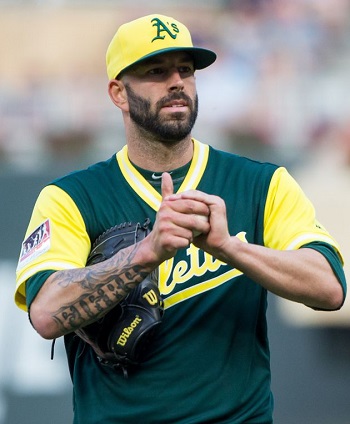
Bringing us to Mike Fiers, the former Houston Astros pitcher—since with the Detroit Tigers (2018) and, now, the Oakland Athletics (2019 and for 2020)—who blew the whistle on the Astros’s against-the-rules 2017 electronic sign-stealing operation four weeks ago. Yahoo! Sports columnist Tim Brown probes the senses around baseball regarding Fiers’s expose, to the press and not to major league baseball’s governing apparatus, and the rock and the hard place between which Fiers may yet find himself for his effort.

The senses as Brown draws them are very mixed, quoting players incumbent and past but with the proviso that their names not be revealed. And Fiers for now is reluctant to talk further about his revelations and what compelled them at last, perhaps pending his discussions with baseball’s investigators. “Hero or snitch?” Brown asks, before answering, “Depends on the lighting, and maybe Mike Fiers doesn’t care which.”

After the Times‘s Serpico-Durk revelations, Serpico himself was shot in the face during an arrest attempt and the suspicion never really abates, on his or other cops’ parts, that his partners set him up. (Serpico still lives with a bullet fragment up against his brain.) Indeed, a Serpico biographer recorded him receiving among his well-wishing greeting cards one whose maker printed inside, “With sincere sympathy,” to which the sender added a handwritten addendum “that you didn’t get your brains blown out, you rat bastard. Happy relapse.”

Fiers is about as likely to be set up for a shot in the face by corrupted ballplayers as is a cobra to be set up on a blind date with a mongoose. But he risks the reputation Brown describes him having, a well-liked teammate on a personal level and as “honest, by all appearances, sometimes to his detriment,” but jeopardising his “place in the fraternity of generations of ballplayers who went along, who shrugged and decided it—whatever that day’s it was—was someone else’s problem.”

Baseball’s fraternal inner culture has never really suffered exposure gladly even when what’s exposed is just jovial, can’t-grow-up-yet, boys-will-be-boys stuff instead the sort of thing for which the Astros (and others, prospectively) have been broiled and basted. Boys being boys is one thing, but cheating above and beyond the bounds of on-field gamesmanship is something else entirely, of course. But exposing even benign hijinks from the inside is foolishness not always suffered gladly.

Jim Brosnan (pitcher) merely revealed the clubhouse, the dugout, the bullpen, and the tours through road towns as the repositories of young men running the spread from rakish to priggish to bawdy. Jim Bouton (pitcher) revealed likewise in far more pointed detail and with far deeper shafts of wit. Bill Veeck (owner) exposed pronounced absences of ethical discrimination among owners incumbent and past, including a few of his own,  with shafts of wit Bouton would recognise as kindred.

Brosnan’s The Long Season and Pennant Race, Bouton’s Ball Four (and hilarious recounting of its controversies and aftermath in I’m Glad You Didn’t Take It Personally), and Veeck’s Veeck—As In Wreck and The Hustler’s Handbook were best sellers. Readers were entertained and perhaps enlightened, but the game didn’t always agree. And how.

The White Sox tried to jam a contract clause down Brosnan’s throat that would bar his writing publicly without prior club approval; Brosnan elected to retire instead. Commissioner Bowie Kuhn tried to suppress Ball Four by forcing Bouton to sign a statement saying it was all his editor Leonard Shecter’s fault. Unidentified members of the San Diego Padres left a burned copy of Ball Four on the top step of the Astros dugout. (Bouton was an Astro when the book was published.)

Astrogate has been rather quiet of late, with the commissioner’s office continuing its investigation but not yet revealing whether the Astro Intelligence Agency operated beyond 2017 or their high-tech cheating exists on other teams and to how far an extent. And you notice that from the moment Fiers’s revelation to The Athletic‘s Ken Rosenthal and Evan Dillich hit the world running the Astros themselves really haven’t challenged Fiers publicly.

Whistleblowing’s conundrums include that the honest provide only so much. That’s what the Knapp Commission faced when formed and operating in the immediate wake of Serpico’s and Durk’s 1970 police corruption revelations. The commission needed (and got, in due course) a completely corrupt cop (it turned out to be a detective named William Phillips) to finish what the pair started and expose its truest depths. Commissioner Rob Manfred and his bloodhounds probably need no-questions-asked cheaters to start finishing what Fiers started.

But the conundrums also include a hell-if-you-do, hell-if-you-don’t kind of channel surfing. Take what you know to the proper in-house investigative channel and risk that its administrators do as assorted NYPD superiors did with Serpico and Durk: little to nothing, if that much. Take what you know at long enough last to the channel of press, when the “proper” channels prove off the air, and the public may call you a hero but at least some of your professional colleagues may express sincere sympathy that you didn’t get your brains blown out, you rat bastard.

Brown records that, for every player who says, “Takes big nuts to call bull(feces) on people and stand there and take the heat that follows. I admire that,” there’s another who says, “Freakin’ punk-ass bitch.” And another who says, “I don’t think he’s a hero or a villain. I just hope he doesn’t get demonized.” Or, yet another who says, “I would not have gone public, but I don’t condemn him for going public . . . In the end, I probably would have fallen back on the sanctity of the clubhouse. Would I have felt good about it? Probably not.”

Once upon a time Buck Weaver fell back on the sanctity of the clubhouse, too, as well as falling back upon the code that enjoins against ratting on “friends,” some of whom weren’t exactly his friends. He probably didn’t feel too good about that, either.

Blake Snell’s hidden plea

2019-12-07 BlakeSnell

Blake Snell was not amused by the Rays trading Tommy Pham.

Within Tampa Bay Rays pitcher Blake Snell’s gutteral emission upon the trade of Tommy Pham to the San Diego Padres, you could find a plea pondered almost as long as professional baseball’s been played. If you wanted to.

On the surface, Snell fuming aboard the social media outlet Twitch was negative amazement that Pham would be surrendered for lesser elements: “We gave Pham up for [Hunter] Renfroe and a damn slap[penis] prospect?” And he has a pretty point, since the Rays may or may not have received equal value in return.

Baseball administrators are nothing if not men and women seeking the maximum prospective performance at the minimum prospective cost, of course. Pham earned $41. million in 2019 and was liable to earn more next season following salary arbitration; Renfroe earned $582,000 in 2019 and isn’t eligible for arbitration until after next year. And the damn slap[penis] prospect, Xavier Edwards, was ranked number five on the Padres prospect list before the deal.

Renfroe in 2019 was the Clete Boyer of outfielders, hitting 33 home runs against a .289 on-base percentage, rather companionable to the longtime Yankee third base legend’s 1967 with the Braves, 26 home runs and a .292 OBP. And Renfroe is a promising defender in his own right. But the Rays are renowned for mulcting large results out of small costs and the words “salary dump” come to mind for some, surely.

Snell apologised almost post haste. “[J]ust saying I’m sorry I’m just upset we’re losing a guy like Tommy who helped our team in so many ways!” he said. “Didn’t mean any disrespect to Edwards who I didn’t know who he was until after I said that. I was just sad to lose Tommy . . . It’s tough losing someone you respect so much and enjoy being around.”

Thus does Snell invite deeper examination, where you may find the unenunciated very present plea for loyalty and the noticeable absence thereof. Except that when you do enunciate it, you provoke another tirelessly tiring debate on where the loyalty disappeared among, well, the players, who need to learn a thing or three about loyalty while they pursue their unsightly riches, yap yap yap.

It’s been that way ever since the advent of free agency, of course. Once upon a time it amused, if only because those bellowing against the lack of player loyalty were only too obvious in their ignorance, willful or otherwise, regarding the lack of team loyalty even to Hall of Famers. In both the so-called Good Old Days and the days, years, decades to follow. It’s still somewhat amusing, even when it gets somewhat annoying.

Referencing Hall of Famers was something I did about a decade ago, for another publication, when pondering the “loyalty” question. (That publication ceased to exist not long after I published my old finding.) It began then and now with there having been but one single-team player (Walter Johnson) among the inaugural five players enshrined in 1936. The first single-team Hall of Famer to follow: Lou Gehrig, in 1939.

It goes from there to those whose careers were entirely or mostly reserve era. Thirty-six single-team Hall of Famers played all or mostly in the reserve era; eighteen (allowing the prospect of at least Derek Jeter and Thurman Munson being elected for 2020 induction) played all or mostly in the free agency era. Out of all 232 Hall of Fame players (Jeter and Munson included), it means 54 players—23 percent, not even one quarter of all Hall of Fame players—were single teamers.

The reasons vary as much as their playing or pitching styles do. Age is one. The chance to bolster or reconstruct a roster, hopefully without downright tanking, is another. Issues off the field, which didn’t begin with Rogers Hornsby’s trade after winning a World Series (as a player-manager) because he was a horse’s ass so far as his team (and a lot of baseball) was concerned and didn’t end with the Phillies’ barely conscionable mistaking of a slumping should-be Hall of Famer Scott Rolen for lacking heart or passion, are others.

Still others are organisational philosophy changes, and economic hardship real (think of Connie Mack’s fire sales breaking apart two separate Philadelphia Athletics dynasties) or alleged. (Think of M. Donald Grant’s capricious purge of Tom Seaver in 1977, to name one, or Charlie Finley’s capricious practically everything around the dynastic-turned-rubble Oakland Athletics of the 1970s. Among others.)

The loyalty issue has been with us since the signature dried on the Messersmith-McNally ruling that ended the reserve clause’s abuse in 1975 and provoked the immediate firing of arbitrator Peter Seitz, who heard the evidence real or imagined and ruled properly on behalf of Andy Messersmith. (The intending-retirement, non-playing Dave McNally, technically an unsigned player, signed onto the action as an insurance fallback in the event the refusing-to-sign Messersmith wavered during the 1975 season.)

And almost invariably it begins with rare diversions forward with player loyalty. The fact that owners pre- and post-free agency felt little if any comparable “loyalty” to their players remains underrated if not undiscussed if not untouched at all. The millionaires-versus-billionaires debate is an exercise in fatuity; the loyalty-versus-disloyalty debate exercises a lot of plain nonsense by people who’d impress you otherwise as being old enough and smart enough to know better.

This week Washington Nationals owner Mark Lerner said plainly that the team could afford to keep only one of two now-free agent World Series heroes/homegrown Nats, Stephen Strasburg and Anthony Rendon, but not both. Lerner’s are economic reasons by his own proclamation, never mind that between himself and his father they’re baseball’s second-richest owners at this writing. Warble not about “loyalty” when Strasburg and Rendon—neither now under binding contract, each free to negotiate on a fair and open job market—are told, pending an unforeseen change of mind or heart, that the team who raised them can’t afford to keep both.

Last March Mike Trout looked at two seasons to come before his first free agency and no small speculation as to whether he’d stay where he was or move elsewhere, and as to how many teams would prepare to mortgage the gold reserves to bring him aboard. That talk included a certain freshly-signed, $350 million Phillie whispering sweet nothings toward Trout regarding keeping the City of Brotherly Love very much at the front of his mind.

Then Trout and his Los Angeles Angels agreed mutually to make him an Angel for life to a $450 million extent, the major talk of which surrounded how richly he deserved the dollars while there seemed little enough appreciation for Trout himself proclaiming publicly, without sounding sirens or fireworks, that he was plenty enough content where he was. And, by the way, hoping more than kinda-sorta that the Angels, maybe, finally, might reconstruct themselves into a team their and baseball’s best player could be proud of.

That was a mutual exercise in loyalty by player and team that went noticed to a glandular level over the fact that Trout would earn the equivalent of a small country’s economy for the rest of his playing career and to a dust bunny’s level over their hard-earned loyalty to each other. Remember it the next time you eavesdrop upon or partake in yet another exercise in the just plain nonsense that baseball loyalty debates become, at least as often as Trout steals a home run from over the center field fence, or hits one there.

The champion Nats and affordability

2019-12-06 AnthonyRendonStephenStrasburg

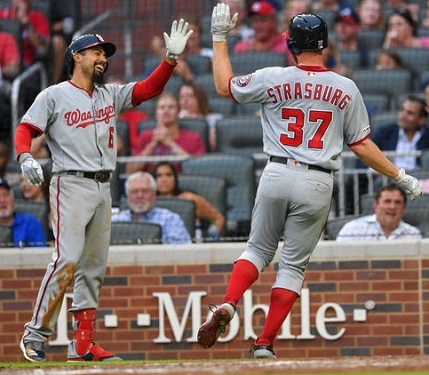
Anthony Rendon and Stephen Strasburg share a high five in Atlanta during 2019. The Nats say they can’t afford to keep both. Depends on how you look at it? (USA Today photo.)

One of the Nationals’ postseason titans will remain a Nat for 2020 at least. Howie Kendrick’s reward for putting paid to the Dodgers’ 2019 and for bombing the Nats ahead to stay in Game Seven of the World Series is a one-year, $6.25 million deal.

That’s the good news. The bad news for Nats fans is that owner Mark Lerner says they can afford to keep only one of their two homegrowns who are now testing their first serious free agency markets.

At minimum, it seems, either Stephen Strasburg or Anthony Rendon is “affordable” even for the team whose ownership—if you include Lerner’s father, Ted, whose fortune anchors in real estate—is baseball’s second richest (net worth $5.3 billion) at this writing, with Giants owner Charles Johnson first richest (net worth $5.1 billion) pending the Mets’ transition to Steve Cohen’s ownership. (Cohen’s net worth: around $15 billion.)

But they can’t afford both.

“We really can only afford to have one of those two guys,” said Lerner about Strasburg and Rendon to NBC Sports Washington Thursday. “They’re huge numbers. We already have a really large payroll to begin with. So we’re pursuing them, we’re pursuing other free agents in case they decide to go elsewhere.”

Kendrick became a Nat in 2018, lost most of the season to a torn Achilles tendon, regrouped in 2019 for a .966 OPS, and became one of the keys to the Nats’ postseason conquest. His National League Championship Series MVP was merely the roast beef between the slices of boutique bread he surrounded it with before and after. Kendrick makes opposing managers look silly.

He took complete advantage of Dodger manager Dave Roberts almost inexplicably leaving Joe Kelly in for a second relief inning and hit a monstrous top of the tenth grand slam to finish the postseason hopes of the team for whom he played in 2015-2016 following nine better than useful seasons as an Angel.

Then Astros manager A.J. Hinch confounded fans and no few analysts alike by reaching for Will Harris instead of Gerrit Cole, as Game Seven starter Zack Greinke’s tank ran past E following a homer to Rendon and a followup walk to Juan Soto. And Kendrick made what Harris himself called “a championship play for a championship team.” It was the right move (Cole never pitched in relief in his life) made wrong.

Harris threw Kendrick a nasty cutter traveling low and away, and Kendrick sent it on a high line the other way until it went bonk! off the right field foul pole. Kendrick’s shot gave the Nats the Game Seven lead they didn’t relinquish and himself the likelihood that he’ll never have to buy his own drinks in Washington again. And it got him his reward for 2020, where he’ll have all season to accept thanks and, just maybe, deliver enough timely swings to send the Nats toward a successful renewal of their lease to the Promised Land.

But what of Strasburg, their World Series MVP, their postseason lancer whose lifetime 1.46 postseason ERA and 2019 1.37 postseason ERA overall hoists as a big-game pitcher the still young man who was their highest-hyped pitching prospect ever? Who survived second-year Tommy John surgery and assorted injuries to come to become first a good, then an above average, and finally a genuinely great pitcher who thrives the best when the moment’s the biggest?

And what of Rendon, their third-place National League MVP finisher in 2019, whose 1.059 postseason OPS and 25 runs postseason runs produced on the way to the Nats’ World Series triumph was at least as valuable to that conquest? Not to mention a third baseman who’s improved in leaps each season at the plate and at the hot corner?

(Rendon’s OPS from 2017-2019: .952; his real batting average [total bases + walks + intentional walks + sacrifices + hit by pitches divided by total plate appearances] over the span: .630. His lifetime RBA so far: .562. Out of eight Hall of Fame third basemen whose careers happened in the post-World War II/post-integration/night ball era, only four are higher than Rendon, in ascending order: George Brett, Eddie Mathews, Chipper Jones, and Mike Schmidt.)

Kendrick threatened to become the face of the postseason early and often, but Strasburg, Rendon, Max Scherzer, Juan Soto, and Ryan Zimmerman are the arguable none-too-small faces of the Nats. They personify the agenda Thomas Boswell says should be the Nats’ pursuit: “preserving the team’s culture.”

Maybe since-departed (for Japan, where he’ll get to play more than part time) Gerardo Parra brought the Nats the Baby Shark and opened their can of fearless fun factor in 2019. Parra may be crossing the Pacific but nobody wants to dispense with the Baby Shark just yet. Maybe not ever.

Boswell says the Nats must weigh such value as Kendrick, Ryan Zimmerman, and “the versatile” Asdrubal Cabrera, Brian Dozier, Matt Adams, “and the modest but must-re-sign [Daniel] Hudson.” Sensibly enough.

But how about weighing the values of Strasburg and Rendon? And how about marrying those and the aforesaid values to an overall Nats culture of winning and having a blast doing it? No team in baseball was more plain fun to watch in 2019 than the Nats. Even the near-stoic Strasburg learned how to loosen up and shake a tail feather in the dugout.

Beware, Lerners. And general manager Mike Rizzo. You may think the Yankees have eyes for Strasburg, you may think the Phillies have likewise (remember what happened when you tried to get cute with Bryce Harper after 2018), but now the Angels may be laying in the weeds for him.

And that would be awfully tempting for Strasburg. Not just because there’d be a challenge for him in yanking their still-in-need-of-remodeling pitching staff into real competitiveness, but because they play an hour’s drive (assuming the traffic is decent, which is never a safe assumption in southern California) from Strasburg’s roots. Often as not in baseball you can go home again.

He’s not the only one with a California team pondering his presence. Rendon may be getting more than glances from the Dodgers he helped destroy in October. In fact, Strasburg and Rendon are both said to be on the Dodger radar, with incumbent Justin Turner willing to move to first base if Rendon becomes his new teammate. Beware, Nats. If you can’t or won’t keep them, the Dodgers might be only too happy to take them.

This would be called joining them if you can’t beat them. It was Strasburg who held down the fort in division series Game Five and didn’t let an early 3-0 Dodger lead knock him out of his zone. And it was Rendon who opened the game-tying top of the eighth, when Roberts gambled on Clayton Kershaw opening the inning, with a yank into the left field bleachers followed immediately by Soto’s yank into the opposite bleachers.

There’s only one thing that might hold the Dodgers back: luxury tax implications. That and that they’ve rarely handed out contracts for more than five years. And Strasburg and Rendon can leverage their southern California overtures when bargaining with other interested teams. (For Rendon, one is thought the Rangers, a homecoming for him as the Angels or Dodgers would be for Strasburg.)

Something to ponder, too, if the Nats let Strasburg and Rendon walk. Cole has suitors to burn, the Yankees in particular, reportedly, but then Scherzer did, too, a few years ago—and the Nats made him an offer he couldn’t refuse.

It’s not unrealistic to think that losing Strasburg and Rendon alike equals gaining Cole on the mound and, maybe, Josh Donaldson for third base. Donaldson’s still better than serviceable at age 33 and he’s a lot less expensive than Rendon, and Boswell notes that Donaldson’s would be a personality fit in the Nats’ clubhouse.

But losing either Strasburg or Rendon, never mind both, would lose a particular degree of Nats gravitas.

“What cannot and need not be lost is the culture that this Finish the Fight team brought to life,” Boswell concludes. “Rosters change. Lucky and luckless seasons both arrive. But once a team sees what values it wants to embody—and what kind of players and people make that possible—then that’s the lodestar to follow.”

Strasburg and Rendon are two of those players and two of those people. The Lerners may want to keep that very much in mind before they decide once and for all that saving a few bucks is just a little more pressing than keeping what’s already proven aboard.

Maybe Cole, Donaldson, and a couple of other imports would fit the Nat culture. Maybe they really won’t. It’s the crapshoot every great team joins every year, similar to reading the size label on the shirt you bought and discovering the label lied in one or another direction. But a good gambler knows the moment when pushing his or her luck means disaster.

It just might be worth every extra dollar for the Lerners not to push their luck this time. Especially with two franchise faces who just so happen to be far more than just a couple of franchise faces, and have been since the days they were baseball born in Nats jumpers. (Not to mention a third, Zimmerman, who’s been a Nat since the day they were re-born in Washington, and would settle for one more year at a reasonable rate for a part-timer who just can’t hang it up quite yet.)

Contrary to what the giddoff-mah-lawn baseball romantics like to think, loyalty was never a prime baseball commodity. Not before the free agency era, not since, and not exclusively on the players’ sides. (Yes, Mr. Thurber, we can look it up.) This time, the Lerners have a splendid chance to show some to two of the guys who stayed the course and finally helped them reach the Promised Land.

The Mets, under new ownership?

2019-12-05 JacobDeGrom

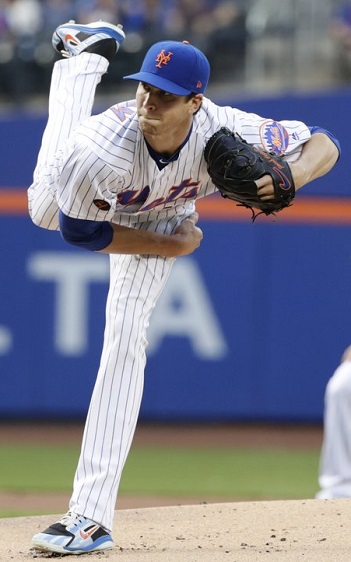
The Mets may soon be owned by a man who paid more for one sculpture than they’re paying Jacob deGrom for the next five years.

Lose a pitcher, gain an owner? As it looked as though the Phillies would sign Zack Wheeler for five years and $118 million, less than he was offered by the White Sox, his now-former Mets looked as though they were about to sell an 80 percent stake in the team to a Long Island boy who, like me, has been a Met fan since the day they were born.

Steve Cohen has in common with me having seen our first Mets games courtesy of the original troupe who played in the ancient Polo Grounds while awaiting Shea Stadium’s completion. That’s almost the full extent of our common ground. For openers, at present he owns a four percent stake in the team, while I own nothing of the team but an alternate game hat and several books.

Cohen played baseball as a boy until a shoulder injury put paid, apparently, to any thoughts he had of growing up to pitch professionally, presumably in a Met uniform. His career ended with slightly more honour than mine did: I discovered 1) I couldn’t hit a fair ball unless the foul lines were moved to a single line crossing the rear point of home plate; and, 2) I couldn’t throw a strike unless the strike zone sat on the batter’s derriere.

So each of us ended our baseball careers and settled for pursuits less likely to provide even that one in a billion shot at immortality.

Mine was becoming an Air Force intelligence analyst and, following, a professional journalist at the regional level with a career described as fitful at best. Cohen’s was going to Wall Street and building a fortune that would, if he intends to buy that 80 percent stake in the Mets, make him baseball’s wealthiest owner almost overnight.

I say “almost” because the reporting holds that the incumbent Wilpons will stay in command for five more years. But the transition of power could happen sooner, as often it does. “According to my sources, Cohen, who is currently a minority owner of the Mets, would immediately own at least a tad over 50% should the deal be approved,” writes Mike Ozanian in Forbes. “Why would anybody buying a majority stake in a dysfunctional business allow the folks who ran it dysfunctionally for years keep running it? Time is of the essence.”

To see the reaction of Met fans who’ve despaired over what The Athletic calls the Wilpons’ “tight fisted and ham handed stewardship of the Mets” is to think the Messiah has come at long enough last. Met fans salivate over the prospect of the tight fists turning into open hands.

Cohen is known for a previous bid to buy the Dodgers (he lost out) and as an art lover and collector who once paid for one sculpture (Pointing Man, by Alberto Giocametti) $3.8 million more than the Mets agreed to pay their back-to-back Cy Young Award-winning pitcher Jacob deGrom for five years beginning in 2020.

The Wilpons’ fists tightened when they turned up among the wounded (victims and partial culprits alike) in the Bernie Madoff Ponzi scheme. Cohen’s SAC Capital Investors, which he built, copped to five counts of insider trading in 2013 and ponied up a $1.2 billion fine. Though Cohen himself wasn’t accused of wrongdoing, SAC Capital was barred from outside investments from there forward.

Cohen merely picked himself up, dusted off, and created Point72 Ventures three years ago and Cohen Private Ventures, which he says will manage his majority Mets stake if the deal is done. The Wilpons are still trying to get out from under the Madoff mess, which only began for them when they thought investing with Madoff would help them with things like the botched Bobby Bonilla deal. (Which the Mets must pay through 2035 at $1 million a year, for a player who’s been retired almost two decades.)

“Madoff ‘made’ them boatloads of money that never existed and they invested it in places they’re still trying to pay back (like their team *cough Bonilla* and television station),” writes Sarah Valenzuela of the New York Daily News. “By 2015, they were paying off about $100M/year to get to the principal amount of their debts, plus the cost of the recently built Citi Field.”

Fred and son Jeff Wilpon have been known as Steinbrennerian meddlers (George, not Hal) without much of anything resembling Steinbrennerian results after they wrested the team’s full ownership from co-owner Nelson Doubleday in 2002. And as often as not the meddlings were destructive enough to be considered human neglect.

The elder Wilpon once forced Hall of Fame pitcher Pedro Martinez to pitch a meaningless game for the box office in 2006 despite a toe injury; it may have aggravated shoulder issues, invited 2007 season-losing surgery, and limited Martinez in 2008, to the point where he returned to the Red Sox after his deal expired to retire as a Red Sox.

When Doubleday wanted in the worst way possible to bring Hall of Famer Mike Piazza to the Mets in 1998, Wilpon actually tried to thwart the deal. Today Piazza’s Hall of Fame plaque shows his head under a Mets cap. Way to call ’em, Fred. Meanwhile, for every Carlos Delgado, Carlos Beltran, and Johan Santana acquisition there were Bonilla’s second Mets deal and acquisitions of aging, past-prime, or completely lost players almost too numerous to mention.

Wilpon pere and Wilpon fils have also been renowned for blocking signings and deals their baseball brain trusts have recommended strongly enough to them while signing off on signings and deals described as dubious most charitably.

And no managerial firing in the Steinbrenner Yankees’ history was half as despicable as the manner in which Wilpon ordered the executions of Willie Randolph, his pitching coach Rick Peterson, and his first base coach Tom Nieto in 2008—after the team traveled to Anaheim and won the first game of the road trip. And after midnight while they were at it.

But before my fellow Met fans drink too deep in celebrating the advent of the Cohen era, they may do wise to ponder the Wednesday evening caution from MLB Trade Rumours‘s Steve Adams:

Any ownership-level shakeup, of course, can have payroll implications for a team, but there’s no immediate indication that the Mets will increase spending in the near future. To the contrary, multiple reports this week have indicated that the Mets may need to move some undesirable contracts before spending further this winter — a reality that has long since been apparent to any who’ve closely examined the team’s payroll outlook. As for what would happen with regard to team payroll down the line, that can’t be known at this time, but it’s worth highlighting that the Bloomberg Billionaire Index lists Cohen’s net worth at a staggering $9.2 billion.

Today’s announcement seemingly puts a finite window on the Wilpons’ rein atop the organization and, as ESPN’s Buster Olney points out (Twitter link), perhaps explains why the club has been so focused on winning as soon as possible and making splashy moves toward that end.

That’s a somewhat extensive way of reminding Met fans—since the day they were born and otherwise—how wise it is to cut the cards no matter how deep you trust Mom.

Cohen grew up on Long Island in Great Neck, a well-to-do place in Nassau County familiar to me mostly as the home of a classic opulent wedding-and-bar-mitzvah semi-factory. Leonard’s of Great Neck, now Leonard’s Palazzo, is known to television fans as the joint where Johnny Sack asked Tony Soprano to perform a hit before Sack was hauled from his daughter’s wedding back to prison, in season six, episode five.

Take that, Mr. Cohen: After my parents moved us from the north Bronx, I finished growing up (har, har) in Long Beach, an island strip across a channel in southern Nassau which had a little bit of every economic strata, a lot of beach and boardwalk, and a home for Don Vito Corleone in The Godfather, from which son and heir Michael plotted and delivered the execution of the heads of the Five Families.

My mob’s better than your mob. #LFGM.