Want a blood feud this weekend? You may get one in Chicago

2019-09-19 WrigleyFieldSignForget the wild card races for a few moments. Have a good gander at the National League Central. Where the Cardinals and the Cubs entered Thursday’s play numeros uno and two-o in the division.

With a measly three games between them in the standings. And, count them, seven games yet to play against each other including three to end the regular season. You wanted an honest-to-goodness rivalry to take the season to the wire? You’ve got it now in the NL Central.

The Red Sox’s dissipation thanks mostly to their starting pitching means no Yankee-Red Sox duel to the death to finish. The American League Central is down to the Twins and the Indians with four games between them in the standings, but such as it is their rivalry seems more like a Friday night bowling league. There’s no blood feud there. Yet.

The western divisions in both leagues are so locked up that both champions-in-waiting (the Astros and the Dodgers) left their age-old or mere territorial rivals behind as far as New York City’s D train leaves 205th Street in the north Bronx when it arrives near Coney Island.

The eastern divisions are sewn up snugly enough, though there’s a vague potential for all-out war if, somehow, by some heretofore unseen alchemy, the Nationals and the Mets end up in the wild card game with one of them getting to deal with the Braves in a division series.

And the wild card rumbles are enough fun, even if you think there’s something just a little out of whack with sitting on the edge biting your nails to the nubs over the thrills, spills, and chills of seeing who’s going to end up . . . in second or even third place but with a postseason ticket regardless.

No, the real blood feuding resumes Thursday night in Wrigley Field. Which will be the Friendless Confines if you’re a Cardinals fan.

Where there’s about as much love or respect for the Cardinals as there was between Frank Hamer and Bonnie & Clyde. Where the legend may still hold that one season’s antics so enraged Hall of Famer Bob Gibson that he begged his manager to pitch him out of turn just for the pleasure of using the Cubs for target practise an extra time or two.

Bad enough the Cardinals’ Thursday starter Jack Flaherty entered as one of the National League’s hottest second-half pitchers. Worse: the Cubs only hit .168 against him with a .297 on-base percentage. Their best swinger against Flaherty, Anthony Rizzo, is down for the count with an ankle injury. Without the only Cub who hits higher than .250 against him—and Rizzo’s hit .533—Flaherty can start the game like a man sinking into a delicious hot tub.

Especially because his Cubs starting opponent, Kyle Hendricks, is a Cardinals pinata by comparison. The Redbirds have hit .249 with a .309 on-base percentage against Hendricks lifetime. The big swinger? Marcell Ozuna, who brings a 1.124 OPS against Hendricks lifetime into the game. Hendricks can’t exactly think about starting in a hot tub. He might have an early shower in which to think afterward if a) he’s not careful and b) his changeup betrays him.

But all September long the Cubs are a game over .500 and the Cardinals, two. But the Cubs just dropped a pair to the lowly but feisty Reds and woke up Thursday morning the winners of six out of their last ten compared to the Cardinals winning five of their last ten.

What a difference a few years makes. As ESPN reporter Jesse Rogers observes, not so long ago the Cardinals had issues on the basepaths, in the field, and out of the bullpen, but that was then and this is now: it’s the Cubs who now lead the league in outs on the bases, sit second in the league in errors (losing Rizzo doesn’t hurt at the plate alone), and haven’t converted more than 58 percent of their bullpen save opportunities.

And his colleague Bradford Doolittle observes that this year’s Cardinals do all the little things right but seem to think the big things are too big, while this year’s Cubs do the big things right while the little things seem not beyond but unknown to them by comparison. Tonight they’re going to test Rizzo’s ankle by letting him play first base. Think the Cardinals might test him the hard way with a few bunts?

There’s also that pesky location factor. The Cubs finish the home portion of their regular season this weekend before playing six on the road to finish, and their 31-44 road record to this point doesn’t exactly bode for getting their kicks on Route 66 or anywhere else. The Cardinals aren’t exactly road hogs, either, but their 36-38 road record when they woke up Thursday morning could turn just as easily into a 40-38 road record when they go to bed Sunday night.

Doolittle thinks Cardinal fans, despite their long standing reputation as being among baseball’s best, suddenly have “a sense of impending doom . . . A lot of people I talk to seem raw that the team didn’t trade for another starter at the deadline, even though their rotation has been lights-out ever since . . . They want to believe, but they aren’t all the way there yet. If the Cards flop against the Cubs, it could get a little ugly in St. Louis.”

Since 2017 the Cubs have actually been 20-5 against the Cardinals in the Confines. What does he think it’s going to get in Chicago if the Cubs flop against the Cardinals this weekend—pretty?

A one-time Cub broadcaster who devolved to become an American president once proclaimed morning in America. Just because it’s still only three years, just about, since their last World Series conquest doesn’t mean Cub Country would proclaim morning in America if the Cubs plotz this weekend.


A date with an Angell

2019-09-19 RogerAngell

Roger Angell, accepting his J. G. Taylor Spink Award at the Hall of Fame in 2014.

Nine days before Eddie Cicotte confessed his membership in the Black Sox, the literary-minded wife of a New York attorney bore a son. Mother and son would each have a long term impact on The New Yorker; the son would have a concurrent and more enduring impact on baseball.

Katharine Sergeant Angell was five years from becoming The New Yorker‘s fiction editor and nine from divorcing her first husband and marrying a writer she’d previously recommended The New Yorker‘s legendary mastermind Harold Ross hire, E.B. White. Her son would assume her job in due course. While he was at it, he’d become baseball’s prose poet laureate.

Just don’t say that to Roger Angell if you should have the honour of meeting him, never mind wishing him a happy 99th birthday in person today.

“I’ve been accused once in a while of being a poet laureate, which has always sort of pissed me off,” Angell once told Salon writer Steve Kettman, coincidentally the author of the splendid One Day at Fenway and editor of Angell’s own anthology Game Time. “That’s not what I was trying to do. I think people who said that really haven’t read me, because what I’ve been doing a lot of times is reporting. It’s not exactly like everybody else’s reporting. I’m reporting about myself, as a fan as well as a baseball writer.”

Just like any average everyday American literary editor who goes to spring training, assorted ballparks, or the World Series, intending nothing but spot reporting, delivering observations the rest of us can only fantasise about delivering. Consider what he delivered in “The Web of the Game” (1981), after watching Ron Darling (then pitching for Yale University) and Frank Viola (then pitching for St. John’s University) tangled in Darling’s 11 no-hit innings, in a game during the 1981 players’ strike, with Smokey Joe Wood (a 34-5/1.91 ERA pitcher for the 1912 Red Sox, then 91 himself) in the audience and, coincidentally, as Angell’s seat companion:

The two pitchers held us — each as intent and calm and purposeful as the other. Ron Darling, never deviating from the purity of his stylish body-lean and leg-crook and his riding, down-thrusting delivery, poured fastballs through the diminishing daylight . . . Viola was dominant in his own fashion, also setting down the Yale hitters one, two, three in the ninth and 10th, with a handful of pitches. His rhythm — the constant variety of speeds and location on his pitches—had the enemy batters leaning and swaying with his motion, and, as antistrophic, was almost as exciting to watch as Darling’s flair and flame.

With two out in the top of the 11th, a St. John’s batter nudged a soft little roller up the first base line—such an easy, waiting, schoolboy sort of chance that the Yale first baseman, O’Connor, allowed the ball to carom off his mitt: a miserable little butchery, except that the second baseman, seeing his pitcher sprinting for the bag, now snatched up the ball and flipped it toward him almost despairingly. Darling took the toss while diving full-length at the bag and, rolling in the dirt, beat the runner by a hair.

“Oh, my!” said Joe Wood. “Oh, my, oh, my!”

A movement instigated by San Francisco Chronicle baseball writer Susan Slusser, which ought to have brought her a Pulitzer Prize for Distinguished Service on the spot, brought Angell his due (many thought overdue, including myself) in naming him the first non-daily beat writer to be elected to the Hall of Fame as its J.G. Taylor Spink award winner.

Daily beat writing has yielded its lyricists. Ring Lardner, Red Smith, Jim Murray (whose wit could have designated him baseball’s hybrid of Byron and James Thurber), Damon Runyon, Shirley Povich, Ira Berkow, to name a few who are very well anthologised and should not be absent from any serious fan and reader’s baseball libraries. Angell has been the thinking person’s epic observer and recorder of the thinking person’s epic game.

He has never been merely sound-bite quotable, which is his virtue and perhaps a key reason beyond his lack of employment by daily newspapers or Websites why it took as long as it did to bring him to Cooperstown as an honouree and not an observer. Which would you prefer—the customary clanking strain of sound-bite-angling, search-engine-optimising writing; or, something like this, concluding a remarkable study of the late and delightful relief pitcher Dan Quisenberry:

We want our favorites to be great out there, and when that stops we feel betrayed a little. They have not only failed but failed us. Maybe this is the real dividing line between pros and bystanders, between the players and the fans. All the players know that at any moment things can go horribly wrong for them in their line of work — they’ll stop hitting, or, if they’re pitchers, suddenly find that for some reason they can no longer fling the ball through that invisible sliver of air where it will do their best work for them — and they will have to live with that diminishment, that failure, for a time or even for good. It’s part of the game. They are prepared to lose out there in plain sight, while the rest of us do it in private and then pretend it hasn’t happened.

This stepson of one of America’s most treasured essayists, a New York Giants fan in his youth, knew how to appreciate the ties that bind baseball’s generations without caring to flog them with nostalgia’s buggy whip.

The stuff about the connection between baseball and American life, the Field of Dreams thing, gives me a pain. I hated that movie. It’s mostly fake. You look back into the meaning of old-time baseball, and really in the early days it was full of roughnecks and drunks. They beat up the umpires and played near saloons. In Field of Dreams there’s a line at the end that says the game of baseball was good when America was good, and they’re talking about the time of the biggest race riots in the country and Prohibition. What is that? That dreaminess, I really hated that.

He wasn’t quite prepared to acquit the contemporary game, its accoutrements in particular, either, as he made very clear writing around the turn of the current century: “The modern game is all bangs and effects: it’s summer-movie fare, awesome and forgettable—and extremely popular with the ticket-buyers.” He was thus kindred to the late commissioner A. Bartlett Giamatti, who lamented likewise the game’s embrace of theatrical ballpark gimmicks.

But Angell has also been an empath obeying particular boundaries of reason with assorted fans of assorted teams, even if his eye burrows deeper than theirs. Even among Red Sox fans in St. Louis watching generations of extraterrestrial deflation come to a surprising 2004 finish:

The Redbird collapse can probably be laid to weak pitching, unless you decide that the baseball gods, a little surfeited by the cruel jokes and disappointments they have inflicted on the Boston team and its followers down the years, and perhaps as sick of the Curse of the Bambino as the rest of us, decided to try a little tenderness.

This notion came to me in the sixth game of the scarifying American League Championship, when Gary Sheffield, swinging violently against Schilling with a teammate at first, topped a little nubber that rolled gently toward Sox third baseman Bill Mueller, then unexpectedly bumped into the bag and hopped up over his glove: base hit. Nothing ensued, as [Curt] Schilling quickly dismissed the next three Yankee hitters, but the tiny bank shot, which is not all that rare in the sport, was the sort of wrinkle that once could have invited a larger, grossly unfair complication and perhaps even a new vitrine next to [Bill] Buckner’s muff or [Aaron] Boone’s shot in the ghastly Sox gallery. You could almost envision the grin upstairs.

Instead, looking back at the action up till now — the Yankees’ daunting three-game lead after the first three meetings of this championship elimination; their nineteen runs in the Game Three blowout; and then the Sox’ two comeback wins achieved across the next two games or twenty-six innings or 10 hours and 51 minutes of consuming, astounding baseball—the old god feels an unfamiliar coal of pity within. “Ah, well,” he murmurs, turning away. “Let it go.”

Angell was never a member of the Baseball Writers Association of America. “The main requirement for membership,” says the BBWAA’s Website, “is still that a writer works for a newspaper or news outlet that covers major league baseball on a regular basis.” That may also be why it took so long to think of Angell as Hall of Fame material in consecrated fact as well as an article of faith. Working for a literary magazine instead of a sporting journal, too, allowed him a freedom of the soul most baseball writers don’t dare imagine.

Another legendary New Yorker editor, William Shawn, instigated Angell’s journey when sending him to spring training in 1962 with one instruction: “See what you find.” Little did Shawn know what he wreaked. Angell subsequently found the Original Mets and their equally surrealistic fans.

“[T]hat was very lucky for me when I thought it out,” Angell told Kettman. “It occurred to me fairly early on that nobody was writing about the fans. “I was a fan, and I felt more like a fan than a sportswriter. I spent a lot of time in the stands, and I was sort of nervous in the clubhouse or the press box. And that was a great fan story, the first year of the Mets. They were these terrific losers that New York took to its heart.”

He would go forth to write with comparable eloquence on such things as the dominance of Sandy Koufax; the miscomprehended “Distance” (his title) of Bob Gibson; the unfathomable collapse of Steve Blass (a Pirates pitching stalwart and World Series hero one moment, unable to reach the strike zone without disaster the next, so it seemed); the trans-dimensional 1975 World Series; the labor disputes in the free agency era; the pride of such men as Tom Seaver and Reggie Jackson; the foolishness of such men as Pete Rose; and the jagged contrast between two Bay Area owners, Charles Finley (Athletics) and Horace Stoneham (Giants):

Baseball as occasion — the enjoyment and company of the game — apparently means nothing to him. Finley is generally reputed to be without friends, and his treatment of his players has been characterized by habitual suspicion, truculence, inconsistency, public abasement, impatience, flattery, parsimony, and ingratitude. He also wins.

Horace Stoneham is — well, most of all he is not Charlie Finley … He is shy, self-effacing, and apparently incapable of public attitudinizing. He attends every home game but is seldom recognizable even by the hoariest Giants fans . . . In 1972, when his dwindling financial resources forced him at last to trade away Willie Mays, perhaps the greatest Giant of them all, he arranged a deal that permitted Mays to move along to the Mets with a salary and a subsequent retirement plan that would guarantee his comfort for the rest of his life…

. . . [W]hen I read that the San Francisco Giants were up for sale, it suddenly came to me that the baseball magnate I really wanted to spend an afternoon with was Horace Stoneham. I got on the telephone to some friends of mine and his (I had never met him), and explained that I did not want to discuss attendance figures or sales prices with him but just wanted to talk baseball. Stoneham called me back in less than an hour. “Come on out,” he said in a cheerful, gravelly Polo Grounds sort of voice. “Come out, and we’ll go to the game together.”

That was part of “The Companions of the Game,” published in The New Yorker in 1975 and republished in two subsequent Angell anthologies, Five Seasons and Game Time. Angell’s baseball anthologies have been subtitled, invariably, A Baseball Companion. He has been that through his reporting and writing, which has been in turn that and more to those who’ve had the pleasure and good taste to read it.

He accepted his Spink Award with grace at the Hall of Fame in July 2014, the kind that makes you think you’d love nothing better than to have him as your company at a game, any game, whether watching the Astros’, the Yankees’, the Dodgers’, the Braves’, the Twins’ dominance; whether agonising over the wrestling match between the Nationals, the Cubs, the Brewers, the Mets, and the Phillies for second place and thus the National League’s wild cards; or, whether suffering along with those unable to release the Orioles, the Tigers, the Mariners, the Marlins, or the Pirates from their hearts no matter how those teams have released competitive sense.

It’s not that life has been a ceaseless pleasure for him. He’s been widowed twice; his eldest daughter was a suicide at 62. He has written (and been honoured for, with the 2015 National Magazine Award for Essays and Criticism) of mortality with the same reality-tempered lyricism as he’s written about our game:

“Most of the people my age is dead. You could look it up” was the way Casey Stengel put it. He was seventy-five at the time, and contemporary social scientists might prefer Casey’s line delivered at eighty-five now, for accuracy, but the point remains. We geezers carry about a bulging directory of dead husbands or wives, children, parents, lovers, brothers and sisters, dentists and shrinks, office sidekicks, summer neighbors, classmates, and bosses, all once entirely familiar to us and seen as part of the safe landscape of the day. It’s no wonder we’re a bit bent. The surprise, for me, is that the accruing weight of these departures doesn’t bury us, and that even the pain of an almost unbearable loss gives way quite quickly to something more distant but still stubbornly gleaming. The dead have departed, but gestures and glances and tones of voice of theirs, even scraps of clothing—that pale-yellow Saks scarf—reappear unexpectedly, along with accompanying touches of sweetness or irritation.

That from the man who once wrote, “Since baseball time is measured only in outs, all you have to do is succeed utterly: keep hitting, keep the rally alive, and you have defeated time. You remain forever young.” And, sometimes, it takes nothing more than a leisurely walk with the bases loaded to keep a rally going, as happened to Pete Alonso Wednesday night, as the Mets opened up in the top of the ninth to overtake and beat the Rockies, 7-4.

Angell’s meditation on mortality is the title essay of his last known anthology, This Old Man: All in Pieces. A man who endures such slings and arrows with the same affectionate wit through which he endured the Original Mets, engaged the owner of the team that engaged his boyhood, or gazed with perspective upon the end of generations of surrealistic Red Sox calamity and the Astros’ first entry into the Promised Land, is a man about whom you can say safely that only the years he’s lived make him ancient.

One year shy of a centenarian, Angell on his birthday today is 144 years younger than his country—which should count its blessings in numerous ways, including that he still lives and writes among us—and he may be twice as wise, too. Happy birthday to the gentleman about whom I refuse to surrender my belief, based upon a lifetime in the company of his writing, that Peter Golenbock was wrong to call him baseball’s Homer—because Homer was ancient Greece’s Roger Angell.

(Portions of this essay were published previously.)

The sordid case of Felipe Vasquez

2019-09-18 FelipeVasquez

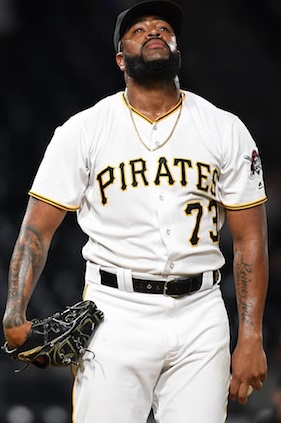
Pirates relief pitcher Felipe Vasquez. His ubiquitous tattoos helped identify him as a sex predator with at least one underage girl.

Let’s see. Either the Astros or the Braves will be the next team to clinch their division titles, and in theory they could do it on the same day, since they both awoke this morning with magic numbers of three. In theory.

The Astros have a better shot at doing it first since their remaining schedule is just a trifle easier than the Braves’. But remember Andujar’s Law: In baseball, there’s just one word—you never know. And the Astros’ main 2019 rivals for the best ratio of excellence to injury compromise or depletion, the Yankees, are a game from clinching their division.

I was wrong so far about the loss of Christian Yelich to the Brewers and their general manager David Stearns was right so far. I thought losing their by-far best player for the season last week meant a gut punch to their season. Stearns thought it was just a gut punch for the night. Stearns wins that argument.

Even if they did it against bottom feeders mostly, the Brewers are 6-1 since Yelich went down after fracturing his knee cap on his own foul off the plate. And they’re tied with the Cubs, who have their own issues, for the second National League wild card.

And I’m still rubbing my eyes over the fact that this year, too, as seems to happen too often in baseball’s wild card era, we’re watching all the thrills, chills, and spills of at least eight teams fighting to the last breaths to finish . . . in second or even third place.

As of this morning it’s still possible mathematically that the National League’s second wild card could be won by a team finishing third in its own division, and two teams (the Mets in the NL East; the Brewers in the NL Central) still have a shot at that. Which means, in theory, a third-place team could heat up enough to go to, if not win the World Series.

And even if the Giants and the Red Sox are out of the races, it was still a thrill Tuesday night when Mike Yastrzemski of the Giants—the grandson of the Red Sox’s Hall of Fame legend Carl Yastrzemski—confabbed with Grandpa on the field before the game at Fenway Park, then blasted one into the center field seats with two out in the top of the fourth.

But all the above gets knocked to one side upon the news that the best pitcher on major league baseball’s possible most fractured and fractuous team this year may be a sex criminal.

Bad enough that the Pirates’ clubhouse became a well known mess this season. Enough of a mess that two of the key culprits, relief pitchers Kyle Crick and Felipe Vasquez, had a clubhouse fight over Vasquez’s music that caused Crick a season-ending finger injury. Way worse is Vasquez arrested Tuesday in Pittsburgh, on Florida and Pennsylvania charges involving sexual misconduct with underage girls.

According to KDKA, CBS Pittsburgh, Vasquez is charged with “computer pornography–solicitation of a child and one count of providing obscene material to minors,” out of Lee County, Florida. Denied bail at his arraignment in Pittsburgh Tuesday—senior district judge Eilenn Conroy considered him a flight risk—he faces an extradition hearing a week from today.

Far more grave is what Pennsylvania State Police announced Tuesday evening, according to The Athletic: charges of statutory sexual assault, unlawful contact with a minor, corruption of a minor by a suspect eighteen or older, and indecent assault of a victim under sixteen.

Yardbarker reported this girl told officers she met Vasquez when she was thirteen and they kept in touch via text messages and other computer/phone apps. USA Today‘s Chris Bumbaca reported the girl’s mother “discovered the messages, two pictures and a video one week after they were sent to the victim on July 16. At that point, the mother told the suspect he was communicating with a minor. Police began an investigation on Aug. 8.”

Bumbaca added that Vasquez’s face wasn’t visible in the images but authorities identified him by way of his numerous and too-distinctive tattoos, and by the girl addressing him as Felipe during their text message exchanges.

“These allegations are very, very serious,” said Pirates pitcher Chris Archer, whose own season ended officially Sunday thanks to shoulder issues keeping him on the injured list since late August. “One term that was used earlier was heinous. Right now, as far as we know, they’re just allegations. There’s not a lot more we can say.”

There wasn’t? The Pirates wasted practically no time wiping Vasquez off the face of their earth before the Pirates hosted the Mariners at PNC Park Tuesday evening, The Athletic‘s Rob Biertempfel writes.

By game time, looking around the stadium, it was as if Vázquez had never played for the Pirates. His clubhouse locker was empty. His banner outside PNC Park had been taken down. His image was scrubbed from the scoreboard videos. His name was deleted from the list of National League save leaders that flashes on concourse monitors before the game. The scorebook magazines with Vázquez on the cover, which normally are handed out to fans as they enter the stadium, were stashed out of sight.

The Pirates informed the commissioner’s office almost at once and Vasquez was put on administrative leave and baseball’s restricted list. He’ll face worse if he’s tried and convicted. And that would still be nothing compared to what his victims and their loved ones have to come to terms with. They deserve your compassion and your prayers.

This isn’t just an athlete accused of and disciplined for domestic violence. This is one accused of having or seeking actual sexual activity with underage girls. ESPN’s Jeff Passan tweeted even more grating news this morning: “Police said . . . Vazquez admitted that he drove nearly an hour in 2017 to meet a 13-year-old girl and tried to have sex with her, according to a criminal complaint released today. After a failed attempt, Vazquez, then 26, left to go to a game, per the complaint.”

Only after 1980’s-1990s Cubs/Indians/Yankees/Giants outfielder Mel Hall’s career ended did we learn he spent much of his off-field career maneuvering 12- and 13-year-old girls into sexual activity. Those grotesque maneuverings continued after his career ended. Hall was finally arrested for rape in 2007 and sentenced to 45 years in prison in 2009.

Until now the worst thing that ever happened to the Pirates in legal terms (the absolute worst at all, of course, was Hall of Famer Roberto Clemente’s death in a 1972 plane crash) was probably six players testifying and facing discipline from then-commissioner Peter Ueberroth as part of the 1985 Pittsburgh drug trials.  Analysts observing the dissipation of this year’s Pirates and suggesting a housecleaning should come may want to amend that suggestion to a fumigation.

One of life’s saddest realities is that there are times, indeed, when a man can be accused falsely and wrongly of such sordid crimes as those with which Vasquez is charged. The evidence known thus far suggests he isn’t even close to one of those men.

Joe Keough, RIP: A Royal hit

2019-09-16 JoeKeough

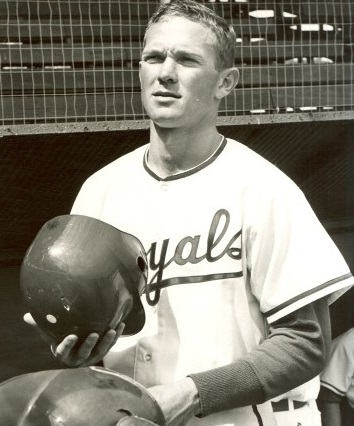
Joe Keough near the Royals dugout: “Those were some of the best times of my life.” (Kansas City Royals photo.)

Unless you’ve been a Royals fan since the day they were born, you wouldn’t recognise Joe Keough immediately. If you’re my age, you remember (maybe) that he was the kid brother (by twelve years) of longtime major league utility man Marty Keough. Or, that his nephew is ill-fated former Athletics pitcher Matt Keough.

But if you are a Royals fan since the day they were born, Joe Keough—who died at 73 on 9 September in Miami—is a name you should and probably do know. The Royals began life winning their first two regular season games, ever—both on walk-off hits. Keough nailed the first one . . . as a pinch hitter.

He became an Original Royal in the first place because the A’s made him available for the American League’s second expansion draft after 1968. He’d gotten a second-half call-up to the A’s and debuted in Yankee Stadium 7 August, in a game featuring one Hall of Famer approaching the end (Mickey Mantle) and another Hall of Famer (Reggie Jackson) who’d only just begun to wreak havoc.

Keough was sent up to pinch hit for A’s reliever Jack Aker against the Yankees’ respected veteran reliever Lindy McDaniel to lead off the top of the eighth. There are worse times to take your first trip to the plate in a major league game, but Keough made the most of it and headlines for it. He yanked one into the right field seats to tie the game at three. Sweetening it was the game going to extras and Jackson’s RBI single in the top of the twelfth holding up for a 4-3 A’s win.

A kid with a .590 OPS wasn’t exactly what the A’s seemed to have in mind, alas, so they exposed Keough to the expansion draft and he became a Royal. He made the Opening Day roster as the Royals began in Municipal Stadium, the former playpen of the A’s before their move to Oakland.

The Royals faced the Twins to begin their new life. Keough spent most of the game watching on the bench, until a three-all tie went to the bottom of the twelfth.”I came out of spring training wanting to start very badly,” he told an interviewer in 2011. “Our manager that year . . . decided not to start me and I was a little upset about that.”

On the mound for the Twins was Joe Grzenda, in relief of former longtime Dodgers relief bellwether Ron Perranoski, after former World Series hero Moe Drabowsky (he of the eleven strikeouts in relief in Game One, ’66 Series) retired the Twins in order in the top.

Former Angel Ed Kirkpatrick led off with a line out to Twins center field fixture Ted Uhlaender but former Red Sox Joe Foy singled and took second on a passed ball while Grzenda worked to Chuck Harrison. The Twins then elected to put Harrison aboard to set up a double play prospect with Bob Oliver, a rookie power hitter, coming up to the plate.

But Grzenda wild pitched Foy and Harrison to third and second, then the Twins elected to re-establish the double play possibility and put Oliver aboard with Royals catcher Ellie Rodriguez, generally a defense-first player with little power at the plate, due to hit next.

Enter Royals manager Joe Gordon—you guessed it. The same Joe Gordon who once shone at second base for the Yankees. The same Joe Gordon whom, managing the Indians in 1960, would be swapped, essentially, for Tigers manager Jimmy Dykes. The same season during which the Indians began life without slugging right fielder Rocky Colavito, whom their capricious general manager Frank Lane dealt to the Tigers for aging outfielder Harvey Kuenn before the season.

Gordon now decided he had a better shot if he inserted Keough, whose rookie 1968 produced a .590 OPS, to pinch hit for Rodriguez, whose cup of coffee with the 1968 Yankees delivered an OPS .085 points lower. And Gordon was right. Keough pulled a line single to right to send Foy home and win it, 4-3. “It was a very cold, cold day,” Keough told Fox4KC last year. “I got a good pitch to hit and I hit it.”

Maybe Keough put a little mojo into the Royals. Because they won the second game of their existence the next day in extra innings, too. This time, it took seventeen innings. And this time, the game-winning RBI single came through the courtesy of future Yankee fixture, World Series-winning Reds manager, and record 116 game-winning Mariners manager Lou Piniella.

The bad news is that’s about as far as the embryonic Royals’ mojo went, even if Piniella became American League’s Rookie of the Year. They finished 28 games out of first in the newly established American League West. The only reason it wasn’t bad enough for a cellar finish is because the White Sox (29 games out) and the Royals’ fellow expansion team, the Ball Four Seattle Pilots (33 out), happened to be much worse.

An outfielder whose habits included climbing the steep Municipal Stadium steps every day with a few teammates during homestands to help stay in shape (“It was a great workout for us”), Keough managed to keep his mojo working long enough to make the Royals’ everyday lineup in 1970 as their leadoff hitter.

He owned a .398 on-base percentage by late June. Then came the second game of a doubleheader against the Angels at home. The good news: the Royals turned a close enough game into a 13-1 blowout. The bad news: Keough’s mojo broke along with his leg three innings earlier.

Somehow a mini-legend has arisen over the decades since that Keough was injured trying to score a run the Royals didn’t really need by the time he scored it. Legends may be stubborn but those pesky facts are more so. Keough was on second in the bottom of the fifth, with the Royals having just taken a 2-1 lead, when their center field star Amos Otis rippled a single to right.

Keough gunned it home and collided with Angels catcher Tom Egan on the play, scoring the third Royals run but fracturing his leg and dislocating his ankle in the collision. The run put the Royals up by two; they’d score six in the eighth to finish what became the blowout. But Keough’s scoring injury killed his season and, for all intent and purpose, his career, just when it began solidifying.

He winced when reminded of the play during that Fox4KC interview. “Those are things you don’t want to remember,” he began, allowing himself a chuckle of regret, “but yes I do remember breaking my leg. It was a lot of pain. It changed my life, but it changed in a lot of different ways that’s good.”

Keough would play three more none-too-impressive major league seasons before calling it a career before the 1974 season. A northern California native, he raised four children and made a post baseball life out of Texas in marketing and real estate development for such companies as Fotomat, 7-Eleven, Burger King, PayLess Shoe Source, and EyeMasters, while enjoying golfing and cooking and his five grandchildren.

Fan friendly and rarely missing from events involving the ’69 Royals for decades to follow, Keough aged gracefully in retirement, looking more like a slim, composed, kindly small town storekeeper than a former ballplayer who ran the steepest stadium stairs to stay in game shape and never forgot his years on the Royals’ earliest teams.

“Those were some of the best times of my life,” he said with a smile.

Feud for thought

2019-09-15 NoahSyndergaard

Noah Syndergaard isn’t exactly being a prima donna when he insists throwing to Tomas Nido behind the plate is both his preference and better for him.

One of the first baseball legends I can remember reading about as a child is the 1927 feud between Pirates outfielder Kiki Cuyler and manager Donie Bush in 1927. I read about it in a pulp early 1966 paperback called Baseball’s Unforgettables, which had the ink-painted heads of Willie Mays and Sandy Koufax on the front jacket and cartoon baseball images—several of also which illustrated the chapters—surrounding them.

The way I read it in that book, Bush “stubbornly and foolishly” held a grudge against Cuyler for refusing a lineup shift out of his number three slot to bat second. Not to mention that the feud between the two may have cost the pennant-winning Pirates the World Series. And neither is entirely true.*

In his first season as strictly a manager (he’d been a player/manager for the 1923 Washington Senators), Bush wasn’t thrilled about the usually mild-mannered Cuyler’s defiance. But if Baseball’s Unforgettables quoted Cuyler as pleading, “Don’t do it, Skip, it’s a jinx for me,” Cuyler himself had a different take: as The Sporting News quoted him in his 1950 obituary, Cuyler didn’t think his kind of freer swinger really belonged in a lineup slot demanding more precise contact hitting.

According to Rob Neyer’s Big Book of Baseball Blunders, the argument didn’t do Cuyler any favours with Bush, but it came to a head not over the batting order but over a potential double play. On 6 August 1927, running from first, Cuyler elected not to slide into second on a double play attempt because he thought he had a better chance of obstructing the relay throw to first by arriving standing up.

The Pirates lost the game and fell three behind the Cubs. Bush didn’t buy Cuyler’s reasoning over the running play. Maybe marrying that to the batting order dispute prompted Bush, at last, to bench Cuyler for the rest of the season (save one early September game) and the Series. Then, the Pirates traded Cuyler to the Cubs after the season.

The legend became that benching Cuyler cost them the Series. The legend is bunk. Cuyler wasn’t the Pirates’ best player in 1927; the Hall of Famer wasn’t even their tenth-best player. (The two best the Pirates had in ’27: Hall of Fame outfielder Paul Waner and pitcher Ray Kremer.) The Pirates went 34-18 after the Cuyler benching to win the pennant. But the only team on the planet who could beat the 1927 Yankees might be the 1998 Yankees, if not this year’s Astros.

The worst thing the feud did was to alienate Donie Bush with the Pirates’ fan base. Cuyler was popular enough that Bush couldn’t recover his public image in Pittsburgh, and he resigned in August 1929. He’d have 65 years in baseball total before his death in 1972 while scouting for the White Sox.

My revisiting the Cuyler-Bush feud was instigated by the current apparent debate between Noah Syndergaard and the Mets. Syndergaard isn’t the first pitcher to think about having a particular catcher working with him or even about having a personal catcher. But the issue amplified Friday night.

That’s when Syndergaard took three shutout innings and a 1-0 Mets lead against Clayton Kershaw into the fourth, with Wilson Ramos behind the plate. After a leadoff groundout, Syndergaard and Dodgers star Cody Bellinger wrestled to a ten-pitch walk. Corey Seager singled Bellinger to third at once; then, A.J. Pollock singled through the right side of the infield to score Bellinger, and Gavin Lux, a rookie September call-up, smashed a three-run homer.

Syndergaard worked the fifth the better to keep Mets manager Mickey Callaway from having to turn to his rickety bullpen too soon. It didn’t keep the Dodgers from piling five more on at that bullpen’s expense. And it re-opened the question of whether Syndergaard should get to throw to his preference, backup catcher Tomas Nido, instead of regular catcher Ramos.

There were those who thought (and probably still think) that Syndergaard wrestling with the Mets over his catchers is going to be one more reason for the Mets to put him on the trading block at last after the season ends. There are those who thought (and probably still think) that forcing Syndergaard to throw to a catcher with whom he’s not comfortable may cost the Mets a by-now-too-slim shot at the postseason.

We’ll know soon enough whether the former proves true, but the latter? The Mets’ postseason chances went from new and much improved with that magnificent post-All Star break run to strikingly slim after losing one too many key contests despite a .600+ record in each of July, August, and September thus far.

What really ruined their postseason chances was their horrible, drama-dominant April through June. They looked like a Mess, acted like it often enough, and still have a few things from those three months returning to bite them in the butts just a little too often even in the middle of their second-half success.

Callaway remains under a white-hot microscope over his tactical missteps and strategic vision-challenges. Saturday’s next-to-the-eleventh hour shutout win against the Dodgers, 3-0, magnified it, when he was forced to pinch hit for one of his few relief jewels, Seth Lugo, with the bases loaded in the bottom of the eighth, where he could have double-switched Ramos out after the backstop ended the seventh and kept Lugo’s lineup slot eight slots away from arriving.

He got lucky with pinch hitter Rajai Davis, who hadn’t had a base hit since late August and took an 0-for-10 string to the plate. Davis yanked Dodger reliever Julio Urias’s 1-2 changeup down the left field line to clear the pads. And he said afterward that he didn’t want to leave the Mets without Ramos’s bat in the lineup.

There’s part of the issue. Ramos has been one of baseball’s hottest hitters since the All-Star break. Nido by comparison can’t hit with a hangar door. But have a look at how Syndergaard—and Cy Young Award defender and 2019 candidate Jacob deGrom—pitch when Ramos or Nido are their catchers:

To Wilson Ramos: G ERA BAA XBH K K/BB K/IP K/G
Jacob deGrom 19 2.68 .209 24 145 5.0 1.3 7.6
Noah Syndergaard 16 5.20 .258 32 97 4.4 1.0 6.1
To Tomas Nido: G ERA BAA XBH K K/BB K/IP K/G
Jacob deGrom 11 1.88 .202 18 91 7.0 1.2 8.3
Noah Syndergaard 10 2.45 .217 20 63 3.3 0.9 6.3

Syndergaard’s -2.75 ERA differential when throwing to Nido instead of Ramos bears out his argument in favour of Nido on purely pitching/defense terms. DeGrom’s differential is -0.80. DeGrom to Ramos still has a Cy Young Award-caliber 2.68 ERA. Syndergaard looks like a Cy Young Award-caliber pitcher with Nido behind the plate and like a Sayonara Award-caliber pitcher with Ramos behind the plate.

Syndergaard strikes batters out just a shard more often than he walks them with Ramos than he does with Nido—but he strikes them out a speck less throwing to Nido than to Ramos.

DeGrom is simply a better pitcher almost regardless of who’s behind the dish for him; you could send bullpen coach (and ex-major league pitcher) Ricky Bones behind the dish and deGrom will pitch like a Cy Young Award winner. If he’s striking out 8.3 hitters a start with Nido behind the plate, assuming deGrom’s average seven innings per start continues, he’s still striking out 7.6 per start with Ramos behind the plate.

While I was at it, I looked up the Mets’ other starters. Zack Wheeler’s ERA is 3.03 lower with Ramos behind the plate than with Nido. Marcus Stroman, who pitched his first truly quality start as a Met Saturday, has a -0.20 differential when throwing to Nido. It may not make a great difference if Stroman throws to Ramos.

(Where’s Steven Matz, you ask? Easy: Matz only threw to Nido once this season, in a relief appearance against the Phillies just before the All-Star break. You can leave Matz with Ramos behind the plate safely, especially with Matz’s turnaround second half. Matz in the second half has a 2.52 ERA and an 8.5 K/9 rate, both far above his first-half struggling. Matz-Ramos is one battery you don’t want to break up.)

Maybe we should look at the walks and hits per inning pitched (WHIP) when each catcher is behind the plate for deGrom and Syndergaard:

To Wilson Ramos G IP H BB WHIP
Jacob deGrom 19 114.0 87 29 1.02
Noah Syndergaard 16 97.0 96 22 1.22
To Tomas Nido G IP H BB WHIP
Jacob deGrom 11 72.0 53 13 0.92
Noah Syndergaard 10 66.0 52 19 1.07

It might have made plenty of sense if the Mets had spent more time reviewing the actual performance papers and decided that, yes, it would be smart to start Tomas Nido every time Jacob deGrom and Noah Syndergaard pitch. And, with the need for Ramos’s live bat as profound as it is, switch Ramos into those games after lifting deGrom or Syndergaard.

Dreaming, you say? This season, Ramos is hitting .314 when the games are late and close—and he’s hitting a whopping .379 with a 1.003 OPS in high leverage. And, yes, that’s mostly thanks to his bristling second half at the plate. Now, try to imagine the outcome of more than a few games if Nido was sent out to start with deGrom and Syndergaard regularly, and Ramos got switched into those games after those two pitchers were lifted.

Curiously, deGrom pitched a gem Saturday with Ramos behind the plate and outpitched Dodgers Cy Young candidate Hyun-Jin Ryu while he was at it: three hits and eight strikeouts in seven innings; nineteen called strikes and eleven swinging strikes; and, a 2-to-1 ground ball to fly ball rate.

But remember that even with Ramos catching him deGrom pitches like the ace he is. Syndergaard, who’s almost as talented, needs every break he can get. You can say Syndergaard is responsible for executing pitches, and you’d be right, of course. But ponder this, as New York Post writer Joel Sherman does:

Kershaw is the best pitcher of his generation and when he was Syndergaard’s age, he insisted on throwing to A.J. Ellis, a light-hitting backup. A main task of a manager is putting players in position to succeed—and that is not happening currently with Syndergaard.

Syndergaard’s not exactly being a prima donna by insisting he’s better off with Nido than with Ramos behind the plate. Kershaw, a Hall of Famer in waiting, really, wasn’t the first to think about personal catchers and he won’t be the last. And a lot of pitchers have credited their success to one or another particular catcher.

Hall of Famer Whitey Ford once said throwing to Hall of Famer Yogi Berra made him the pitcher he became. And those pesky statistics also bear out that every Yankee pitcher not named Ford when Berra was the regular Yankee catcher pitched better throwing to Berra than at any other time in their entire careers.

(You want to argue success? With Yogi as their regular catcher, the Yankees won nine pennants and seven World Series including five straight despite pitching staffs composed mostly of pitchers who shone as Yankees but were comparative non-topics elsewhere.)

That’s not quite the same as the personal catcher concept, of course, but it’s not something to dismiss too readily.

Tim McCarver had a fine playing career but a lot of it included being Steve Carlton’s preference behind the plate. Charlie O’Brien and then Eddie Perez were a lot more valuable to the Braves because Greg Maddux preferred pitching to one and then the other when the one left as a free agent. Those catchers weren’t exactly in Berra’s league but a pair of Hall of Famers must have known and seen something, right?

You can’t really say that obstinance over who catches whom will sign the Mets’ 2019 death warrant if they don’t make even the wild card play-in game. Of course, if by some alchemy the Mets do sneak into the second wild card and play the likely first card-winning Nationals in the play-in game, they should be broiled and basted if they send anyone not named Nido out to catch either deGrom or Syndergaard in that game.

No Syndergaard-vs.-Mets feud will cost the Mets. Any more than a Kiki Cuyler-Donie Bush feud really cost the 1927 Pirates. Those Pirates won the pennant without Cuyler down the stretch, but they were done in in the World Series by an immovable threshing machine. These Mets will have done themselves in with a first half that, for all their second-half perseverance, still seems like the insurmountable burden.


* Baseball’s Unforgettables also managed to get the spelling of Donie Bush’s name wrong—the book spelled it “Donnie.”

Born Owen Joseph Bush, his original nickname as a Tigers shortstop was Ownie, which teammate Ed Killian got changed to Donie based on Killian describing a pitch on which Bush struck out as a “donie” pitch, “donie” happening to rhyme with Bush’s original nickname. Teammates picked up on it—and began calling him Donie Bush.