Don’t overthink, either . . .

2019-08-15 MickeyCallawaySethLugo

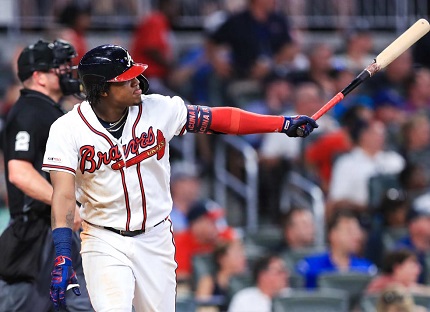
Mickey Callaway lifts Seth Lugo in the seventh Wednesday—after Callaway shouldn’t have lifted Steven Matz to start the inning.

What really cost the Mets in Wednesday night’s disaster in Atlanta? And does it really mean the Mets’ astonishing enough post All-Star break self-resurrection imploding before their and our eyes and ears?

Two cases of overthink. One calamity of a bottom of the seventh. One close-but-no-cigar final stand in the top of the ninth. And a 6-4 loss that lands prominently on the roll of bad, very bad, don’t even think about it Met immolations.

You be the judge.

Was it overthinking Mets manager Mickey Callaway lifting Steven Matz after letting Matz bat for himself in the top of the seventh? Or, was it Rookie of the Year candidate Pete Alonso’s rookie fielding mistake costing the Mets maybe two critical outs in the bottom of the seventh?

Matz was as secure on cruise control as a pitcher can be Wednesday night. Six innings pitched, two hits and one earned run surrendered, and only 79 pitches thrown. Almost as much of a masterpiece as he pitched two days before the new single mid-season trade deadline, when he threw a five-hit shutout at the Pirates.

Then Matz thanked Callaway for letting him swing in the top of the seventh, the game tied at one apiece, with a two-out base hit that set him up to be the eventual tiebreaking run when Amed Rosario singled him to third and took second on the play and J.D. Davis promptly singled him home.

All of a sudden it looked as though the Mets really were going to shake off the bad news that Jeff McNeil, their top-of-the-order ignition switch, would spend ten days on the injured list thanks to the left hamstring he strained hustling out a grounder late Tuesday night.

And Callaway thanked Matz by hooking him in favour of Seth Lugo, lately the Mets’ best relief pitcher, but last seen pitching the final two innings last Saturday and shaking off Juan Soto’s eight-inning home run to win it after the Mets came back late on the Nationals a second straight night to win.

This wasn’t exactly the same thing as Gene Mauch pushing a panic button after a stolen home plate loss and going to a three-man pitching rotation of Hall of Famer Jim Bunning, Chris Short, and whomever else he dared let himself trust otherwise with the 1964 Phillies six games up and a pennant in hand—only to see it blow a ten-game pennant-costing losing streak up in his face.

But after Wednesday night it could portend the end of the Mets’ bootstrap postseason hopes.

Because Lugo, the owner of an 11.6 strikeouts per nine rate this season, didn’t have his best, and surrendered a leadoff walk to Josh Donaldson, two followup singles to load the bases, and Ender Inciarte’s RBI single to left center promptly after that, re-tying the game at two each.

And then it really happened.

Braves catcher Tyler Flowers grounded one between first and second that clearly looked like a second baseman’s play. Mets second baseman Ruben Tejada looked like he was ready to spear it. But Alonso playing first, and in proper positioning except for maybe a two-small-step cheat to his immediate right, scrambled hard to his right trying to get that ball.

And, failing by about an inch when the ball snuck just under and past his downstretched glove.

Even with the two-step cheat right Alonso could have reached his pad with room to spare to take a throw from Tejada. And the throw would have hit him in plenty of time to throw home and nail Adam Duvall coming down the third base line.

But Alonso’s derring-do attempt cost the Mets a tiebreaking run instead of helping the Mets to two critically swift outs. And, the chance to escape without further calamity. And, most significant, an easier time of winning the game than they’d end up having losing it.

Consider: Matt Joyce hit a sinking liner that Mets right fielder Michael Conforto took on a sliding short-hop, with Conforto springing up sharply and throwing to second to get Flowers. If Alonso played proper positioning and nailed that double play, the run represented by Johan Camargo running from third would be vaporised by Flowers as the side-retiring out.

Instead, Camargo’s run scored and Ronald Acuna, Jr. promptly singled Inciarte home, chasing Lugo out of the game in favour of Luis Avilan. Who promptly surrendered Ozzie Albies’s RBI single before getting Freddie Freeman to whack into a step-and-throw double play.

“I thought I made a bunch of good pitches. They didn’t really hit anything hard,” Lugo said after the game. “A little brain fart there not covering first base, I should have known where the defense was, but I thought I made good pitches.”

Lugo was right about the Braves not hitting particularly hard balls against him. But he wasn’t to blame for the first base mishap. He was probably caught as far off guard as anyone else in the park when Alonso scrambled out of position instead of letting Tejada have it and being ready for a throw to first.

Callaway refused to second guess lifting Matz and sending Lugo out for the bottom of the seventh. Apparently, he preferred to let just about everyone else do it for him.

“I’ll make that move 100 times out of 100, that’s the right move in my mind,” the manager said after the game ended. “Lugo is our best reliever, he’s been our best pitcher overall lately, so the reward is he puts up two zeroes, you win the game.” Never mind that Jacob deGrom might make an argument as to whom the Mets’ best pitcher overall has been this year.

“The plan was to go two innings with Lugo and see who was coming up in the ninth,” Callaway said. The Braves love it when a plan doesn’t come together.

What about Matz having been so efficient against Dallas Keuchel, who’d been as stingy with the Mets as Matz was with the Braves, until the Mets got into the Braves’ otherwise skittery bullpen to break the one-all tie with more bullpen treats yet to come? What about Matz having retired fourteen straight Braves before he scored the tiebreaker in the top of the seventh?

All Callaway saw was his pitcher running the bases in the top of the seventh. He didn’t see how his man actually did feel, even after that. “I was feeling good and my command was starting to come together,” Matz said after the game.

If he was feeling good and his command was starting to come together after fourteen straight outs, only one run on his evening’s jacket, and only 79 pitches on his left arm to that point, Callaway—formerly a respected pitching coach who’s supposed to know and measure these things on the spot—was asleep on his feet.

Instead, the Mets now have their first three-game losing streak since the All-Star break. It’s their longest losing streak since the seven-game streak that took them to the last day of June. Until this week their dog days of June began seeming like distant memories.

And Callaway lifting Matz before Alonso scrambled too far out of position for a grounder to second he couldn’t snatch makes formerly distant memories like David Cone giving the Dodgers bulletin board fodder, Kenny Rogers walking home the pennant-losing run, Carlos Beltran frozen solid on a pennant-losing strike three, and Hall of Famer Tom Glavine killed to death in the first at the end of 2007, become only too vivid all over again.

“Don’t think,” Crash Davis admonished Nuke LaLoosh in Bull Durham. “Because it’ll only hurt the ball club.” Don’t overthink, either. It has the potential of nuking the ball club. Or forcing it to hope for one salvage instead of potentially winning a set against the division leaders.

Now we really get to see what these Mets are really made of. On Thursday night, they’ll do one of two things: 1) They’ll acquit themselves and begin shaking off Wednesday night’s disaster as if it was just a one-night nightmare. 2) They’ll get clobbered or implode.

If the former, there’s plenty of hope yet, especially with the Indians due to meet them back in New York after a weekend in Kansas City that shouldn’t be too arduous against a collection of Royals who’ve won only three of their first twelve August games.

If the latter, hope springs infernal, no matter what happens in Kansas City, because the Indians aren’t the Royals, and the implosion of these Mets may continue drastically. Enough to make that 21-8 second half before Wednesday night seem like a pleasant dream ended by a very rudely exploding alarm clock.
“#L[et’s]F[or]G[et]M[ets]?”

2019-08-14 SunTrustPark

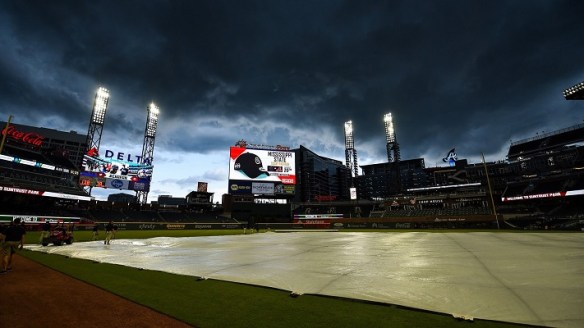
Atlanta’s Sun Trust Park Wednesday night, shortly after scheduled game time–but not a Mets disaster— was delayed.

Rain and the look of a storm of doom over Atlanta’s Sun Trust Park delayed game time between the Mets and the Braves by about an hour and a half Wednesday night. By the time the game ended, traveling Mets fans in the ballpark must have wondered if that storm-of-doom look was really an omen of doom.

For the Mets.

If the Mets’ post All-Star break surge and swath turns into disaster the rest of the way, their faithful are liable to look back to the bottom of the seventh Wednesday night. And ask themselves how often even the most heads-up rookies make the kind of rookie mistakes that prove to deflate the re-aspiring.

The kind that turn a two-all tie early in the bottom of the seventh into the open door through which the Braves finally finished a five-run inning that may have had even them wondering whether they were really there even if they were the beneficiaries.

The kind Pete Alonso, to this point a solid Rookie of the Year candidate, including normally steady and heads-up play at first base, instigated when he ran so wide of first to try for a grounder that had “second baseman” clearly in its destination window that it turned into an RBI single. When nobody was left to cover first on the play on which Alonso should likely have stayed in his proper position.

The kind that serve as a prelude to the Braves gifting the Mets the bases loaded and one out in the top of the ninth, after the Mets scratched their way back to a two-run deficit, and the Mets looking the proverbial gift horse not just in the mouth but all the way down the creature’s throat.

The kind that clear a path to a 6-4 loss that stands an excellent chance of entering Mets lore on the wrong side of the ledger, because it’s the kind of loss that can and often enough does turn what had been baseball’s hottest team until arriving in Atlanta into a collapsing bubble.

Alonso made a plain rookie mistake. It invited more than just a single inning five spot against the Mets. It invited serious thinking as to whether these Mets, as plucky and as willful and as tenacious as they’d been before they arrived in Atlanta this week, played too far over their own heads since the All-Star break to think of any kind of serious contention until next year.

And it was the last thing the Mets needed after learning their top-of-the-order ignition switch, Jeff McNeil, hit the ten day injured list with a left hamstring strain.

With the tying run already home against Mets reliever Seth Lugo and the bases still loaded, Braves catcher Tyler Flowers grounded one toward second. Alonso may have taken a couple of cheat steps to his right at the moment of contact, but the ball headed just too clearly toward Mets second baseman Ruben Tejada.

Alonso still scrambled to his right furiously. And the ball scrambled right past his downstretched glove. And Lugo at the mound may have been caught completely flatfoot by Alonso scrambling for a ball he really had no business trying to play. Tejada would have such a simpler grab that, in proper position, Alonso could have taken the throw for the out at first and thrown home to get Braves left fielder Adam Duvall.

And with Lugo not even close to covering first on a play where he shouldn’t have had to think about it, Tejada did grab the ball after Alonso’s staggering miss. With no place to throw. With Duvall scoring safely and the Atlanta ducks still on the pond.

Then pinch hitter Matt Joyce lined one that Mets right fielder Michael Conforto almost reached before it hit the grass, Conforto having to settle for a sliding short-hop pick and a throw in to get Flowers at second while Johan Camargo scored. And Ronald Acuna, Jr. singled to right center to send Ender Inciarte home and Lugo out of the game in favour of Luis Avilan.

Ozzie Albies greeted him with sixth single of the inning before Avilan got Freddie Freeman to hit into a step-and-throw inning-ending double play.

Too little, too late.

Or was it? After wasting Steven Matz’s solid start against a surprisingly stingy Dallas Keuchel, the Mets found themselves pushing reliever Mark Melancon and the Braves up against the wall in the top of the ninth.

Lagares rapped a one-out single and Joe Panik pinch hitting doubled to shallow left. Amed Rosario singled Lagares home and pinch hitter Luis Guillorme singled Panik home. And up stepped Alonso in desperate need of redeeming himself and his terrible miscue.

He rapped a bouncer toward second, where Albies threw it inside-out to Camargo coming over from shortstop. Camargo caught the ball as Guillorme arrived sliding but—as replays and review showed, strangely enough—Camargo began transferring the ball out of his glove a split moment before his foot touched the base, and he couldn’t hold the ball in his throwing hand, the ball bumping and grinding away from him.

The review overturned the original out call at second. The Mets were just handed the bases loaded and only one out. A base hit was liable to tie the game; an extra-base hit liable to give the Mets a one-run lead at minimum.

But Wilson Ramos struck out swinging on a Melancon curve ball that dove like a fighter plane shot down. And Braves manager Brian Snitker brought in a lefthanded former Met, Jerry Blevins, to work to lefthanded incumbent Met Michael Conforto.

First Conforto missed hammering Blevins’s opening fastball for a grand slam by a couple of feet wide of the right field foul pole. Then, Conforto fouled off a curve ball. Then, he swung on and missed a curve ball.

Even Mets manager Mickey Callaway’s decision to lift Matz when the Mets wrested a 2-1 lead in the top of the seventh—after Matz himself hit a two-out single and scored the first of two tiebreaking runs on J.D. Davis’s single up the pipe—won’t be second guessed as heavily as Alonso might be for hustling himself into such a mishap instead of standing his ground and waiting for the putout that might have changed the inning tone. Might.

It’s hard enough when you run yourself into a fateful fielding mistake while in proper position. It’s worse when it happens as you’re scrambling and rambling too far out of position. And don’t ask about when you subsequently scratch, claw, burrow, and shovel your way back to within a pair of runs and ducks on the pond with one out in the ninth, and come up with the ducks quacking fowl over abandonment.

It’s worse to think that Alonso, the rookie who’s been so magnificent for these Mets all year long, through the worst of times and the better of times alike, may yet be remembered the way Met fans remember David Cone leaving the Dodgers bulletin board fodder in the 1988 National League Championship Series.

Or, Kenny Rogers walking home the pennant-losing run in the 1999 National League Championship Series.

Or, Carlos Beltran frozen by strike three to end the 2006 National League Championship Series.

Or, Hall of Famer Tom Glavine battered on the final day to secure their fall out of the 2007 postseason.

Or, Lucas Duda, with the easiest chance on earth, throwing home offline in the top of the ninth of Game Five, 2015 World Series.

Men who had done well enough or better as Mets only to come up, despite careers ranging from modest to good to great to the Hall of Fame, like enough 20th Century (and one or two 21st Century) Cubs and Red Sox to start writing their own snakebite history.

This year’s Mets continue learning the hard way that they can’t win everything at the last minute, or even the next-to-last minute. Alonso’s own rally hashtag, #LFGM, may have begun turning from “L[et’s]F[ornicating]G[o]M[ets!]!” to “L[et’s]F[or]G[et]M[ets!]”

It may take a radical intervention to get the Mets into crisis addiction recovery, after all. And by that time it may yet be too little, too late, to save a season they looked as though they were turning into surrealistic redemption.


Wounded cops and battered Cubs

2019-08-17 BryceHarperRhysHoskins

Bryce Harper gives Rhys Hoskins props after Harper’s first-inning bomb started a Wednesday night Phillies blowout . . . unaware, likely, that six Philly cops were wounded in gunfire with a barricaded suspect.

A self-barricaded narcotics suspect in a home on the north side of Philadelphia. A standoff with police involving over an hour’s worth of gunfire exchanges, maybe more, and six  officers wounded.

The standoff began shortly before the Phillies faced the Cubs at Citizens Bank Park Wednesday night. It was still ongoing after the Phillies delivered a far less fatal kind of gunfire at the Cubs good for ten runs before the third full inning expired. It was still ongoing after Bryce Harper hit his second home run of the night.

And it was still ongoing, apparently, after the Phillies finished what they started, an 11-1 blowout of the National League Central leaders.

None of the six wounded cops was injured gravely, thankfully, though the city’s police commissioner Richard Ross said several of the cops who responded to the barricader and got into the house had to escape by jumping through windows. At one point the standoff that began late in the Philadelphia afternoon had nearby Temple University’s Health Sciences Center on lockdown.

Cole Hamels made his third start since returning from the injured list and his first in Philadelphia since leaving the Phillies in a then non-waiver trade deadline deal with the Rangers four years earlier. The audience cheered him appreciatively when he batted in the top of the third, but it was hard to tell whether it was thanks for the memories past or thanks for the clobbering the Phillies were giving him this night.

While police continued trying to resolve the standoff without any further injury or damage, and word emerged that there was a second narcotics suspect in the house aside from the shooter, the Phillies came to bat after starting pitcher Aaron Nola rid himself of the Cubs in the top of the first with a ground out sandwiching a pair of swinging strikeouts.

They didn’t give Hamels a chance to settle into any groove remotely similar in the bottom of the first. Rhys Hoskins singled with one out and an old nemesis named Bryce Harper stepped up to the plate. It’s not that Harper has that impressive a set of past performance papers against Hamels, it’s that Hamels knocked Harper down notoriously during Harper’s rookie season in Washington.

But this time Harper delivered the knock. After looking at a changeup on the low inside corner for an opening strike, he drove a fastball away into middle of the left center field seats. Just like that the Phillies had a 2-0 advantage. Hamels had no way of knowing what was to follow from there. By the time he learned, he must have been shaking his head in the clubhouse muttering, Wha’happened?

Wha’happened was the opening result of Charlie Manuel, returning to the dugout as the Phillies’ hitting coach for the rest of the season, taking the Phillies by the horns and all but ordering them to lighten up, inhale at the plate. Sort of.

They had all the data they could possibly need to help them. But unless they could relax while measuring the situations and the pitches, they weren’t going to hit anything but the pine after returning to the dugout.

“We have to get back to enjoy playing the game and enjoy situational hitting, do things correct, move the runners, have a lot of fun,” said Manuel, taking over for John Mallee, a hitting coach who knew and delivered the data but couldn’t seem to marry it to the hitters properly.

“I think the environment can be different as far as talking to the guys and letting them talk to me,” Manuel continued. “We need to get better. We have a talented team.”

They’d beaten the Cubs 4-2 on Tuesday night to begin Manuel’s sort of homecoming. But what they did to continue the celebration Wednesday night defied practically everything else attached to the Phillies this year. Logic was only the first victim of that defiance.

Hoskins and Harper wasted no time proving Manuel right in the first. More Phillies saw and raised in the bottom of the second. When Roman Quinn led off taking a full-count walk and Cesar Hernandez hit Hamels’s first service for a double to the back of center field. When Nola himself, following a swinging strikeout, shot an arrow through the left side of the infield to send Quinn home. When Hoskins sent home Hernandez with a sacrifice fly and J.T. Realmuto doubled Nola to third.

The bad news was Harper working out a walk to load the bases but the Phillies stranding the ducks on the pond when Jean Segura struck out. The good news was the Phillies wasting no time atoning for that in the bottom of the third.

Three straight pitches from Hamels—who got a nice ovation from his former home fans when he batted in the third—and it was a double off the left center field padding by Scott Kingery, Quinn dropping a clumsy looking bunt but still beating it out for a base hit, and Hernandez dumping the proverbial quail into center to score Kingery.

With Adam Haseley at the plate the Phillies got a little more daring, executing a flawless double steal to set up second and third. And Haseley thanked his mates for their derring-do by beating out a grounder to first allowing Quinn to score and Hernandez to third.

Hamels’s Philadelphia homecoming ended almost before it began, and Alec Mills came in for the Cubs with Nola himself coming to the plate.

And despite showing bunt briefly Nola walked on four pitches to load up the pads once again. Hoskins slashed a hard enough grounder that Cubs shortstop Baez could throw home to force Hernandez at the plate for the first out. But there was no defense for Realmuto fouling himself into an 0-2 count before launching a cruise missile into the left field seats, just past the foul pole.

Almost out of nowhere, the Phillies jumped all over the Cubs for ten runs before three full innings were in the books. The Citizens Bank Park crowd began chanting Manuel’s first name gleefully.

If you can’t have fun while you’re dropping ten on the other guys, you’ve got problems even Manuel can’t fix. The Phillies broadcast team was having even more fun after that than they already had stationed behind the Phillies’ dugout for the evening. They even let the Phillie Phanatic plop Village People-like headgear onto their domes as the sides changed for the eighth as “Y.M.C.A.” pounded around the ballpark.

After two comparatively quiet innings during which Nola stayed in cruise control and Mills gamely held fort for the Cubs since Realmuto’s salami, Harper—who’d singled near the end of the third, before being wasted by a followup Area Code 6-4-3—looked at two high and outside pitches before sending a middle low fastball into the second deck behind right field to lead off the bottom of the sixth.

For the most part Nola cruised his way through the first six innings. He blended his breaking balls and his fastball into a cocktail all but guaranteed to send the Cubs into a stupor at the plate. About the only thing close to a real battle came to open the top of the seventh, when Kris Bryant wrestled him to a full count, including three straight foul offs, before sending a slightly hanging breaker to the near rear of the lower left field seats.

Nola could afford to be generous by then if that was his mood. That was only the third Cub hit off him all night long. The first one, a leadoff single by Anthony Rizzo in the top of the second, turned into Javier Baez forcing Rizzo at second and deciding rather futilely that it was worth challenging Realmuto’s throwing arm, Realmuto springing out of his crouch faster than a jack-in-the-box to throw a dead-on tracer, nailing Baez with the reply, “Ain’t worth it, bro.”

You felt sorry for Mills. Mop-up relief? Mills had to clean up a chemical spill, comfortable perhaps only in the thought that it wasn’t his bright idea to have ducks on the pond when Realmuto drilled him in the third. He was a one-man hazmat team for the Cubs otherwise, if you didn’t count Harper’s sixth inning-opening smash, and it went for so little there must have been moments when he felt like the last man standing on the planet.

It was both the tenth time the Phillies scored in double figures on the year and only the second time Hamels didn’t get past three innings on the year. But somehow, some way, it seemed to mean a lot more to both the Phillies and the home audience this time.

Before Juan Nicasio came on to pitch the top of the ninth as rain began hitting the ballpark and the field, the news came that the final two Philadelphia police still inside the north side house were now out of the house alive and reasonably well, considering, extracted by S.W.A.T. team members “with stealth,” Ross told reporters near the scene.

The rain came down a little more firmly as the Cubs’ trade deadline acquisition Nick Castellanos rapped a one-out base hit to right center. But Nicasio struck Bryant out while Castellanos took second on defensive indifference. Castellanos then took third on further defensive indifference as Rizzo looked at ball two. But then Rizzo flied out to the left field corner to put the blowout firmly in the bank.

The six wounded cops, meanwhile, were reported treated and released from a hospital about half an hour after the game ended.

On the assumption that very few if anyone in the ballpark knew what was happening on the north side of town, both the Phillies and their fans were going to walk from a house of pleasure through a not so gentle, not so good gray night, into news about which the most positive thing to say was thank God it wasn’t far worse. So far.


UPDATE: The suspect who stood off and exchanged gunfire with Philadelphia police, identified as Maurice Hill, was finally apprehended around midnight Eastern time. Philadelphia police commissioner Richard Ross himself took the unusual step of joining Hill’s attorney in trying to negotiate Hill out of the house in which he barricaded himself.

News reports indicated the standoff began at 4:30 Eastern time, when police attempted to serve Hill with an arrest warrant on narcotics related charges. The Phillies and the Cubs were preparing to play Wednesday night’s game at the time.

On the harping about Harper

2019-08-13 BryceHarper

Playfully shushing Giants fans last weekend (after shushing them with a three-run homer) is one thing, but a lot of Bryce Harper’s critics might want to shush, too, if they look at his season a little deeper.

The old schoolers can’t decide whether to be thrilled or dismayed that Bryce Harper’s “only” a .250 hitter this year. It figures, in a way. Too many people still can’t get past their first impressions of Harper. Even seven years after the fact. They can’t see the talent for the real or imagined ego.

They won’t always admit it but that .250 batting average gives them a thrill at seeing what they still consider an insolent punk cut down to size. But they also hope, regardless, that the Phillies bringing former manager Charlie Manuel back as their hitting coach for the rest of 2019—after John Mallee couldn’t seem to grok how to marry analytics to individual hitters—gets Harper to hit “better.”

Suggest they look a little more deeply and see what they can’t see beyond the .250, or the National League-leading 139 strikeouts, and they just don’t have time for such nonsense. Not even if taking that deeper look might tell them what FanGraphs has figured out: Harper this season may be the most clutch hitter in baseball.

Clutch hitting seems at once definable and a little elusive. In Smart Baseball, ESPN analyst Keith Law says there are such things as clutch hits but not clutch hitters: “the idea that a certain hitter is somehow better in these close and late situations—or even that some hitters are demonstrably worse in said situations—is not based in fact, nor has it withstood dozens of attempts to verify it . . . if you’re a good hitter, you’re a good clutch hitter, and if you’re a good clutch hitter, you were just a good hitter to begin with.”

“Statistically,” writes ESPN’s Sam Miller, “‘clutch’ means a player hits better in the highest-leverage moments than he does in lower-leverage ones. It means his impact on his team’s win probability is greater than his overall numbers alone would suggest.” And hitting in the Phillies’ highest leverage situations in 2019, Harper’s numbers look a lot different than his basic slash line.

As a matter of fact, Harper’s high-leverage slash line (read carefully) is .322/.385/.655. He just spent a weekend going 3-for-14 against the Giants, and on the surface that doesn’t look terribly impressive, never mind “clutch” . . . but guess what those three hits were?

1) A three-run homer when the Phillies trailed by a run in the seventh inning. (Making it a little more delicious: a Giants fan chanting “Overrated!” at Harper loudly as he checked in at the plate that time up.) 2) A bases-loaded single that sent home a pair and turned a deficit into a one-run lead in the second. 3) A home run that turned a one-run lead into a two-run advantage.

Harper is also among 2019’s top hitters for win probability added. If you use Baseball Reference‘s WPA measure, Harper’s seventh; if you use FanGraphs‘s, he’s sixth. He’s in the mix with several players on better teams, including a pair of Dodgers (Cody Bellinger, Max Muncy), a pair of Braves (Freddie Freeman, Ronald Acuna, Jr.), and a pair of Red Sox (Xander Bogaerts, Mookie Betts). Not to mention Mike Trout, who’s next to the top despite his team not being as good as even Harper’s is this year.

It’s Harper’s statistics in low-leverage situations, Miller writes, that’s pulling his overall performance papers down. The cynic to whom Harper’s been a boil on baseball’s butt from the moment he arrived won’t give the deeper look.

Or, listen to Harper himself. The mature Harper who still thinks baseball ought to be fun, doesn’t apologise for having fun, but doesn’t put his foot in his mouth as often as he did when he was a kid who thought the world was his for the possessing.

When Harper signed that thirteen-year contract that’s going to pay him about three times the equivalent of a small state economy, he never promised anyone rose gardens. But how many really paid attention to what he said when he faced the press after signing the deal?

Being able to be part of an organization for 13 years, and to be able to put all my faith and trust into everybody in this organization, I’m very excited about it. I’m not going to tell you I’m going to win MVP every single year. Is that my goal? Absolutely, I want to do that every single year. But there’s going to be down years, there’s going to be big years, there’s going to be years that are just OK. We’re gonna go in, we’re gonna try to do everything we can to win and play hard and play well — that’s what it’s all about.

You can argue (I have) that a sizeable enough piece of Harper is doing just what the Phillies’ Hall of Fame legend Mike Schmidt also did after signing his first big money contract: pressing, trying too hard to live up to the bucks the first time out of the chute. More players than Joe and Jan Fan want to think about have been there, done that.

But Harper is too realistic, too self-aware, to know that even if he could blow Ted Williams out of the water the Phillies wouldn’t and couldn’t possibly live by him alone. He shifted his emphases from himself to the team more frequently than you’d admit if you still couldn’t get past the image of Harper as a self-possessed egomaniac.

“If I’m 0-for-4 or 4-for-4, that doesn’t really matter,” he said under the post-signing questioning. “It’s about what we can do to get that extra run to win the game . . . The thing about the (NL) East is it’s a juggernaut. I’m not going to tell you that we’re going to come in this year and win the World Series or win the division this year. That’s the goal. But good things take time, as well.”

Carp all you want about Harper’s cumulatively down 2019. But then confront that .322/.385/.655 high-leverage slash line. And ponder these among Harper’s situational isolated slash lines:

Bryce Harper, 2019 PA AVG OBP SLG OPS
Men on base at all 235 .342 .434 .628 1.062
Runners in scoring position 121 .378 .479 .653 1.132
Second and third/two out 11 .333 .636 1.000 1.636
Bases loaded 15 .333 .333 .667 1.000

This guy is an offensive dominator overall in the moments when it absolutely matters the most to a Phillies team on which he sits, as Miller also notes, with double the win probability added of their second best hitter and over triple their third-best.

The question now shouldn’t be whether Harper’s let the Phillies (or anyone else) down. As Miller says, “They’ve let Harper down.” If you’re still going to be foolish enough to see nothing beyond his .250 traditional batting average, maybe you’ll at least give him his due as the most powerful and most clutch .250 hitter in baseball this season.

At minimum, give Harper his due as a young man with a heart and a conscience, too. The North Camden (New Jersey) Little League, presumably chock full of young players who include some Phillies fans, was robbed in June. Harper just donated Under Armour 4 cleats and other Under Armour equipment, plus signed baseballs, to players in that league. In person, at a local Dick’s Sporting Goods store.

“Growing up that’s what it was all about, looking up to the heroes I did, the guys I loved to watch play,” he told Forbes. “To be able to do that and be that guy now for these kids means the world. Being able to start that process of giving back to them and being able to put a new pair of cleats on their feet, new batting gloves on their hands, and being there today was a lot of fun. That’s what it’s all about.”

Hitting in the highest leverage ain’t half bad, either.


Impatience is no virtue

2019-08-14 RonaldAcunaJr

Ronald Acuna, Jr.’s fourth-inning bomb was almost half as important as bagging Todd Frazier trying to score in the sixth Tuesday night.

Zack Wheeler took the blame himself. The Mets pulled into heat-hammered Atlanta Tuesday and came up short against the National League East-leading Braves. Wheeler simply said he didn’t have it. But he had lots of help along the way to the 5-3 loss.

“It stinks,” Wheeler lamented after the game. “We’re on this run and I really didn’t give us a chance. This one’s on me.” Not entirely. A lot of the help Wheeler got came through the kindness of Braves left fielder Ronald Acuna, Jr.’s heart.

And if there’s justice in baseball world, Acuna should extend that kindness to Mets third base coach Gary DiSarcina and credit him with a major assist.

Because no sooner did Todd Frazier atone for a rally-compromising double play in the top of the sixth, whacking a double to the back of center field off Braves starter Max Fried, than Mets center fielder Juan Lagares lined a single right to Acuna playing in a none-too-deep left field positioning.

Frazier isn’t as swift afoot as he was earlier in his career, but even Hall of Fame road runner Rickey Henderson would have resembled Wile E. Coyote on a hit that shallow against a left fielder with an arm like Acuna’s.

You get why Frazier had eyes on the plate with the Mets down four runs at the moment. But DiSarcina should have thrown up a stop sign post haste. With the pitcher’s spot due to follow Lagares, and Wheeler’s evening over with recent acquisition Brad Brach up and throwing in the pen, the Mets were certain to send up a pinch hitter with Jeff McNeil, their leadoff man, due to follow if the pinch swinger could swing.

The light never even changed to yellow. Frazier rounded third at just about the moment Acuna let fly. Frazier was such a dead pigeon sliding toward the plate you got the impression Braves catcher Brian McCann tagged him out as a mere formality. And a grand chance to close the distance escaped the Mets.

“His arm,” said Acuna’s manager Brian Snitker, “is a weapon.” Disrespecting that weapon equals disaster.

Coming off taking two of three from the Nationals last weekend, winning the two in almost anti-textbook examples of doing things the hard way, the Mets let Fried and the Braves compel them to try doing it the hard way again. I said it before, I’ll say it again: crisis addiction only wins you so many games.

All night long, whenever they swung the bat the Mets swung as if they thought they could hit the ball right out of Fried’s hand. With Fried pitching exactly the way you’d expect a guy with a 1.38 walks/hits per inning pitched rate, patience would have been the Mets’ virtue. Tuesday night they approached Fried as though patience were what you saw in the doctor’s waiting room.

And the Mets better hope they duck another kind of crisis, after McNeil tweaked his left hamstring trying to hustle out a leadoff ground out in the top of the ninth. He flung his helmet to the ground in obvious discomfort, let a trainer escort him back to the dugout, and said after the game he didn’t feel anything pop.

“Just a little snag,” said McNeil, who undergoes an MRI Wednesday. “Nothing crazy.” He and the Mets better hope it’s nothing “crazy.” Things have been crazy enough for them this year.

The Braves are deep enough that they could withstand life without shortstop Dansby Swanson and rookie slugger Austin Riley for a spell, even if they have been only 17-13 since the All-Star break. And they’re deep enough that even that post-break record doesn’t hurt them after spending the first half eluding everyone else in their division at 54-37.

The Mets aren’t that deep no matter how they’ve looked since the break. They can’t afford to lose McNeil for any appreciable time. And they know it.

“It’s tough. He’s a huge part of this team. He brings fire every day to the field,” said Wheeler. “He’s a ballplayer and you need those type of guys on your team and you need them in the lineup. It’s unfortunate that happened, hopefully it’s not too serious and he can get back decently quick. We need his bat, that’s for sure.” His bat, and his passion.

Recently minted Joe Panik’s going to play a lot more second base now, and he can still whip his leather with authority as well as postseason experience. Bringing back prodigal veteran Ruben Tejada—whom the Mets re-signed in March, but who hasn’t played a major league game since he was a 2017 Oriole while hitting .337 at Syracuse this year—is a band-aid.

There wasn’t much Wheeler could do on a night he admits was an off night from keeping the Braves off the bases and the scoreboard. Acuna himself opened the proceedings with a base hit in the bottom of the first and, after Freddie Freeman sent him to third with a one-out single, Josh Donaldson singled him home. A fly out later, Matt Joyce singled to deep enough right to score Freeman.

The Mets were in a 2-0 hole before they got a second crack at Fried. They’d squandered the first one brilliantly. Pete Alonso and J.D. Davis wrung back-to-back walks out of the Braves lefthander, but Ramos with a near-perfect inner zone pitch to handle and pull whacked it instead to Charlie Culberson, the former Dodger now pressed into shortstop service until Swanson returns from the injured list. Culberson tossed to second for the inning-ending force.

They looked like they’d get to Fried in the top of the second when, after two quick enough outs, Lagares singled up the pipe and, of all people, Wheeler himself got plunked to set up first and second. Never one to look a gift horse in the proverbial mouth, McNeil drilled a single deep enough to left to send Lagares home and cut the deficit in half. But Mets shortstop Amed Rosario let Fried fool him with a slider that broke right under his bat for the side-retiring strikeout.

Freeman put things a tick further out of reach in the bottom of the inning with an RBI single. After the Mets wasted two-out baserunners in the third and the fourth, Acuna made it a little more tough to catch up in the bottom of the fourth. With one out and nobody aboard, Acuna wrestled his way back from 0-2, caught Wheeler’s two-seamer traveling right down Main Street, and sent it traveling over the left field wall.

Ender Inciarte turned a three-run Atlanta edge into a four-run distance in the bottom of the fifth, after Wheeler wild-pitched McCann (leadoff single) to second, hitting a double into the right field corner to send McCann home with the fifth and final Braves run.

But come the top of the seventh, it was Sun Trust Park’s scattered audience now in need of oxygen above and beyond the oppressive heat: the Braves went to the bullpen. And in came Luke Jackson, whose recent misadventures may not have spelled final disaster but were misadventures enough to make Braves fans wonder if he hadn’t been taking lessons in pressure pitching from last postseason’s version of Craig Kimbrel.

Now the Mets went to pinch hitter Luis Guillorme in the pitcher’s hole to lead off the seventh. And Jackson gave the home audience a better reason to put the nitro pills under their tongues. He got Guillorme to pop out to Culberson out from shortstop, then caught McNeil and Rosario overanxious enough to strike them out swinging back to back.

But then Snitker went to Shane Greene, the new toy from Detroit who was supposed to step into the lockdown job out of the Braves’ pen but whose ERA since joining the Braves is a ghastly 14.54. If even one fan in the stands pondered thoughts of Snitker taking pity on the Mets with this move, you couldn’t blame him or her.

Right off the bat, Alonso and Davis singled back to back to open the top of the eighth. And after Ramos forced Davis at second, Snitker took no more chances, bringing in former Met Jerry Blevins. Michael Conforto grounded one to first that got rid of Ramos at second but sent Alonso home with the well overdue second Mets run.

Out came Blevins and in came another former Met, Anthony Swarzak. Frazier singled Conforto to second promptly, and Lagares beat out a grounder to the back of first base to score Conforto almost as promptly, pushing Frazier to second, and suddenly the Mets were back to a mere two-run deficit. But pinch-hitter Panik, swinging a little over anxiously himself, grounded out to short for the side.

Drew Gagnon, recalled from Syracuse (AAA) for his third spell with the Mets this year, got rid of pinch hitter Rafael Ortega, Acuna, and Ozzie Albies almost in a blink in the top of the ninth. But after McNeil’s ham snagged, another trade deadline-minted Brave reliever, Mark Melancon, shaking off his Miami disaster admirably, struck out Rosario and Alonso swinging to end it.

There are teams up and down the standings against whom you can go into crisis and come out with your heads intact and triumphant. The Mets were reminded Monday night that the Braves aren’t one of them.

Neither is Acuna’s throwing arm. Give it even a fraction of an inch, and he’ll take as much distance as you let him get away with. Not to mention his trying and having an excellent chance of becoming only the third player 22 or under to hit forty or more into the seats in a season—behind Hall of Famers Mel Ott and Eddie Mathews, the latter a Braves legend in his own right.

If the Mets want to remain baseball’s hottest post-All Star break team and stay in the postseason hunt, they’d better not dismiss that reminder lightly. Especially against these Braves, who almost never show mercy to those asleep at the switch.