Eli Grba, RIP: Fallen and resurrected

2019-01-16 eligrbaangels

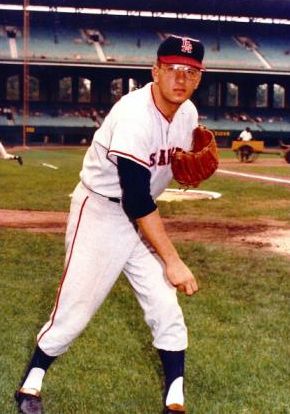
Eli Grba, the first Angel . . . (Photo courtesy of the Society for American Baseball Research.)

No less than Casey Stengel himself suggested the newborn major league Los Angeles Angels help themselves when the Yankees made Eli Grba available in baseball’s first expansion draft. Stengel liked the bespectacled righthander’s  potential even if, in his final seasons managing the team, he couldn’t always swing Grba into the Yankee rotation, and Grba’s record to date mixed between starting and the bullpen was inconsistent.

The National League expanded a year later, with Stengel on tap as the manager of the incoming Mets, and with the first pick of that expansion draft the Mets picked Giants catcher Hobie Landrith. “You hafta have a catcher,” Stengel said of the pick, “or else you’ll have a lot of passed balls.” So the Ol’ Perfesser had a hand in a battery being picked to open each league’s first expansions.

Grba, who died at 84 Monday following a three-month battle with pancreatic cancer, started and won the Angels’ first regular season game, a 7-2 complete-game triumph over the Baltimore Orioles. The game featured future Hall of Famers Brooks Robinson and Hoyt Wilhelm and the Angels drawing first blood with back-to-back home runs from Ted Kluszewski (drafted from the White Sox) and Bob Cerv (drafted like Grba from the Yankees) in the top of the first off Orioles starter Milt Pappas.

The Angels weren’t even close to finished. They battered Pappas and his relief John Papa before Wes Stock, Billy Hoeft, and Wilhelm settled them down, including an RBI single from pint-sized outfielder Albie Pearson (a draft from the Orioles) and a three-run homer from Kluszewski in the second, putting them up 7-0. (Kluszewski and Pearson roomed on the road, with the 6’2″ muscular Kluszewski telling the 5’5″ Pearson, “I get the bed and you get the dresser drawer.”)

The only runs the Orioles could pry out of Grba that day were Jim Gentile scoring on a fielding and throwing error on the same two-out infield play in the second, and Jackie Brandt scoring on an infield error in the third.

Grba, who’d won six of ten decisions with the 1960 Yankees, finished a six-hitter and provided immediate fodder for headline writers who couldn’t resist having mad fun with his missing-vowel surname (pronounced like the baby food brand) in the times to come. (GRBA PTCHS 4-HTTR was typical.) The bad news was that his triumph was the only win on a 1-7 existence-opening Angels road trip that was further compromised by eight rainouts. It took the 1962 Mets losing the first nine straight of their existence a year later to erase that, sort of.

A big righthander himself, Grba would stand after the Angels’ first two seasons as their all-time winner (19) and all-time loser (22). The further bad news was that in 1962 he’d be lost in the glittery shuffle of rookies Bo Belinsky and Dean Chance—both of whom took a little too readily to the lifestyle of the Hollywood demimonde, Belinsky especially, and both of whom led the pitching staff much of the season while they were at it, sparking the outside possibility of the Angels reaching the World Series.

It didn’t happen. Belinsky opened the season 7-1—including five straight wins to open with the fifth being his once-fabled no-hitter—but finished 10-11 with a 3.56 ERA. Chance led the starters with 14 wins and a 2.96 ERA. Grba found himself back in the same pattern he’d experienced with the Yankees, shuttling between starting and relieving, and finished with eight wins, nine losses, and a 4.54 ERA despite the advent of a pitching-rich baseball era and the Angels playing their home games in Dodger Stadium. (The Angels weren’t exactly buddies with the Dodgers, so much not that their broadcasters called the park Chavez Ravine at owner Gene Autry’s insistence.)

The Angels finished third in the American League in 1962, still a staggering season for an expansion team. They were hit even harder when 40-year-old reliever Art Fowler took a line drive in his face during pre-game practise and starter Ken McBride went down with a cracked rib, and a six-game losing streak in September erased their faint pennant hope.

An only child whose mother raised him alone in Chicago after his father abandoned her when their son was still a small boy, Grba was first a Red Sox discovery until they dealt him to the Yankees in March 1957. The kid who’d grown up a White Sox fan was less than thrilled: “The Yankees would come in and beat us all the time.” His Yankee spell was delayed when the Army drafted him; he was discharged in time for spring training 1959.

05angels.0409.kjs

To hell and back, Grba tosses out a gold-covered baseball as a ceremonial first pitch for the Angels’ fiftieth Opening Day.

Grba was the Angels’ starting pitcher on Opening Day their first two seasons. In May 1963, after marrying and buying his home, Grba was sent to the minors. “I don’t understand,” he’d say, “how a guy can be good enough to pitch the opening game two years in a row and then isn’t even good enough to pitch in the bullpen.” They sent him to Honolulu, the same minor league team where they exiled Belinsky after a terrible 1963 start.

That was after the Angels unloaded another former Yankee, former relief star Ryne Duren, after Duren’s already hard drinking began to spiral out of control when his marriage collapsed and his infant son unexpectedly died. Duren would drink himself out of baseball (as a Senator, he once had to be talked off a bridge in a suicide bid by manager Gil Hodges) but sober up by 1968. He’d be only the first of a few Angels having to go there.

Grba was a competitor to a fault, his signature moment sometimes thought to be the day he pitched in Yankee Stadium for the first time as an Angel, surrendered home runs in consecutive at-bats to Hall of Famer Mickey Mantle, and circled the mound screaming insults at Mantle as the latter rounded the bases.

But like Duren and Belinsky, Grba developed too much taste for alcohol. He admitted it began affecting his pitching as soon as 1963. Unlike Belinsky, who’d revive his career a few times in Hawaii, Grba became a minor league traveler until his drinking got far enough out of hand to force him out of baseball. “My priorities,” Grba would remember, “were all gone. [Hall of Fame pitcher] Bob Lemon saw me one day and said, ‘I’ve never seen a pitcher lose his stuff as fast as you did’.”

Grba lost his stuff and, in due course, three marriages, before he hit rock bottom in 1981, after several equally failed rehab attempts. This time Grba lived and worked at an El Monte, California detox center, after more than a decade bounding between jobs and between southern California and his native Chicago. Sneaking back to his room in the wee small hours one night, he lost his balance and—depending upon which account you believe—he hit the floor or fell through a window. Whichever it was, Grba finally quit drinking.

He got help from an unlikely source, according to Los Angeles magazine: Bo Belinsky.  The rakish lefthander was once the toast of baseball thanks to patronage from fading but still influential columnist Walter Winchell after his no-hitter and five-game career-opening winning streak. But the Angels suspended him in August 1964, despite what looked a solid season in the making, after a hotel room brawl with veteran sportswriter Braven Dyer.

Belinsky’s career careened off the rails after his trade to the Phillies near the end of 1964 and ended after too much back-and-forth to the minors in 1970. Already a heavy drinker, Belinsky also became amphetamine addict while he was at it, the latter something he’d admit years later that he picked up in the Phillies’ bullpen. “I’d occasionally used greenies, amphetamines, as a starter, but in Philadelphia they had red juice,” Belinsky would remember, “and when I got into the bullpen, I started getting loaded every day, because as a reliever, you never know when you might have to play. This chemical started coming into my life. I thought I could handle it, because I was strong and still had that phony smile. But something was happening to my system.”

When Belinsky’s second marriage collapsed in 1981, he began his own battle to get and stay sober, including membership in Alcoholics Anonymous. In line with A.A.’s twelfth-step principle, carrying its message to fellow alcoholics, Belinsky reached out to Grba after learning of his former teammate’s struggle. “Bo and I had never been that close,” Grba told Los Angeles. “He was too Hollywood. But he came and got me and took me to an AA meeting. I was nervous, but Bo said, ‘Don’t worry, Eli, they’re all drunks just like you and me’.”

Grba stayed sober the rest of his life. So did Belinsky, after a few ups and downs in the 1980s including a suicide attempt of his own, before staying clean and working first as a Hawaii alcohol counselor and, later, a public relations executive for a Las Vegas automotive concern, before his death at 64 of complications from bladder cancer in 2001. So did Duren, who became an addiction counselor after his 1968 cleanup, working for various agencies and groups until his death at 81 in 2011.

Getting and staying sober brought Grba back to baseball. He became a minor league pitching coach and manager, a pitching coach again, and a scout, including in the Phillies’ system thanks to being clean and sober still when he re-connected with another Angels teammate, Lee Thomas, then the Phillies’ general manager.

Grba retired in 1997 and moved with his fourth wife, Regina, to Alabama. He also re-connected with his children, including son Nicholas, now a retired Air Force staff sergeant; and, Stacy, his daughter who also served with the Air Force. In 2016, Grba co-wrote his memoir, Baseball’s Fallen Angel. “The way I was drinking it is amazing I can remember anything,” he told an interviewer while promoting the book. “I had six alcoholic seizures and six DUIs. How I never killed myself I’ll never know.”

When the Angels celebrated their fiftieth anniversary as a major league franchise in 2011, Grba was invited to the ceremonies and to throw out a ceremonial first pitch. That day opens Grba’s memoir, co-written with Douglas Williams, a harrowing account of a haunted man who’d sent himself to hell and back.

“At that game Eli realized so many of his former teammates are no longer with us and I know he wondered why God left him here after he had lived so hard with his alcohol problem,” Williams said later. “Then he realized that maybe he was still here so he could tell his story and warn others of the pitfalls he fell into.”

“What I think about sometimes is about how I messed it up,” Grba told the Orange County Register of his self-shattered career and his three broken marriages. “Baseball has been a secondary thought to me ever since I got sober, I didn’t leave the Angels the way I wanted. It’s nice to be recognized as the first, nice to be remembered, and it’s an honor.”

Grba threw a perfect strike for that ceremonial first pitch. It was nothing compared to the perfect strike he threw for himself, his children, and his grandchildren, after he sobered up to stay.
Mel Stottlemyre, RIP: Quietly monumental

2019-01-14 melstottlemyre

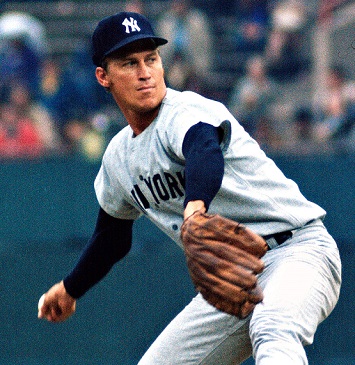
Mel Stottlemyre, the best pitcher of the Yankees’ lost decade, later a World Series-winning pitching coach.

When the 1964 Yankees won what turned out to be the last pennant of the old guard, it wasn’t pretty. First-year manager Yogi Berra was the unsuspecting victim of backstabbing abetted by first-year general manager Ralph Houk. Age and injury began catching up to the team. Their sale to CBS rocked baseball controversially. And Berra was saddled especially by an unreliable bullpen.

With Hall of Famer Whitey Ford beginning to experience elbow discomfort and Jim Bouton suffering an unexpected tired arm in the first half, lefthander Al Downing putting up a solid season wasn’t quite enough even if he would lead the American League in strikeouts. (He also led in walks, unfortunately.) Over Houk’s objection, still-co-owner Dan Topping made two moves before turning it over to the Tiffany Network.

He ordered the call-up, from the Richmond farm, of a kid named Mel Stottlemyre, who’d grown up a Yankee fan despite living cross continent. His mild manner was probably the only thing mild about him. On the mound, the Missouri-born Pacific Northwesterner proved something else immediately. So did Pedro Ramos, a journeyman righthander who joined the Yankees that September’s beginning.

Stottlemyre would win nine of twelve starting decisions down the stretch including a five-start winning streak and two shutouts. Ramos down the stretch gave Berra and the Yankees the bullpen stopper they were missing since Steve Hamilton’s early-season success dissipated.

The Yankees won the pennant at almost the final minute. Their Series opponents, the Cardinals, won their pennant a little bit later than that. The Phillies’ infamous collapse threatened to send the National League to a three-way pennant tie before the Cardinals survived against the hapless Mets on a final weekend during which the Reds bumped the Phillies off once and for all.

Stottlemyre—who died Sunday at 77, after a long battle with multiple myeloma—went on to beat Bob Gibson handily in Game Two of the World Series. He faced Gibson in Game Five and came out in a 2-0 hole (the Yankees would go on to lose); he faced Gibson again in Game Seven and was done in in the fourth, when rookie infielder Phil Linz couldn’t avoid a takeout slide on what might have been an inning-ending double play, turning instead into a Cardinals three-run inning en route the 7-5 final for the Redbirds.

“Tim McCarver hit a grounder to Joe Pepitone at first,” Stottlemyre would remember. “Pepi made a good throw to second but the runner took Phil Linz out and he made a wide throw back to first. I came over and dove for the ball and landed on my right shoulder. Fortunately I wasn’t injured.”

That wouldn’t happen for another decade. In the interim, Stottlemyre—whose money pitch was a filthy hard sinker—became the best pitcher on a Yankee club entering its lost decade. Ford’s elbow turned into his nightmare and the end of his career soon enough. Bouton developed serious arm trouble, enough to reduce him to a marginal relief pitcher. Downing proved talented, inconsistent, and injury plagued. The team’s other stars (Hall of Famer Mickey Mantle plus Roger Maris, Tony Kubek, and Elston Howard) surrendered to age, injury, or both. And except for pitchers Fritz Peterson and Stan Bahnsen, plus reliable (and underrated) outfielder Roy White, the parched farm produced journeymen at best.

And Stottlemyre, who’d become a three-time 20+ game winner in his career, suffered the 1966 indignity of losing 20 games despite pitching to his normal capability and making his second straight All-Star team while the Yankees finished dead last for the first time since 1912. He suffered his highest ERA ever with a lower fielding-independent pitching rate (ERA minus defense) that was around his career norm; twelve of his 20 losses came when the Yankees gave him two or less runs to work with. He had four no-decision starts in which he pitched well enough to win, surrendering three earned runs or less; in ten of his losses he pitched well enough to win along the same criteria.

Stottlemyre would have more individual moments, including the staggering inside-the-park grand slam he hit to beat the Red Sox in 1965. “I didn’t slide in at the plate so much as I collapsed,” he remembered. When the pitcher who surrendered it to him, Bill Monbouquette, became a Yankee in 1967, Stottlemyre relished needling him about it. He had it listed in the 1967 Yankee yearbook as his greatest baseball thrill.

By the 1970s, he was accompanied by Peterson and then Bahnsen as the core of a promising new Yankee staff. It lasted only long enough for Bahnsen, the 1968 AL Rookie of the Year, to be traded after the 1971 season; and, for Peterson and fellow pitcher Mike Kekich to swap families notoriously in spring 1973, prompting the eventual trades of both.

Stottlemyre and his wife, Jean, were close to both pitchers and their wives and couldn’t figure how the deal could have been done without them figuring something was up. Not until the day Kekich, according to Stottlemyre, called to ask if he’d heard about the trade. Knowing both Peterson and Kekich were first class pranksters, the Stottlemyres first thought it was one of their gags.

It turned out to be nothing compared to how Stottlemyre’s career ended. After George Steinbrenner bought the Yankees in 1973, and Stottlemyre landed himself an $87,500 salary for 1974 following his first-ever contract holdout, he felt something pop in his shoulder that June. What popped was his rotator cuff. Season over. The following spring, after an off day fishing in the Everglades, Stottlemyre got a call to meet general manager Gabe Paul. Released. The day before his $30,000 severance would vest.

Stottlemyre fumed and went home to Issaquah, Washington, twenty minutes outside Seattle. But after a spell as a pitching coach in the Mariners’ system before joining the Mets as their pitching coach for their mid-1980s glory seasons, he worked two years for the Astros in the same job. Then, of all things, the Yankees wanted him back. To become Joe Torre’s pitching coach in 1996.

“I made a lot of statements about [Steinbrenner] that I had to eat twenty years later,” said Stottlemyre, who felt that despite Steinbrenner’s then-suspension The Boss could have intervened quietly but firmly in how his original release was handled. “When they decided they wanted me to come back to be Joe’s pitching coach, George called me himself and apologised. That really meant something.”

He added four Yankee World Series rings to the one he won with the 1986 Mets. Then Steinbrenner angered him again, this time after the Angels beat the Yankees in the 2005 American League division series and Steinbrenner congratulated Angels manager Mike Scioscia—whose team had been the only one to beat Torre’s Yankees consistently over the years, in regular season as well as postseason play—but said nothing for Torre.

2019-01-14 melstottlemyremonumentpark

Stottlemyre with his Monument Park plaque, 2015.

The usually mild Stottlemyre hit the ceiling. “To congratulate the other manager and not congratulate your own, after what he’s done this year, I laughed,” he said later. He laughed, and he quit. Except for a one-season return engagement as the Mariners’ pitching coach in 2008, Stottlemyre called it a career.

In the interim, Stottlemyre had suffered great sorrow when his youngest son, Jason, died of leukemia at age 11; and, great pride, when his other two sons, Todd and Mel, Jr., became second-generation major league pitchers. Todd’s career outlasted his father’s by three seasons but earned him only half the wins above replacement-level his father earned; Mel, Jr.’s major league career lasted one season.

Stottlemyre himself thought he had his cancer beaten once, in 2001, after chemotherapy and stem-cell treatment appeared to knock it out of his park. Remembering Jason’s battle decades earlier kept him strong, as did his involvement with the Multiple Myeloma Research Foundation. Reminded then that he had more hair on his head than he had before his chemo, Stottlemyre laughed. “Everybody’s mentioned that to me,” he replied, “although I don’t recommend what I had to go through to do it.”

Ten years after he left the Yankees for the final time, Stottlemyre was stunned to be invited to Old-Timer’s Day 2015 . . . where his entry into the Yankees’ fabled Monument Park was unveiled. There was probably nobody more shocked over it than Stottlemyre himself, who felt that as a pitcher he’d represented an era the Yankees and their fans would prefer to forget.

“If I never get to come to another Old Timers Day,” he told the Yankee Stadium crowd, “I will take these memories and I’ll start another baseball club, coaching up there, wherever they need me.”

Once upon a time, Stottlemyre’s uniform number—30, which hasn’t been retired yet (it was seen last on the back of now ex-Yankee reliever David Robertson)—was also a journalist’s code at the end of a good piece of copy. He wasn’t always good copy during his career, other than pitching and winning. But men who beat Bob Gibson in even one World Series game draw almost as much attention and respect as men who live well and battle more insidious foes with his kind of silent courage.

Former pitcher Bowie now gasps for air

2019-01-09 micahbowienationals

Micah Bowie, on the mound as a National, before assorted elbow, hip, and shoulder issues killed a career they compromised in the first place.

Micah Bowie’s isn’t necessarily a name you’d recognise at first hearing. He pitched for five major league teams, when he could pitch at all, before retiring in 2008. Now he may be lucky to be alive at all. The lefthander who left baseball hoping to help aspiring players avoid or get past injuries of the kind that derailed his career gasps for air now. Literally.

Bowie suffers a ruptured diaphragm. A harrowing YouTube video shows him fighting for his breath behind assorted monitoring cables attached to his chest. (He’s believed to have a mere eight percent lung capacity now.) Compared to this, spending his professional baseball life losing a war with his elbow, hip, shoulder, and groin was child’s play for the now 44-year-old Texas product.

The Major League Baseball Players Association spurned a request from Bowie’s family to vest his $60,000-per-year medical benefit in advance of the normal 62-years-old vesting age. Bowie was released from palliative care on 29 December 2018, according to journalist Douglas Gladstone, whose mission has become advocating for such players as Bowie and for former major leaguers denied pensions after a 1980 rules change.

Bowie was due to go to the Jewish National Lung Hospital in Denver on 3 January. Bowie’s wife, Keeley, has all she can do to keep a semblance of normalcy for their children in the middle of her husband’s poor prognosis. The Players Association, whose executive director Tony Clark is a former major league first baseman, and whose staffers today include Hall of Famer Dave Winfield and several other former players, didn’t respond to requests from this journal for comment.

The players’ union may have rejected Bowie’s family for an early benefit vest, but that’s not the case with one-time Cy Young Award runner-up Mike Norris, one of the quintet of starting pitchers Sports Illustrated ballyhooed as the Athletics’ “Five Aces” in an April 1981 cover story. Former Nationals pitching coach Steve McCatty plus former Blue Jays pitching coach Rick Langford, Brian Kingman, and Matt Keough completed the quintet; Billy Martin, a manager whom Bill James once described as “a man who did not quite believe in the existence of the future,” rode them hard until they were put to bed wet, figuratively.

Their splash turned to drowning within three seasons, mostly, as one after another of the Five came down with career-destroying arm or shoulder issues after a collective workload that sent baseball people then and now to the nearest whiskey jug. Norris—who pitched through pain in 1981 and 1982 after winning 22 games in 1980—also turned up in cocaine’s grip, testifying at the notorious 1985 Pittsburgh drug trials.

He cleaned up and in time became involved with Reviving Baseball in Inner Cities, a group helping youth learn the game and its pitfalls alike. In 1999 hes underwent surgery to correct cervical myelopathy, a spinal condition. A decade later, at age 53, Norris asked for and received his $89,000 annual family disability benefit.

“It is anathema to me why, if Mike Norris could get his reported $89,000 disability benefits claim approved a decade ago,” says Gladstone, who doesn’t begrudge Norris receiving it, “the union is unwilling to do the same for Micah and his family. And Mr. Norris wasn’t in palliative care.”

Bowie never got anywhere near Norris’s brief but certain acquaintance with mound glory. What began with an ulnar ligament injury in the Braves’ system in 1966 turned into two more injuries to it that finally forced him to Tommy John surgery in 2003. He’d barely worked his way back when he suffered a detached latissimus muscle under his throwing arm and, two years later, a groin injury. He was lucky to pitch parts of six major league seasons with the Braves, the Cubs, the Athletics, the Nationals, and the Rockies before he called it a career after the Astros released him from their organisation in 2008.

“I’ve gone through most every injury that you can go through as a pitcher,” Bowie told the San Antonio Express-News in 2010. “I know how to find out how to fix it, and how to come back and pitch on the major-league level. I want to take those things that guarantee you take the hurt away.”

On ninety acres east of San Marcos, Texas, Bowie put his knowledge and his money where his mouth was. He formed the Bowie Baseball Academy with staffers that included former minor league manager Joe Szekely, former Astros first-round pick Jimmy Gonzalez, current Pirates prospect Pasquale Mazzocoli, former Dodger minor league catcher Brett Magnusson, and former Royals minor leaguer David Wood.

“Every time I got hurt, I got released,” Bowie told Express-News writer Richard Oliver. “I lost my livelihood, my job. These kids get hurt, they lose college, they lose opportunity. I don’t want an injury to be the determining factor if they play baseball or not.”

Not the way it was for Bowie. After three relief appearances for the 1999 Braves, despite being groomed as a starter in the minors, he was traded to the Cubs in the package that brough the Braves veteran pitcher Terry Mulholland and infielder Jose Hernandez. The Cubs returned him to starting where he didn’t exactly flourish; then, he was converted to relief work by the A’s. The Tommy John surgery followed not long after that, and he missed 2004 recuperating before the Nationals signed him on a minor league deal.

Bowie got another major league callup to the Nats in 2006 and became an effective setup reliever (1.37 ERA in fifteen appearances) before a groin injury derailed his season. He returned for 2007, again in the setup role, before four of the Nats’ five starting pitchers hit the disabled list and he returned to the starting role. In six starts he earned a 4-0 record with a 3.82 ERA before the hip injury hit.

He has also been a regular instructor at T Bar M Camps, a non-denominational Christian sports camp located in his native Texas. His entry at the camps’ Website includes a quote from Paul the Apostle’s letter to the Colossians: “Whatever you do , work at it with all your heart, as working for the Lord, and not for men.”

It isn’t his heart that threatens Bowie’s life now.

The Yankees re-up Zach the Knife

2019-01-06 zachbritton

Zach Britton stays a Yankee after all . . .

Apparently, Zach Britton has decided life in the Yankee bullpen is worth living for the next few years, and the Yankees have decided concurrently that life in their bullpen can only be enhanced by keeping him aboard. Hence will Britton sign to return to the Bronx for three years, $40 million, and an opt-out clause contingent on whether the Yankees pick up a fourth-year option after the second year of the new deal.

The Angels were thought to be the top finalists for both Britton and David Robertson, before Robertson negotiated his own new deal with the Phillies, eliminating the middle man, for two years, $23 million. Needing a serious bullpen upgrade, the Angels apparently didn’t move fast or furious enough on either, which seems a little too par for their course.

The Phillies have more or less hinted Robertson stands to become their Andrew Miller, going into games when they’re on the line regardless of the inning in question as well as being one of two relievers (Seranthony Dominguez the other) in line for the save opportunities. Britton merely re-joins a very powerful Yankee pen with encouraging work to build on since he went there from the broiled and basted Orioles last summer.

The Empire Emeritus didn’t exactly want to lose Robertson if they could help it, but they’re banking on Britton building upon 25 Yankee innings with a 2.88 ERA including 21 strikeouts. If he’s really begun to re-discover the right handle on what was once his money pitch, a hard, sharp, wipeout sinkerball, the Yankees make out at bargain rates when all is said and done.

The alarms sounded softly in Britton’s deeper numbers: his fielding-independent pitching rate (FIP: your ERA when your defense is taken out of the equation, folks) as a Yankee was 4.08, but that was down from the 4.44 FIP he showed with the Orioles last year before the trade. His strikeout-to-walk rate was 1.91 as a Yankee and 1.62 on the season as a whole. The Yankees know he isn’t quite Zach the Knife who terrorised the American League from 2014-2016. They also know he may not become that Britton ever again.

But if he can build on what he did do for them last year, they’ll get a Britton who keeps their bullpen in one piece and makes life a lot simpler in the late innings. For the Yankees, that is. A pen with such bulls as Aroldis Chapman, Dellin Betances, Chad Green, and a healthy Britton can turn the rest of the American League into a china shop.

If the Yankees want to go back to the postseason and go deeper than the round one dispatch they got from the Red Sox last October, they’ll need that. And maybe this time Britton’s manager won’t leave him or any of the other bulls stewed and warmed in the bullpen with no place to go when a wild card game, if not a pennant, is on the line.

Two Octobers ago, the Orioles and the Blue Jays took the wild card game to the eleventh inning tied at two each. The Jays spent their then-closer Roberto Osuna for a wipeout ninth against two of the Orioles’ biggest boppers, Manny Machado and Mark Trumbo, plus Matt Wieters, and the teams matched bulls until Orioles manager Buck Showalter pulled Brian Duensing after he opened the bottom of the eleventh by striking out Ezequiel Carerra.

Showalter reached for Ubaldo Jimenez, normally a starter but on a string in which he surrendered only a .172 batting average against him from August beginning through regular season’s end, married to a .252 on-base percentage. But Jimenez surrendered back-to-back singles for first and third, on fastballs down the pipe or at least belt high, abetted by left fielder Nolan Reimhold’s bobble of Josh Donaldson’s first-pitch base hit. And the skipper plus his infielders confabbed at the mound.

Maybe they agreed Jimenez’s job regarding Edwin Encarnacion checking in at the plate was to throw nothing but a double play ball. What just about everyone in baseball agreed upon in that moment was how ridiculous it seemed that Britton—who’d just posted the arguable best season any major league closer’s had under the contemporary coordinates of the job—wasn’t even a topic.

He’d allowed four earned runs all year long and not a one since April, he had an 0.54 ERA and a 1.94 FIP, and out of 254 hitters faced 202 of them either struck out or whacked balls into the ground. Yet Showalter didn’t go to the mound with a hook for Jimenez and a signal for Britton. He didn’t even have Britton warming up.

Showalter’s was the wrong conservatism in that moment, wanting the righthander-vs.-righthander matchup, not even pondering that, lefthander though he is, Britton in 2016 kept righthanded hitters to a .155 batting average and a .199 slugging percentage. With Encarnacion hitting in the lap of luxury as it was, having to think of nothing more complicated than hitting a measly sacrifice fly to win it, that luxury would have been spoiled if he’d had to try getting Britton’s sinker in the air.

But you know about those looking gift horses in the mouths. The Orioles should have. Their lineup struggled against lefthanded pitching that year but the Jays started righthander Marcus Stroman against them that night. And the only thing the Orioles had to show for it was Trumbo’s two-run homer in the fourth. So it was Jimenez versus Encarnacion, leaving Encarnacion in the luxury bath.

Sure enough, Jimenez threw Encarnacion a fastball right down the pipe to open. And Encarnacion hit that gift into the second deck, turning Rogers Centre into the place where the nuts hunt the squirrels, sending the Jays to the division series they’d win against the Rangers only to lose the League Championship Series to the Indians. Showalter hadn’t learned a thing from Mike Matheny’s identical mistake two years prior.

With a trip to the 2014 World Series on the line, Matheny stayed with a still-rusty Michael Wacha in the bottom of the ninth rather than reach for his then-shutdown closer, Trevor Rosenthal, because, well, you don’t bring your closer in unless you have a lead to protect, right? Wrong. The then-Cardinals manager watched Travis Ishikawa channel his inner Bobby Thomson and hit a three-run homer to the top of Levi’s Landing in Pac Bell Park with the pennant attached. Inspiring dubbings of Russ Hodges over Joe Buck and sending the Giants to the World Series.

Showalter and Matheny can commiserate over a few drinks now. Matheny and two coaches were purged last July, the first in-season managerial change the Cardinals made in almost a quarter of a century. Showalter was executed a couple of days after the 2018 season ended. Matheny lost his clubhouse; Showalter—who’d turned the Orioles around after taking over in 2010 and taking them to a three postseasons in five years string, belying his former reputation as a detail freak who wore out his welcome as fast as he earned it—may have been lucky not to lose his marble. Singular.

The Orioles collapsed completely after that wild card game loss. They finished dead last in the American League East the next two seasons including 2018 and found themselves forced to offload their more prime talents including Machado and Britton. Britton himself suffered even worse, losing part of early 2017 to tightness in his forearm, before an offseason workout hit him with a torn Achilles tendon that would keep him out of action until June last year.

Dealing Britton and Machado (to the Dodgers) was the Orioles’ admitting that it was time to blow up and rebuild. After they’d been 7-20 at one point last year, thirty years after another Orioles team with a couple of future Hall of Famers (Cal Ripken, Eddie Murray) aboard opened a season 0-21. The Yankees have re-upped Britton and may yet remain in the Machado market.

All Yankee manager Aaron Boone has to do is prove he’s learned a lesson or two from last fall’s division series wipeout, and not leave Britton or any of his best bulls blowing in the wind, while leaving lesser or gassed arms to do the clutch pitching with a postseason advance on the line.


2018: This game’s still fun, OK?

2018WSRedSoxYou’d think that with all the whining about things like defensive shifts (which aren’t as shifty as you’ve been led to think), bullpenning (They think we never done anything before we done it—Casey Stengel), and the ridiculous unwritten rules, continued, that baseball in 2018 sometimes seemed about as much fun as undergoing root canal with no anesthetic. And you’d be thinking wrongly.

Herewith the best of the 2018 highlights with one truly grotesque lowlight and one true vale of tears:

*The New Boston Massacre—It happened in early August, when the Red Sox swept the Yankees in a four-game set, four decades after the Yankees battered the Red Sox to get back into the American League East race. And it continued in the postseason, after splitting two division series games in Boston with Aaron Judge blasting “New York, New York” on his way out of Fenway Park.

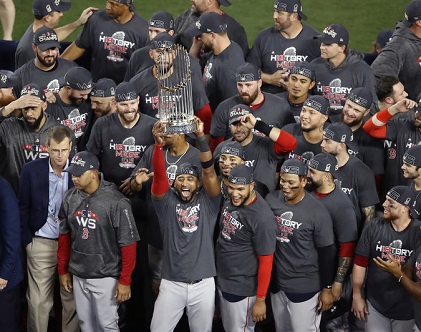
Losing only one game each in all three postseason sets gave the 108 game-winning Red Sox—with the unlikely Steve Pearce the World Series MVP, with Mookie Betts winning the AL’s Most Valuable Player award, and with Andrew Benintendi making the catch of the season to save a Red Sox ALCS win and probably their season while he was at it, among other individual conquests, not to mention David Price burying his former reputation as a postseason bust—their fourth World Series triumph of the new century.

*Botes Against the Current—12 August. Pinch hitting for Cubs reliever Justin Wilson. Bottom of the ninth. Bases loaded and deuces wild. Nationals reliever Ryan Madson throwing a fastball to the floor of the zone. Pinch hitter (underline that, gang) David Bote hitting it over Wrigley Field’s center field wall. “Five minutes ago,” tweeted Washington Post baseball writer Barry Svrluga, “I was sure Washington would reach October. Now I think there’s no chance.”

Bote’s blast closed the coffin lid on the Nationals’ 2018; it wouldn’t be long before the nails were hammered in. It may have been the second most dramatic home run of the year, behind Max Muncy’s game-ending blast in Game Three of the World Series . . . in the bottom of the eighteenth inning.

And, just ahead of Betts’s July epic against the Blue Jays, when he ended a thirteen-pitch bottom-of-the-fourth at-bat against J.A. Happ with a salami. (Assist to Jays first baseman Justin Smoak, who ran down a 1-2 foul pop and had it bound off his glove to keep Betts alive early.) Betts was so jubilant after he hit the ball—knowing at once it was going out (and I mean out: it flew over a sign at the back of the Green Monster seats and out of Fenway Park entirely)—he almost tripped over himself up the first base line running it out.

*The Woe-riolesHow else does a team celebrate the thirtieth anniversary of going 0-21 to open a season? With 2018’s worst record and the third worst winning percentage in their franchise history, including when they were the woebegone St. Louis Browns. “This team is awful—direct-to-DVD awful,” writes Sports Illustrated‘s Jon Tayler amid the magazine’s hypothetical New Year’s resolutions for all teams. “There’s no reason to hope for anything other than 100-plus losses and a whole lot of innings and at-bats given to anonymous dreck. So don’t fret when it’s mid-August and you have fewer wins than Aaron Judge has home runs.”

From the Oriole Way to the Orioles Have Lost Their Way. (Trivia: The ’88 Zer-Os finished with seven more wins.)

*Manono—In April, Sean Manaea threw the Athletics’ first no-hitter since Dallas Braden’s perfect game on Mother’s Day 2010. It made the Red Sox—with an .894 winning percentage at the time—the best team ever to be no-hit. It was 2018’s first no-hitter, and Manaea enjoyed the double treat of being interviewed on the field post-game by Braden himself, now working for NBC Sports California.

But Manaea’s season ended for all intent and purpose in August when his shoulder began to bark. Come 19 September: arthroscopic surgery to repair a shoulder impingement, sending Manaea down for the count until after the 2019 season.

*Float like a Seaver, sting like a Schmidt—The Angels won the comparatively modest sweepstakes for Japanese two-way player Shohei Ohtani. After making a critical adjustment near the end of spring training, Ohtani won the American League’s Rookie of the Year award based on his mound and plate work. His signature moments: 1) Shaking off a three-run first to punch out twelve A’s in his first start. 2) Hitting three home runs in two days, against the Indians and the A’s.

The only major leaguer before him to hit 20+ home runs and pitch 50+ innings in the same season? Some bum named Ruth.

*This One’s for Mom—A’s outfielder Stephen Piscotty was traded there from St. Louis after 2017 so he could be closer to his ALS-stricken mother, Gretchen. She lost the battle on 6 May 2018. After taking one day off and returning with a base hit his first time up against the Astros (pitcher Lance McCullers politely stepped off the mound to let him bask in the ovation), Piscotty left the team on bereavement leave. He returned to the A’s in Boston two days after his first Mother’s Day without her.

With the A’s up already, 2-0, Piscotty batted for the first time in the top of the second . . . and ripped one into the Green Monster seats. “To hit a home run in his first at-bat [back] like that,” said manager Bob Melvin, “there’s something in the air. Probably Gretchen.”

*One for the Records?—Baseball’s going to miss Adrian Beltre, who retired after the season and now awaits his election to the Hall of Fame in five years. (Bank on it.) But he went out the same way he ended his seven previous seasons. I don’t know for sure if this is a record for petty crime, but Beltre stole exactly . . . one base each in his final eight years. The Man of Steal he wasn’t.

*Valdez is Coming—According to Jayson Stark of The Athletic, it took 92,000 major league pitching starts by almost 1,600 major league pitchers to do in the entire 21st century to date what Astros rookie Framber Valdez did in back-to-back 2018 starts: equal pitching lines in two starts each of five innings pitched, two hits, one earned run, three walks, and three strikeouts. This is what you call consistency. We think.

*Bang for the Big Bucks—Yankee rookie Miguel Andjuar earned $550,000 in 2018 and hit .297 with 27 homers and 92 runs batted in. Manny Machado, dividing his season between the Orioles and the Dodgers, earned $16 million in 2018 and hit . . . .297 with 37 home runs and 107 RBI. Says Red Sox podcaster Terry Cushman: “The Yankees would rather pay an extra $29,500,000.00 more a year for ten more home runs. Who’s the dummies?”

Cushman also points out that the Empire Emeritus could, in theory, go the entire length of the deal without winning a World Series with Machado under contract, if they end up winning the Machado sweepstakes, while the Olde Towne Team won the 2018 World Series despite still paying off on Pablo Sandoval’s deal.

*Jacob’s Ladder—The Mets looked even worse giving Jacob deGrom grounds to sue for non-support than the Mariners did with Felix Hernandez eight years earlier. How very Mets it was that deGrom pitched like a combination of 1965-66 Sandy Koufax, 1968 Bob Gibson, and 2000 Pedro Martinez, and the Mets treated him like the late Anthony Young, almost: deGrom had only ten wins to show for a performance that should have gotten him a 22-9 record at minimum.

Cy Young Award voters looked at his 1.70 ERA, his 1.97 fielding-independent pitching (once again: that’s your ERA when your defenses are removed from the equation), the sub-.200 batting average against him, his wins above a replacement-level player at any position (10.0), and that he was only the second pitcher since earned runs became an official stat (in 1913) to have an ERA under 2.00, 250+ strikeouts, and -50 walks in the same season, and voted deGrom the Cy Young winner with 29 of 30 possible first-place votes.

This made for the fourth Cy Young Award by Mets pitchers, and this time the Mets did everything in their power to prevent it.

*Urena Crock—Nobody could stop the National League’s Rookie of the Year, Atlanta’s Ronald Acuna, Jr., from destroying baseballs, but Miami’s Jose Urena picked the absolute wrong way to try . . . after Acuna spent the first three games of an August set a) hitting one bomb in each game of a doubleheader; and, b) hitting two bombs in the second game of the set. Leading off in the bottom of the first of the fourth game, Acuna took one on the elbow from Urena, on the first pitch, with malice aforethought. It brought the Braves pouring out of their dugout and a lot of questions as to why plate umpire Chad Fairchild delayed ejecting Urena.

Then, as Acuna continued shaking the pain off, the benches re-emptied after Braves manager Brian Snitker—justifiably—remained in a rage over why Urena had yet to be ejected from the game. At long last, he was. Bizarrely, so was Snitker. Urena ended up suspended six games. It should have been six starts.

*Eff Tha Fun Police—Nationals closer Sean Doolittle was unamused over bat flips and their accompanying harrumphing—because he wants to see more of them. Bat flips, that is. “If a guy hits a home run off me, drops to his knees, pretends the bat is a bazooka, and shoots it out at the sky, I don’t give a shit,” he said emphatically in an online interview. “When you’re in the backyard as a kid playing and falling in love with the game and you crush the ball? You do a celebration. You stand and watch it like Ken Griffey, Jr. You don’t hit the ball and put your head down and run as fast as you can. That’s not fun. It’s okay to embrace that part of a game.”

I agreed with him then and now. As I wrote then, “I hope a lot of hitters drop to one knee and point their bats to the sky like bazookas when they hit one out. I hope a lot of pitchers start channeling their inner Dennis Eckersley and start fanning pistols after they strike someone out. I’d kill to see a hitter moonwalk around the bases after hitting one out. Let’s see more keystone combinations chest bump or make like jugglers after they turn a particularly slick and tough double play.”

Hall of Famer Willie Stargell once said, “The umpire doesn’t say, ‘Work Ball’.” I said then and still believe now: you want to work ball, play the game in a business suit. This game’s still supposed to be fun. OK?