
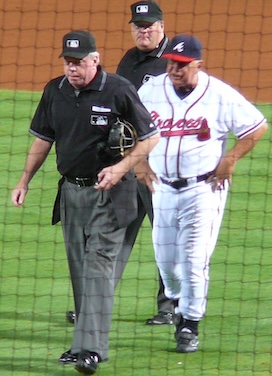
Bobby Cox, standing up for his player[s], should be remembered for more than his record for getting sent to the showers.
Cox’s passing yielded a flood of grief especially in the immediate wake of longtime former Braves owner Ted Turner’s passing just a couple of days earlier. “Haven’t posted on social in quite some time but can’t stay quiet in this time of loss,” began a tweet from Cox’s Hall of Fame third baseman Chipper Jones, whom he drafted as the Braves general manager before returning to the dugout.
I’m struggling to tell all what Bobby Cox meant to me and so many others in Braves Country. He was the leader of men and a second father to so many Atlanta Braves thru the yrs. I’m so sad today, but as I sit here watching my two youngest boys play in their championship games on the day he passed, I can’t help but shout the same things he did from the corner of the dugout. ‘Come on kid, u got this!’ We are gonna miss him so much, but his legacy is forever cemented with the success of this franchise for the last 35+ yrs. He started it as GM, continued as manager, and passing the torch to others, the Atlanta Braves will continue to be force that Bobby Cox always wanted us to be. We love you Skipper. You were our rock. I love you more than words can express. My boys won both of their games…..Bobby had a hand, I have no doubt!
Maybe the number one quality his former players wanted the world to remember was Cox the skipper having their backs. It was probably the likeliest reason why he got to set the record for a major league manager getting thrown out of a game. Cox above all figured it better to get himself sent to his room than the player who was still liable to land a game-winning hit or the pitcher liable to deliver the game-ending out.
“I generally don’t go onto the field that much,” he once said, “but 90 percent of the time it’s because my player is upset.”
And I’ve got to get in there right away and keep him in the game or at least stick up for him. My relationships with umpires, in my mind, is great. I like them, every single one of them. Being a major-league umpire is the single toughest job in sports. It’s hard. Those guys are good. But again, I have to stick up for my players.
Cox also had the knack of spotting when a player of obvious talent was mispositioned and doing something about it. “What can I say? He saved my career,” said one such player, 1980s Braves center fielder Dale Murphy, the brightest star on moribund teams following their brief rise in the early 1980s. “Hung in there with me during my early days and made the decision to move me to the outfield. Changed my career/life forever.”
Brought up a catcher, Murphy wasn’t even the second coming of Choo Choo Coleman, never mind Yogi Berra. Cox spotted Murphy’s throwing problems from behind the plate and converted him in time to an outfielder. Murphy might have become a Hall of Famer had it not been for a round of injuries ensuring his decline phase would be more like an eighty-story drop.
Cox’s first term managing the Braves ended in his firing after the 1982 season. After a spell managing the Blue Jays, he returned to the Braves in the front office first. As general manager, he began bringing in pieces that would help found a National League dynasty—trading for Hall of Fame pitcher John Smoltz, drafting Jones and Hall of Fame pitcher Tom Glavine, and providing himself a foundation of solid defense, solid pitching, and solid, smart hitting when he returned to the Braves dugout.
He liked things kept businesslike but not without humour, even if the outside world didn’t always see the lighter side of his Braves as they began and continued their dominance of the National League in the 1990s. Described often enough as gentle but firm, Cox seemed a combination of father figure and older, experienced friend without letting anyone forget whom the boss was.
Need pitching reinforcement? Cox helped prod his front office successor John Schuerholz to dip into the free agency pool and sign Hall of Famer Greg Maddux, whom the Cubs had left to feel less than appreciated despite the team-first ethic that held hands with the brainy talent. Jokers in the Braves deck? Cox prodded for and got their dismissals. Hit the road, Neon Deion Sanders and John (Off His) Rocker.
“What made him a great manager,” said Glavine once upon a time, “was that he was so good at handling his players.”
He was so good at getting the best and most out of his guys. He treated everybody with the utmost respect and made everybody understand that whether you were a superstar or the 25th man coming out of spring training, you were going to be an important piece of the puzzle. He made guys not only understand that but believe it.
“Every day,” said Marquis Grissom, a Braves outfielder from 1995-96, “he would ask me, ‘How you doing? How’s your family doing?’ (He was) able to push all of us in the right direction and get the best out of all of us, and I think that says the world about Bobby Cox—and if you can’t play for him, you can’t play for nobody.”
Cox managed to win one World Series among the five pennants among that closet full of division championships. Opposing managers like Bruce Bochy weren’t the only ones who wondered how much deeper Cox teams would have gone in the postseason if they’d had better relief pitching. Yet the best they got—Smoltz, already one of the greatest Braves starting pitchers—recovering from Tommy John surgery and sending himself to the bullpen a couple of seasons—still wasn’t quite enough.
The skipper knew only too well that you could be the 1927 Yankees and still get taken down by a slightly better team. When the Braves lost his final postseason on the bridge (2010) thanks largely to defensive miscues and Chipper Jones’s absence (season-ending August knee surgery), Cox still wouldn’t blame his players. He credited Bochy’s Giants for their superior play.
“RIP my second father,” tweeted Cox’s longtime center field mainstay, Hall of Famer Andruw Jones, who turned into the single most run-preventive center fielder ever under Cox’s leadership. Jones was hardly the only player who did better under Cox’s guidance than anyone else’s.
Cox earned four Baseball Writers Association Manager of the Year awards, tying him with fellow Hall of Fame skipper Tony La Russa. Those two plus Buck Showalter are the only skippers to win the prize in three different decades, while Cox stands alone as an eight-time Sporting News Manager of the Year winner. He also got to stand for induction into the Hall of Fame with two of his pitching mainstays, Maddux and Glavine.
His retirement included working as a Braves advisor until the 2019 stroke a day after he went to the Braves’s regular-season home opener. He rehabbed from it and regained enough to be able to enjoy a little travel with his wife and more time with his children and grandchildren, but he now confined his Braves activities to watching and rooting from a safe home distance.
That included watching the Braves win their next World Series, beating the Astros in 2021.
“A small part of Bobby Cox changes you as a baseball player,” said Smoltz of the man who was first spotted as managerial material when knee injuries killed his potential as a young Yankee third baseman in the mid-1960s. “Twenty years with the man changes your life.”
It’s not unreasonable to suggest, then, that eternity in the Elysian Fields (we imagine the Lord urging him in: “Come on, kid, you got this!”) will change a few of its citizens, either.

