

Kevin Brown, discoursing on the Orioles’ previous futility against the Rays in Tampa Bay versus their success there this year through that evening . . . the discourse that got him suspended indefinitely, as things turned out. (NASN screen capture.)
Apparently, all you have to do is speak the truth on the air, and if the baseball team whose games you announce or analyse is owned by people for whom the truth is inconvenient, you can be suspended indefinitely. The MASN’s lead Orioles play-by-play man, Kevin Brown (not the former major league pitcher), has learned the hard way.
All Brown did was say on the air that the Orioles—the American League’s most pleasant surprise of the year, leading the East—had won more games against the Rays in Tampa Bay this year (three out of five) than over the previous three. (Three of 21.) It was the plain truth. No insult intended. It wasn’t even an opinion.
But Brown seems to have been suspended indefinitely since late July, when he made the foregoing observation advancing a series finale between the two teams in Tropicana Field. The jarring scoop belonged to Awful Announcing Monday:
[We’ve] confirmed through multiple sources familiar with the situation that Brown has been suspended indefinitely, that it came after the Rays series, that he only wound up on the radio for the Phillies’ series thanks to another controversy about a different announcer’s apparel, and that the comment here seems to be what’s at issue. The Orioles dispute an official suspension took place, but none the less Brown has been off television since July 26th.
The online outrage only begins with The Cooperstown Casebook author Jay Jaffe: “OMG this is the weakest sauce imaginable by the Orioles.” But this is hardly the first time the owning Angeloses have spread this kind of weak sauce.
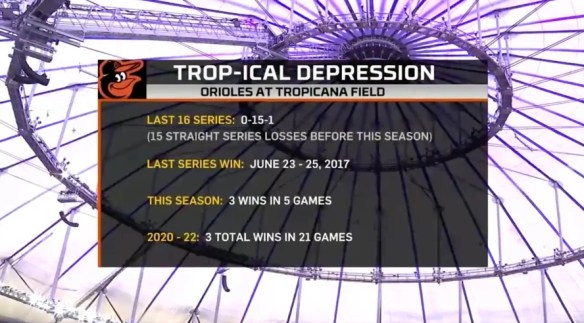
The factual graphic behind Brown’s fateful observation.
In 1997, Peter Angelos all but fired his lead radio announcer Jon Miller. The reasons included speculation that Miller’s weekend gig as a lead ESPN baseball announcer (with Hall of Fame second baseman turned colour commentator Joe Morgan) rankled both the Orioles and their radio flagship WBAL. Until they didn’t.
“Orioles officials,” wrote the Washington Post‘s Mark Maske, “said Angelos disliked Miller’s willingness to criticize the team harshly on the air when it wasn’t playing well.” Oops.
Miller, of course, went on to become the voice of the Giants in San Francisco. He probably saw oceans of downs and oceans of ups calling Giants games for what are now 26 years. He’s also accepted the Frick Award as a Hall of Fame broadcaster, in the same season the Giants won the first of three World Series titles in the span of five years.
Nobody seemed to want Miller fired when two Diamondbacks errors but three baserunning mistakes by then-Giants outfielder Ruben Rivera, ending with Rivera thrown out at the plate, prompted Miller to pronounce, “That was the worst baserunning in the history of the game!”
Whether Brown ends up staying with the Orioles on the air or whether he finds himself compelled to move onward (if he does, there should be no shortage of teams ready and willing to bring him to their mikes), this gives a disgraceful look to a baseball team who has gone from notorious tanking to AL East leadership and become must-see television approaching the hard stretch drive.
The Angeloses are hardly pioneers in baseball censorship. When the Yankees ended 1966 in dead last place (this was quite before divisional play), another Hall of Fame voice, Red Barber, committed his own such heinous crime—denied a camera pan of a near-empty Yankee Stadium, Barber intoned, “I don’t know what the paid attendance is today, but whatever it is, it is the smallest crowd in the history of Yankee Stadium, and this crowd’s the story, not the game.”
Oops. Among the reported mere 413 in the stands was Michael Burke, appointed by CBS (who’d bought the Yankees controversially in 1964) to oversee the Yankees. When the season ended officially, so ended Barber’s decade-plus Yankee tenure. The Ole Redhead elected to retire from there, but his purge was as wrong then as is Brown’s suspension now.
“Speak what you perceive as the truth,” said the late Hall of Fame broadcaster Tim McCarver. “If that’s outspokenness, that’s fine.” That was said after the Mets dumped him as a television analyst in 1998, proclaiming outspokenness wasn’t all that fine—and that Hall of Fame pitcher/franchise icon Tom Seaver, a Yankee broadcaster for five years, would do better as a “team player.”
Brown wasn’t even being outspoken, and he’s been put in the deep freeze for who knows how long. It’s difficult not to imagine the Angeloses answering “Honesty is the best policy” with “That’s what you think.”
 Throneberry Fields Forever