
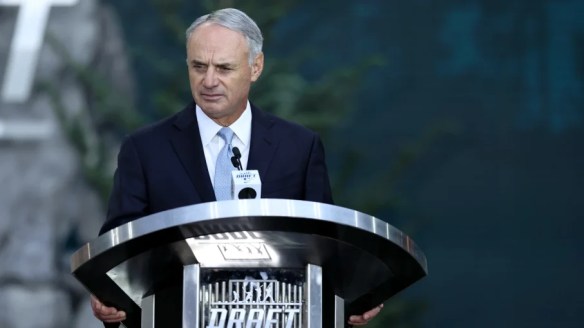
Rob Manfred at last month’s draft in Seattle—where the commissioner couldn’t quite understand why he was booed so lustily by the crowd.
I saw it first from Even Drellich, the Athletic writer whose Winning Fixes Everything proved the most in-depth exposure of Astrogate and what developed it. Commissioner Rob Manfred’s re-election for another term of office is all but a done deal when the owners vote next week. Manfred has said publicly he’d like another term in the job, which he considers “the best job in the world” to have.
A commissioner’s re-election window begins nine months prior to his term’s designated expiration date. Drellich says the owners’ vote will come smack dab at the opening of that window. If the owners have enough of a contingency among them who don’t have oatmeal for brains, Manfred should be denied. If.
He’s overseen a continuous climb in baseball’s revenues since he took the job in 2015, disrupted only by the coronavirus pan-damn-ic. That by itself may be enough to win him another five-year term. But it’s time to consider yet again an observation upon which I’ve leaned shamelessly that was first sketched by longtime New York Times writer George Vecsey: The common good of the game isn’t the same thing as making money for the owners.
The 2021-22 owners’ lockout said, guess again. When Manfred laughed during the first announcement of canceled games, assuredly he did not laugh like Figaro that he might not weep. I’ll say it again: When Manfred called it a “defensive lockout,” it sounded like Vladimir Putin pleading that he’s only defending Mother Russia from Ukraine’s “aggression.”
His handling of the Oakland/Las Vegas debacle as much as said, Oh, yes it is. He failed to school himself deeply enough on the core of that debacle, a capricious owner who tried and failed to strong-arm Oakland after reducing his team to compost, but discovered Las Vegas and its Nevada parent state didn’t have to be strong-armed to fall hook, line, and stinker into giving him a new ballpark.
The commissioner was caught pants down when he said mid-June that there was “no Oakland offer, OK? They never got to a point where they had a plan to build a stadium at any site.” Oakland mayor Sheng Thao said, that’s what you think. Last weekend she laid down the law to the commissioner in person. Oops.
Of course, John Fisher wanted Oakland to build him a big real estate development with a ballpark thrown in for good measure. Of course Oakland’s political (lack of) class finally said, not happening that way. Manfred has stood for continuing the nebulous push of municipalities building ballparks at taxpayers’ expense.
He has stood there even when it turns from a questionable proposition to a downright disaster. Atlanta’s Turner Field was only two decades old when the Braves decided the city limits were just too much and it was time to strike for the burbs. Double oops.
“[T]hey abandoned . . . Turner Field for suburban Cobb County in large measure because the county agreed to commit hundreds of millions of tax dollars to the project,” wrote CBS Sports’s Dayn Perry. “That tally is more than $350 million (and probably growing), which means Cobb taxpayers will never come close to getting that back.” Not even if the Braves own the National League East (again) for the foreseeable future.
Those are just too-obvious manifestations. Manfred has been baseball’s Professor Pepperwinkle, using the game as a lab and those who play and administer it as the experimental rats. For every one change he has ordered or shepherded that’s been good for the game, you can find several that have been worth either a laugh or a lament.
The universal designated hitter has been one of the good ones. Sorry, but I’m going to die on the hill that says however much fun it is to see the extreme outliers who can actually handle themselves at the plate, they were just that, outliers. When pitchers as a class hit a mere .162 from the end of the dead ball era through the end of the 2021 season, the universal DH was long overdue.
The ghost runner on second base to open extra half innings has been one of the terrible ones. So has the three-batter minimum for relief pitchers, especially when a manager is barred from lifting a pitcher right then and there who doesn’t have it and might be dangerously wild. So have the expanded wild cards and postseasons that dilute championship play even further.
The jury may still be out on the pitch clock. But it does present issues ranging from the sublime to the dangerous, especially concerning pitchers’ arms. Manfred’s inability thus far to commit to turning it off in the postseason’s late innings suggests he’d rather sacrifice the integrity of a championship round than one inch of his stubbornness.
We should also have noticed that the truest reason for lengthening games was never even a topic in Manfred’s mind: reducing the broadcast commercials between half innings to a single minute each. Smart negotiating could have brought that about without costing the owners money. They were no further endowed with vision on that than Manfred.
It’s also difficult to determine which has become more cringe-inspiring: the garish City Connect and All-Star Game uniforms; or, the presence of small advertising patches on uniform sleeves. It’s not impossible to say that the former are merely grotesque but the latter suggest the future baseball uniform might become the next best thing to a NASCAR jumpsuit.
Manfred has also shown far too much tendency to put his foot in his mouth and worry about the actualities after the screaming dissipates. Remember his dismissal of the World Series trophy as “a hunk of metal,” addressing questions of whether he would or could vacate the 2017 Astros’ World Series triumph once Astrogate erupted?
Fast forward to last month. Manfred now said he made a boo-boo giving 2017-18 Astros players immunity in return for spilling about the Astro Intelligence Agency. “Once we gave players immunity, it puts you in a box as to what exactly you were going to do in terms of punishment,” he told Time. “I might have gone about the investigative process without that grant of immunity and see where it takes us. Starting with, I’m not going to punish anybody, maybe not my best decision ever.”
But he did that to himself. The memo he sent down after the Red Sox and Yankee incidents of using AppleWatches and other devices in their dugouts to steal signs made clear he’d punish front offices, not players. He dropped a hammer on Astros owner Jim Crane and then-general manager Jeff Luhnow, but he let the cheaters in the dugout and on the field get away with murder.
Sort of. To this day, those 2017-18 Astros still playing major league baseball hear it from fans in the stands. Conversely, and unfairly, Astros second baseman Jose Altuve hears it despite it being shown authoritatively—and discussed in both Drellich’s book and Andy Martino’s previous Cheated: The Inside Story of the Astros Scandal and a Colorful History of Sign Stealing—that Altuve was “the one player that didn’t use” the stolen signs.
Now, back to the Oakland debacle. That fine day Nevada’s state legislature elected to spend $380 million of their citizens’ money on a Las Vegas ballpark for the A’s, A’s fans staged a “reverse boycott.” They poured into the decrepit RingCentral Coliseum to protest, among other things, Fisher’s gutting of the team while hiking ticket prices, doing squat to improve anything at the old dump, then all but saying it was all the fans’ fault.
Commissioner Pepperwinkle’s response? “It was great. It’s great to see what is this year almost an average major league baseball crowd in the facility for one night. That’s a great thing.” Ask him how a 27,759-strong crowd turned out to be a little over three times the average RingCentral Coliseum crowd for one particular event, and he was probably stuck for an answer.
Wait—no, he wasn’t. “The ballpark’s not in good shape,” he said. “The ballpark is not a major league facility. I’ve said it repeatedly.” Ask him how it was allowed to devolve in the first place. Now he might be stuck for an answer.
Someone should present these and more to the owners when they gather to vote upon whether Manfred gets another term. It may be asking them to think beyond their competence, and beyond their faith that the common good of the game is making money for them. But at least they won’t be able to plead ignorance.
 Throneberry Fields Forever